Olsen Preterm Weight-for-Gestational-Age Growth Chart
Plot a preterm infant's birth weight against gestational age on the Olsen 2010 intrauterine growth curves. The calculator returns a Z-score, a percentile, and an SGA/AGA/LGA classification for any gestational age between 23 and 41 weeks.
LMS Method: Z = ((X/M)^L - 1) / (L × S)
How It Works
The Olsen weight-for-gestational-age calculator converts a birth weight and a gestational age into a percentile that answers "out of 100 US infants born at the same gestational age and sex, how many weighed less than this baby?" Under the hood it looks up three parameters from the Olsen 2010 LMS table — L (Box-Cox skewness), M (median birth weight at that week), and S (coefficient of variation) — for the child's exact gestational age, computes a Z-score with Z = ((X/M)^L − 1) / (L × S), and maps that Z through the standard normal CDF to a percentile between 0 and 100. The table is indexed in 1-week steps from 23 to 41 weeks, so fractional gestational ages are handled by linear interpolation of L, M, and S between the two bracketing rows. The result is classified as SGA (Small for Gestational Age, below 10th), AGA (Appropriate, 10th–90th), or LGA (Large, above 90th) — the threshold set clinicians use to flag neonatal management needs like hypoglycemia screening and feeding-plan adjustments.
Example Problem
A boy born at 32 weeks gestational age weighs 1,829 g (1.829 kg). What is his weight-for-gestational-age percentile?
- Select 'Boy' for gender.
- Enter 32 weeks for gestational age.
- Enter 1829 g (or 1.829 kg) for weight.
- Look up the Olsen LMS triple for boys at 32 weeks: L ≈ 1.075, M ≈ 1.829 kg, S ≈ 0.167.
- Compute Z = ((1.829 / 1.829)^1.075 − 1) / (1.075 × 0.167) ≈ 0.00, so the percentile is Φ(0) ≈ 50th.
- Result: ~50th percentile — the Olsen median weight for boys at 32 weeks is 1.829 kg. Classification: AGA (Appropriate for Gestational Age).
Key Concepts
The Olsen charts are an intrauterine growth reference, not a postnatal growth-tracking tool. They describe how US infants born between 2006 and 2008 weighed at birth across the 23–41-week gestational-age range — the key distinction being that each infant contributes one data point (birth weight) at their exact delivery week, rather than a time series of weights. That makes the Olsen chart the right tool for a single delivery-room classification (SGA, AGA, LGA) and the wrong tool for weekly weight tracking after birth. For ongoing postnatal growth of a preterm infant in the NICU, most US clinicians switch to the Fenton 2013 preterm growth chart (extends through 50 weeks post-menstrual age) or the Intergrowth-21st Postnatal Growth Standards. Once a preterm baby reaches roughly 40 weeks post-menstrual age (their corrected full-term milestone), the WHO 0–24 month standard becomes the reference of choice, using corrected age for the first 2–3 years.
Applications
- Birth weight classification (SGA/AGA/LGA) for preterm infants in the delivery room or NICU
- Neonatal risk stratification — SGA infants get hypoglycemia screening, LGA infants get brachial-plexus-injury monitoring
- Feeding-plan selection — preterm nutrition protocols often branch on AGA vs SGA status
- Benchmarking NICU outcomes against a contemporary US preterm reference
- Research on intrauterine growth restriction, maternal factors, and preterm outcomes
- Parent counseling — giving families a concrete percentile for where their newborn falls
Common Mistakes
- Using the Olsen chart for postnatal weight tracking after birth — it is a single-point intrauterine reference, not a time-series tool. Switch to Fenton (or WHO at full-term-corrected) once the baby is a few days old.
- Using WHO or CDC postnatal charts for preterm birth-weight classification — those references are built from term births and will systematically misclassify preterm infants.
- Confusing gestational age (weeks of pregnancy at birth) with chronological age (time since birth) or corrected age (chronological minus weeks preterm). Only gestational age goes in this calculator.
- Mixing up grams and kilograms — preterm weights are commonly charted in grams (e.g., 1,829 g) but international clinical software often expects kilograms. A typo of 1829 kg will fail the sanity check rather than silently return a garbage percentile.
- Using SGA classification alone without clinical context — some constitutionally small but healthy infants cross the 10th-percentile threshold and do not need intervention.
- Applying Olsen to twins or higher-order multiples without caution — multi-gestation birth weights run lower than the Olsen singleton reference, and separate multiple-pregnancy charts exist for that purpose.
Frequently Asked Questions
What is the Olsen 2010 intrauterine weight-for-age reference?
It is the US intrauterine growth reference published by Olsen et al. in 2010, built from a national sample of healthy newborns at gestational ages 23–41 weeks. The chart compares a baby's birth weight (or current weight in early NICU days) to other newborns at the same gestational age. WHO standards do not extend to preterm gestational ages, so Olsen and similar charts (Fenton, INTERGROWTH-21st) fill that gap in preterm-specific growth assessment.
How is this different from WHO or CDC growth charts?
WHO and CDC charts describe postnatal growth of (mostly) term infants after birth. The Olsen chart is an intrauterine reference — it describes how US infants weighed at the moment of birth across gestational ages 23 to 41 weeks. Use Olsen at delivery to classify a preterm infant as SGA, AGA, or LGA. Use WHO or CDC later on to track weight gain over time (with a corrected-age adjustment while the baby is still under 2–3 years).
What is the difference between SGA, AGA, and LGA?
The Olsen chart splits birth weight into three bands at the 10th and 90th percentiles. SGA (Small for Gestational Age) is below the 10th percentile and triggers hypoglycemia screening and closer nutritional management. AGA (Appropriate for Gestational Age) is the 10th to 90th percentile — the typical range. LGA (Large for Gestational Age) is above the 90th and prompts evaluation for maternal diabetes and monitoring for birth injuries such as brachial plexus palsy.
Should I use Olsen or Fenton for preterm growth?
Olsen 2010 is the US intrauterine reference for birth-weight classification at delivery. Fenton 2013 extends further and is the preferred reference for ongoing postnatal growth of preterm infants in the NICU — it spans 22 to 50 weeks post-menstrual age and is designed for weekly in-hospital tracking. In practice, many US NICUs use Olsen at delivery for SGA/AGA/LGA and then switch to Fenton (or the Intergrowth-21st Postnatal Standard) for week-over-week weight tracking until the baby reaches term-corrected age.
When do preterm babies transition to the WHO or CDC postnatal charts?
Most clinicians move a preterm infant onto the WHO 0–24 month standard once the baby reaches 40 weeks post-menstrual age (their corrected full-term milestone). From that point the WHO chart is plotted using corrected age (chronological age minus weeks preterm) for the first 2 to 3 years. After about age 2–3 the correction is typically dropped and the child is plotted using chronological age on the age-appropriate CDC chart.
Should I enter weight in grams, kilograms, or pounds?
Use whichever unit the scale produced — grams, kilograms, or pounds. Preterm weights are most commonly recorded in grams in NICU settings (for example, 1,829 g) because gram-level precision matters for small infants and for daily weight-change monitoring. The calculator converts internally and the chart, tooltip, and reference table all follow your selected unit.
Is a low Olsen percentile an emergency?
A birth weight below the 10th percentile (SGA) or below the 3rd percentile (severe SGA) is a screening flag, not a diagnosis. It prompts neonatal evaluation for glucose stability, temperature regulation, feeding tolerance, and investigation of maternal and placental factors. Many SGA infants do well with routine preterm care. A single Olsen reading should always be interpreted alongside the full clinical picture by the neonatal team.
When should I consult neonatology about an Olsen result?
Any preterm birth — regardless of percentile — is managed by a neonatal team, and Olsen is one of several inputs they already use. As a parent or non-specialist clinician, the percentile is most useful as a conversation starter. Escalate sooner for weights below the 3rd percentile, for unexpected SGA or LGA status that wasn't predicted by prenatal ultrasound, or when the result contradicts what the prenatal growth scans showed.
Reference:
Olsen IE, Groveman SA, Lawson ML, Clark RH, Zemel BS. New intrauterine growth curves based on United States data. Pediatrics. 2010;125(2):e214-e224. https://doi.org/10.1542/peds.2009-0913
Worked Examples
Very preterm
Where does a 24-week girl weighing 650 g fall on the Olsen chart?
A neonatologist is classifying a 24-week gestational-age girl at delivery. Birth weight is 650 g and the team needs an immediate SGA/AGA/LGA call before the infant goes to the NICU.
- Knowns: gestational age 24 wk, sex girl, birth weight 650 g (0.650 kg)
- Olsen LMS lookup at 24 wk (girls): L ≈ 1.18, M ≈ 0.651 kg, S ≈ 0.149
- Z = ((0.650 / 0.651)^1.18 − 1) / (1.18 × 0.149) ≈ −0.01
- Φ(−0.01) ≈ 0.496
~50th percentile — right at the Olsen median. Classification: AGA (Appropriate for Gestational Age).
At 24 weeks the LMS bands are narrow in absolute terms — a 100 g swing moves the percentile noticeably. Neonatal management hinges on more than birth-weight percentile alone.
Moderate preterm
A 32-week boy weighs 1.5 kg at birth — what Olsen percentile?
A moderate preterm boy is delivered at 32 completed weeks with a birth weight of 1.5 kg (well below the 32-week median of 1.829 kg). The neonatal team checks whether he crosses the 10th-percentile SGA threshold.
- Knowns: gestational age 32 wk, sex boy, birth weight 1.5 kg
- Olsen LMS lookup at 32 wk (boys): L ≈ 1.075, M ≈ 1.829 kg, S ≈ 0.167
- Z = ((1.500 / 1.829)^1.075 − 1) / (1.075 × 0.167) ≈ −1.07
- Φ(−1.07) ≈ 0.142
~14th percentile — below average for 32 weeks but above the 10th-percentile SGA cutoff. Classification: AGA.
A single Olsen reading is a delivery-room snapshot. Ongoing weight change after birth is tracked on a postnatal preterm chart such as Fenton 2013.
Late preterm
A 36-week girl weighs 3.25 kg at birth — SGA, AGA, or LGA?
A late-preterm girl is delivered at 36 weeks with a birth weight of 3.25 kg. The attending wants to know whether she crosses into the LGA zone, which would trigger additional screening for maternal diabetes and birth-trauma monitoring.
- Knowns: gestational age 36 wk, sex girl, birth weight 3.25 kg
- Olsen LMS lookup at 36 wk (girls): L ≈ 0.764, M ≈ 2.664 kg, S ≈ 0.192
- Z = ((3.250 / 2.664)^0.764 − 1) / (0.764 × 0.192) ≈ 1.12
- Φ(1.12) ≈ 0.869
~87th percentile — above average for 36 weeks but still below the 90th-percentile LGA cutoff. Classification: AGA.
Late-preterm infants grow faster than earlier-gestation preemies, so percentile bands shift quickly between 34 and 40 weeks. Always re-compute if the gestational age is updated after delivery.
How the percentile is calculated
The Olsen weight-for-gestational-age calculator turns one birth-weight measurement into a percentile in three stages. First, it looks up three Olsen 2010 parameters — L, M, and S — from the intrauterine reference table for the infant's exact gestational age and sex. L is the Box-Cox power transform (it accounts for the skew of preterm birth-weight distributions), M is the median birth weight at that week, and S is the coefficient of variation. Second, it plugs those parameters into the Z-score formula:
Z score equals the quantity X divided by M, raised to the power L, minus 1, divided by L times S.
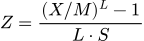
Where:
- X — the infant's birth weight in kilograms.
- M — the Olsen median birth weight at that gestational age and sex.
- L — the Box-Cox skewness parameter.
- S — the coefficient of variation (a scaled standard deviation).
Third, the Z-score is mapped to a percentile through the standard normal cumulative distribution function, Φ(Z). A Z of 0 maps to the 50th percentile, −1.28 to the 10th (SGA cutoff), and +1.28 to the 90th (LGA cutoff). The Olsen table is indexed in 1-week steps from 23 to 41 weeks, so fractional gestational ages (for example 32.5 weeks) are handled by linearly interpolating L, M, and S between the two bracketing rows.
Unlike postnatal charts (WHO, CDC), each infant in the Olsen dataset contributes a single data point — their birth weight at their exact delivery week. That is what makes Olsen the right tool for a one-shot delivery-room classification, and the wrong tool for tracking weekly weight change after birth. For the postnatal trajectory of a preterm infant, use the Fenton 2013 chart or the Intergrowth-21st Postnatal Growth Standard.
Related Calculators
- Length-for-Age (Olsen, Preterm)
- Head Circ-for-Age (Olsen, Preterm)
- CDC Weight-for-Age (0-36 mo) — for postnatal weight tracking after a preterm baby reaches term-corrected
- BSA Calculator — Calculate body surface area for clinical dosing
- Dosage by Weight Calculator — Weight-based pediatric medication dosing
Related Sites
- Hourly Salaries — Hourly wage to annual salary converter
- LoanChop — Loan prepayment calculator
- AJ Designer — 200+ engineering and science calculators
- Temperature Tool — Temperature unit converter
- CameraDOF — Depth of field calculator for photographers
- Dollars Per Hour — Weekly paycheck calculator with overtime