WHO Length-for-Age Growth Chart (0-24 Months)
Plot a child's recumbent length against WHO growth standards for ages 0 to 24 months. The chart displays the standard percentile curves (3rd, 15th, 50th, 85th, 97th) and pins your child's measurement so you can see exactly where they fall on the WHO length-for-age chart.
LMS Method: Z = ((X/M)^L - 1) / (L × S), percentile = Φ(Z) × 100
How It Works
The WHO length-for-age chart converts a single recumbent length measurement into a percentile that answers "out of 100 healthy breastfed infants of the same age and sex, how many are shorter than mine?" Under the hood the calculator looks up three WHO parameters — L (skewness), M (median length), and S (coefficient of variation) — from the WHO Multicentre Growth Reference Study (MGRS) table for the child's exact age in days, computes a Z-score with the Box-Cox equation Z = ((X/M)^L − 1) / (L × S), and maps that Z-score through the standard normal CDF to a percentile between 0 and 100. Because the WHO dataset publishes LMS values at daily resolution from birth through 24 months, no interpolation is required — each day of age has its own row of parameters, so the math is exact at every age in the 0-24 month range.
Example Problem
A 6-month-old girl has a recumbent length of 65 cm at her well-child visit. Where does she fall on the WHO length-for-age chart?
- Record the child's date of birth and the date of today's measurement — 6 months apart — and note the sex as Girl.
- Confirm the measurement is recumbent length (child lying flat), not standing height. For children under 2, always use recumbent length.
- Convert the length to centimeters if it was recorded in inches. Here it is already 65 cm, so no conversion is needed.
- Compute the child's age in days: 6 months × 30.4375 ≈ 183 days.
- Look up the WHO daily LMS triple for girls at day 183: L = 1.0, M ≈ 65.73 cm, S ≈ 0.0352.
- Compute the Z-score with Z = ((X/M)^L − 1) / (L × S). Substituting gives Z ≈ ((65/65.73)^1.0 − 1) / (1.0 × 0.0352) ≈ −0.32.
- Map the Z-score through the standard normal CDF: Φ(−0.32) ≈ 0.37, so the percentile is approximately the 37th — well within the healthy range.
Key Concepts
A percentile is a rank, not a percentage or a grade. The 75th percentile means 75% of children of the same age and sex are shorter than this child — it does not mean the child is "75% healthy." Most pediatricians treat the 3rd to 97th percentile band as the normal range, with anything outside that band a prompt for follow-up. A single measurement is a snapshot; trajectory across several visits is almost always more clinically meaningful than a one-off number. The WHO 0-24 month length-for-age standard is prescriptive rather than descriptive — it describes how healthy breastfed infants grow under optimal conditions (adequate nutrition, non-smoking environment, standard pediatric care), not how the average infant in any one country has happened to grow. The American Academy of Pediatrics recommends WHO standards for all children under 24 months, so this chart is the default US recommendation for length tracking in infancy. Recumbent length is measured with the child lying flat on a length board, with the head held against a fixed stop and legs gently straightened — it is about 0.7 cm longer than standing height because of gravity and spinal compression.
Applications
- Well-infant visits: pediatricians plot each length measurement to confirm a steady growth trajectory through the first two years.
- Stunting screening in global health programs: lengths below the 3rd WHO percentile (Z ≤ −2) flag chronic undernutrition and trigger nutritional follow-up.
- Short-stature surveillance: measurements below the 3rd percentile prompt growth-hormone workups and endocrinology referrals when trend data supports a concern.
- Catch-up growth tracking after illness: pediatricians watch for return to the previous growth channel after hospitalization, infection, or feeding difficulties.
- NICU graduate monitoring: infants born preterm are tracked on corrected age (chronological age minus weeks preterm) until they catch up, typically through age 2-3.
- International or immigrant family visits where a consistent global reference (WHO) is preferred over country-specific charts.
Common Mistakes
- Measuring standing height instead of recumbent length — for children under 2, always use recumbent length; standing height is about 0.7 cm shorter and will bias the percentile downward.
- Confusing percentile with percentage — the 40th percentile does not mean the child is at 40% of a healthy length, it means 40% of same-age same-sex peers are shorter.
- Using the wrong chart for the child's age — this calculator covers 0-24 months; switch to the WHO 2-5 Stature-for-Age or CDC 2-20 Stature-for-Age chart for older children.
- Comparing a single reading to expected values instead of examining the growth trend across multiple visits.
- Not converting units — always verify whether the length was recorded in centimeters or inches before entering it.
- Ignoring prematurity — infants born before 37 weeks should be plotted by corrected age for the first 2-3 years, not chronological age.
Frequently Asked Questions
What is the WHO length-for-age chart for 0-24 months?
Length-for-age is the WHO Child Growth Standard that compares a baby's recumbent length (0–24 months) to a global reference of healthy breastfed infants. The percentile shows where the baby ranks in that reference — the 50th is exactly average, and values between the 3rd and 97th percentile are within the typical healthy range. WHO publishes the underlying L, M, S parameters at daily resolution, so length-for-age can be computed for any age in days, not just whole months.
How is the WHO chart different from the CDC length chart?
The WHO standards are prescriptive — they describe how children grow under optimal conditions (adequate nutrition, non-smoking environment, standard pediatric care) based on the Multicentre Growth Reference Study of healthy breastfed infants from six countries. The CDC charts are descriptive — they describe how US children actually grew in national health surveys between 1963 and 1994. The American Academy of Pediatrics recommends WHO from birth to 24 months and CDC from age 2 onward, which is why this calculator uses WHO data and the CDC 0-36 month calculator uses CDC data.
What is the difference between length and height?
Length is measured with the child lying down (recumbent) on a length board with the head against a fixed stop and the legs gently straightened. Height is measured standing up. For children under 2 years use recumbent length — standing height is about 0.7 cm shorter because of gravity and spinal compression, so the two are not interchangeable inside the 0-24 month WHO chart.
My child dropped percentiles. Should I be worried?
A shift of one percentile band between visits is common and usually normal, particularly in the first 6-12 months as infants find their own genetic growth channel. Crossing two or more major percentile lines (for example, from the 75th to the 25th) warrants a conversation with your pediatrician to rule out nutritional or medical causes. Trend direction over several visits matters far more than any single reading.
Do premature babies use the same chart?
For infants born before 37 weeks, plot by corrected age — chronological age minus weeks of prematurity — for the first 2-3 years. A baby born 8 weeks early and measured at 6 months chronological age should be plotted at 4 months corrected. After about age 2-3 the correction is usually dropped. Some pediatricians also use Olsen or Fenton preterm-specific length charts for the earliest weeks.
How should recumbent length be measured at home?
Accurate home measurement is hard — a 0.5 cm error can shift the percentile by 5-10 points. A proper infantometer has a fixed headpiece, a sliding foot stop, and requires two adults (one to hold the head against the stop, one to straighten the legs and read the sliding stop). Clinic measurements with this equipment are the reliable standard. If you are measuring at home with a tape measure on a flat surface, record the reading, but treat it as an estimate until the next well-child visit confirms the trend.
When should I consult my pediatrician about my child's length?
Consult your pediatrician if your child's length is below the 3rd percentile (Z-score under about −2) or above the 97th (Z-score over about +2) on the WHO chart, if they have crossed two or more major percentile bands between visits, or if the length trend has plateaued for two or more months without explanation. Your pediatrician will combine the length reading with weight, head circumference, feeding history, and developmental milestones before deciding whether further workup is needed. This calculator is a screening aid, not a diagnosis.
How often should length be measured in infancy?
Typical US well-child schedules include length checks at birth, 1 month, 2 months, 4 months, 6 months, 9 months, 12 months, 15 months, 18 months, and 24 months. WHO recommends similar intervals internationally. Extra visits are added when an infant is not growing in length as expected or is recovering from illness, feeding problems, or a preterm birth.
Reference:
WHO Child Growth Standards. World Health Organization, 2006. https://www.who.int/tools/child-growth-standards
Worked Examples
Early infancy
Where does a 3-month-old boy measuring 61 cm fall on the WHO length chart?
A pediatrician is reviewing a healthy-term boy at his 3-month well-child visit. His recorded recumbent length is 61.0 cm (24.0 in) and the provider wants a quick WHO percentile read.
- Knowns: age 3.0 mo, sex boy, length 61.0 cm
- WHO daily LMS lookup at day 91 (boys): L = 1.0, M ≈ 61.40 cm, S ≈ 0.0333
- Z = ((61.0 / 61.40)^1.0 − 1) / (1.0 × 0.0333) ≈ −0.20
- Φ(−0.20) ≈ 0.422
~42nd percentile — healthy, just below the WHO median for 3-month-old boys.
A single reading at the 42nd percentile is well within the healthy range; the pediatrician watches whether he continues tracking that channel at the 4-month and 6-month visits.
1-year well-child visit
A 12-month-old girl measures 29 in at her 1-year visit — what percentile?
A parent arrives at the 12-month well-child visit with a girl whose recumbent length on the exam board is 29.0 in. The WHO length-for-age chart converts this to centimeters internally (29.0 in × 2.54 = 73.66 cm) and computes the percentile.
- Knowns: age 12.0 mo, sex girl, length 29.0 in → 73.66 cm
- WHO daily LMS lookup at day 365 (girls): L = 1.0, M ≈ 74.00 cm, S ≈ 0.0348
- Z ≈ ((73.66 / 74.00)^1.0 − 1) / (1.0 × 0.0348) ≈ −0.13
- Φ(−0.13) ≈ 0.447
~45th percentile — essentially at the WHO median for 12-month-old girls.
Measuring recumbent length on a squirming 1-year-old is hard to repeat exactly — a 0.5 cm error can shift the percentile by 5-10 points, so trust the trajectory across visits more than any single reading.
Toddler growth review
An 18-month-old boy measures 82 cm at his 1½-year visit — what percentile?
At his 18-month well-child visit this boy measures 82.0 cm recumbent length. His provider is confirming he has tracked close to the same percentile band since his 9-month visit, when he was at the 55th. Steady channel tracking is the reassuring finding.
- Knowns: age 18.0 mo, sex boy, length 82.0 cm
- WHO daily LMS lookup at day 547 (boys): L = 1.0, M ≈ 82.23 cm, S ≈ 0.0328
- Z = ((82.0 / 82.23)^1.0 − 1) / (1.0 × 0.0328) ≈ −0.09
- Φ(−0.09) ≈ 0.466
~47th percentile — well within the healthy range and consistent with his prior channel.
This calculator returns a single snapshot; a toddler's length is best interpreted alongside prior visits and head-circumference and weight trends.
How the percentile is calculated
The calculator turns one recumbent length measurement into a percentile in three stages. First, it computes the child's age in days and looks up three WHO parameters — L, M, and S — from the WHO Child Growth Standards table for that exact day and sex. L is the Box-Cox power transform (it accounts for the skew in childhood length distributions), M is the median length at that age, and S is the coefficient of variation. WHO publishes these values at daily resolution for days 0 through ~730 (24 months), so fractional ages are handled exactly with no interpolation. Second, it plugs those parameters into the Z-score formula:
Z score equals the quantity X divided by M, raised to the power L, minus 1, divided by L times S.
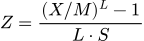
Where:
- X — the child's measured recumbent length in centimeters.
- M — the WHO median length at that age and sex.
- L — the Box-Cox skewness parameter (handles non-symmetric length distributions). For length-for-age, WHO sets L = 1.0 across the 0-24 month range, so the formula reduces to the simpler Z = (X − M) / (M × S).
- S — the coefficient of variation (a scaled standard deviation).
Third, the Z-score is mapped to a percentile through the standard normal cumulative distribution function, Φ(Z). A Z of 0 maps to the 50th percentile, −1.88 to the 3rd, and +1.88 to the 97th. Because the WHO length-for-age standard uses daily resolution, this calculator skips the interpolation step the CDC 0-36 month chart requires and returns an exact answer for every age in days inside the 0-24 month range.
Related Calculators
- Weight-for-Age (WHO, 0-24 mo)
- Head Circumference-for-Age (WHO, 0-24 mo)
- Weight-for-Length (WHO, 0-24 mo)
- Length-for-Age (CDC, 0-36 mo) — descriptive US reference
- Z-Score Calculator — Convert z-scores to percentiles and probabilities
Related Sites
- RN Calc — Nursing dosage and calculation tools
- Medical Equations — Hemodynamic, pulmonary, and dosing calculators
- AJ Designer — 200+ engineering and science calculators
- Temperature Tool — Temperature unit converter
- LoanChop — Loan prepayment calculator
- Compare 2 Loans — Side-by-side loan comparison calculator