CDC Stature-for-Age Growth Chart (2-20 Years)
Plot your child's standing height against CDC reference data for ages 2-20 years. The chart displays the standard percentile curves (3rd, 15th, 50th, 85th, 97th) with your child's measurement pinned on top so you can see the growth channel at a glance.
LMS Method: Z = ((X/M)^L - 1) / (L × S), percentile = Φ(Z) × 100
How It Works
The CDC 2-20 stature-for-age chart converts one standing-height measurement into a percentile that answers "out of 100 US children of the same age and sex, how many are shorter than mine?" The calculator looks up three parameters from the CDC LMS reference table — L (Box-Cox skewness), M (median stature in cm), and S (coefficient of variation) — for the child's exact age and sex, computes a Z-score with Z = ((X/M)^L − 1) / (L × S), and maps that Z-score through the standard normal cumulative distribution function Φ(Z) to a percentile between 0 and 100. The CDC table spans ages 24 to 240 months in half-month increments, so fractional ages are handled by linearly interpolating L, M, and S between the two bracketing rows.
Example Problem
A 10-year-old girl measures 138.2 cm (54.4 in) in standing height. Where does she fall on the CDC stature-for-age chart?
- Record the child's date of birth and the date of measurement — 10 years (120 months) apart — and note the sex as Girl.
- Confirm the measurement is standing height (shoes off, heels/buttocks/shoulders against the wall). If recorded in inches, the calculator converts to centimeters automatically.
- Look up the CDC LMS triple for girls at 120.5 months: L ≈ 0.285, M ≈ 138.21 cm, S ≈ 0.049.
- Compute the Z-score with Z = ((X/M)^L − 1) / (L × S). Substituting gives Z ≈ ((138.2/138.21)^0.285 − 1) / (0.285 × 0.049) ≈ 0.00.
- Map the Z-score through the standard normal CDF: Φ(0) ≈ 0.50, so the percentile is the 50th.
- Report the result: a 10-year-old girl at 138.2 cm sits exactly at the CDC median — half of US girls her age are shorter, half are taller.
Key Concepts
A percentile is a rank, not a grade. The 75th percentile means 75% of same-age, same-sex US children are shorter than this child — it does not mean the child is "75% healthy" or tall by absolute standards. Clinicians treat the 3rd through 97th percentile band as the normal range. A single snapshot matters less than the trajectory: children usually track along one percentile channel after age 2-3, and crossing two or more major bands up or down is the more common reason for clinical follow-up. The pubertal growth spurt temporarily accelerates height gain (typically ages 10-14 for girls and 12-16 for boys), and the growth plates in long bones usually close by ~15 in girls and ~17 in boys, after which additional height gain is minimal. Parental height is the single strongest predictor of adult height for typical children — the Khamis-Roche method (see our Height Predictor) combines mid-parental height with current measurements to estimate adult stature.
Applications
- Routine growth monitoring at annual well-child check-ups.
- Evaluating short stature (below the 3rd percentile) — familial vs. pathologic (growth hormone deficiency, celiac disease, Turner syndrome, constitutional delay).
- Evaluating tall stature (above the 97th percentile) — familial vs. pathologic (Marfan, Klinefelter, precocious puberty).
- Monitoring growth through puberty and the adolescent growth spurt.
- Tracking growth in children with chronic conditions (celiac disease, inflammatory bowel disease, chronic kidney disease).
- Comparing projected adult height from parental height against the child's current trajectory.
Common Mistakes
- Measuring recumbent length instead of standing height for children over 2 — standing height is about 0.7 cm shorter than recumbent length.
- Using the CDC 0-36 month length-for-age chart for children over 3 years instead of switching to the 2-20 stature-for-age chart.
- Interpreting a single crossed percentile line as a problem — children shift channels slightly through puberty; the concern is persistent crossing of two or more major bands.
- Comparing a child's height to adult standards or celebrity averages rather than age-appropriate percentiles.
- Measuring with shoes on, feet not flat, or without proper positioning (heels, buttocks, and shoulders against the wall).
- Ignoring mid-parental height — a child who is short for population percentiles but tracking near their genetic target is usually not pathologic.
Frequently Asked Questions
What is the CDC stature-for-age chart for 2-20 years?
It is the CDC growth chart that tracks standing height (stature) from age 2 through 20 against US national health survey data. The 50th percentile is the median US height for a child's exact age and sex. Values between the 3rd and 97th are typical. Persistent crossings of two or more major percentile bands across visits warrant pediatric review for growth concerns or constitutional growth delay.
What age range does this calculator cover?
This calculator uses CDC growth reference data for children and adolescents aged 2 to 20 years (24 to 240 months). For children under 2, use the CDC 0-36 month length-for-age chart with recumbent length. Entries beyond 240 months will return an error — adult height does not have a pediatric percentile.
Should I use my child's height in cm or inches?
You can use either unit — the calculator converts inches to centimeters automatically and displays the chart in the unit you select. For the most accurate percentile, use the height recorded at your pediatrician's office rather than a home measurement.
What is the difference between stature and length?
Stature refers to standing height (measured upright with the child's heels, buttocks, and shoulders against a wall), used for children 2 years and older. Length refers to recumbent length (measured lying down), used for children under 2. Standing height is approximately 0.7 cm shorter than recumbent length for the same child — switching charts at age 2 introduces this small step.
When does the pubertal growth spurt happen?
Girls typically begin their pubertal growth spurt between ages 10 and 12 and reach peak height velocity around age 12, adding 8-10 cm per year at the peak. Boys start about two years later, peak around age 14 at 9-11 cm per year, and generally finish growing later. A child who appears to be shifting up a percentile band during these windows is often simply spurting ahead of the median timeline.
When should I be concerned about my child's height?
See your pediatrician if your child's height is consistently below the 3rd percentile, above the 97th percentile, or crossing two or more major percentile lines up or down between visits. A single reading outside the normal band is less concerning than a persistent trend. Other triggers for evaluation include a predicted adult height well outside the parental range and signs of early or delayed puberty alongside height changes.
When do growth plates close?
The epiphyseal (growth) plates at the ends of long bones typically fuse around age 14-16 in girls and 16-18 in boys, after which linear growth effectively stops. Pediatric endocrinologists confirm growth potential with a bone-age X-ray of the left hand; the difference between bone age and chronological age estimates how much growth is still possible.
How does parental height affect my child's percentile?
Genetics explains roughly 60-80% of adult height for a typical child. Mid-parental height (the average of father's and mother's height, adjusted +6.5 cm for boys and −6.5 cm for girls) gives a genetic target zone of about ±8.5 cm. A child whose percentile differs from this zone despite otherwise healthy growth may simply be reverting to the family mean. Our Height Predictor uses the Khamis-Roche method to combine parental height with current measurements for a more precise adult-height estimate.
Reference:
CDC Growth Charts: United States. National Center for Health Statistics, 2000. https://www.cdc.gov/growthcharts/
Worked Examples
Young child
Where does a 3-year-old boy who measures 96.5 cm tall sit on the CDC chart?
A pediatrician is reviewing a 3-year-old boy at his well-child visit. Stand-up height (shoes off, heels against the wall) comes in at 96.5 cm (38.0 in). The provider wants a quick percentile read.
- Knowns: age 36 mo, sex boy, standing height 96.5 cm
- CDC LMS lookup at 36 mo (boys): L ≈ −0.35, M ≈ 94.96 cm, S ≈ 0.0406
- Z = ((96.5 / 94.96)^−0.35 − 1) / (−0.35 × 0.0406) ≈ +0.40
- Φ(+0.40) ≈ 0.654
~65th percentile — squarely in the average range, slightly above the median.
Toddlers who have just transitioned from the 0-36 month length chart often shift a few points because stature is measured standing and length is measured lying down.
Pre-teen
A 10-year-old girl is 54.4 inches tall — what percentile?
A parent brings a 10-year-old girl in for a routine visit. Height is recorded as 54.4 in (138.2 cm). The calculator converts inches to centimeters internally and computes the stature-for-age percentile.
- Knowns: age 120 mo, sex girl, standing height 54.4 in → 138.2 cm
- CDC LMS lookup at 120.5 mo (girls): L ≈ 0.285, M ≈ 138.21 cm, S ≈ 0.049
- Z ≈ ((138.2 / 138.21)^0.285 − 1) / (0.285 × 0.049) ≈ 0.00
- Φ(0.00) ≈ 0.500
~50th percentile — exactly at the CDC median for 10-year-old girls.
Pre-pubertal tracking is usually steady; many girls begin accelerating off this channel between ages 10 and 12 as the pubertal spurt starts.
Teen growth spurt
A 15-year-old boy is 175 cm tall — how tall is he for his age?
At 12 this boy sat on the 50th percentile. Now at 15 his standing height is 175 cm (5' 8.9"). The provider wants to confirm he is tracking within the expected band as his pubertal spurt peaks.
- Knowns: age 180 mo, sex boy, standing height 175.0 cm
- CDC LMS lookup at 180.5 mo (boys): L ≈ 2.21, M ≈ 170.14 cm, S ≈ 0.046
- Z ≈ ((175.0 / 170.14)^2.21 − 1) / (2.21 × 0.046) ≈ +0.64
- Φ(+0.64) ≈ 0.739
~74th percentile — above the median and on-track for a typical teenage spurt.
Peak height velocity for boys is usually around age 14. Growth typically slows noticeably by age 16-17 as growth plates near closure.
How the percentile is calculated
The calculator turns one standing-height measurement into a percentile in three stages. First, it looks up three CDC parameters — L, M, and S — from the CDC 2000 reference table for the child's exact age and sex. L is the Box-Cox power transform (it accounts for skew in the stature distribution), M is the median stature at that age in centimeters, and S is the coefficient of variation. Second, it plugs those parameters into the Z-score formula:
Z score equals the quantity X divided by M, raised to the power L, minus 1, divided by L times S.
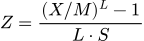
Where:
- X — the child's measured standing height in centimeters.
- M — the CDC median stature at that age and sex.
- L — the Box-Cox skewness parameter.
- S — the coefficient of variation (a scaled standard deviation).
Third, the Z-score is mapped to a percentile through the standard normal cumulative distribution function, Φ(Z). A Z of 0 maps to the 50th percentile, −1.88 to the 3rd, and +1.88 to the 97th. The CDC 2-20 table spans 24 to 240 months in half-month steps, so fractional ages are handled by linearly interpolating L, M, and S between the two bracketing rows.
Related Calculators
- Weight-for-Age (CDC, 2-20 yr)
- Weight-for-Stature (CDC, 2-20 yr)
- Extended BMI-for-Age (CDC, 2-20 yr)
- Adult Height Predictor (Khamis-Roche) — project adult height from parental height
- Z-Score Calculator — Convert z-scores to percentiles and probabilities
Related Sites
- Medical Equations — Hemodynamic, pulmonary, and dosing calculators
- RN Calc — Nursing dosage and calculation tools
- Dollars Per Hour — Weekly paycheck calculator with overtime
- OptionsMath — Options trading profit and loss calculators
- CameraDOF — Depth of field calculator for photographers
- Percent Error Calculator — Calculate percent error between experimental and theoretical values