CDC Extended BMI-for-Age Growth Chart (2-20 Years)
Calculate a child's BMI-for-age percentile on the CDC 2022 Extended BMI charts (ages 2-20). Below the 95th percentile the standard LMS method is used; at or above the 95th the extended formula replaces the saturating LMS tail with a half-normal distribution scaled by σ, so severe pediatric obesity (up to the 99.99th percentile) is measured accurately.
BMI = weight (kg) / height (m)² | Extended Z (above 95th) = 1.645 + (BMI − P95) / σ
How It Works
The CDC Extended BMI-for-Age chart is a 2022 update to the classic CDC 2000 BMI chart. Below the 95th percentile it behaves exactly like the standard chart — the calculator looks up the LMS triple (L, M, S) for the child's exact age and sex, computes a Z-score with Z = ((BMI/M)^L − 1) / (L × S), and maps Z to a percentile through the normal CDF. At or above the 95th percentile the LMS tail compresses so severely that percentile differences become meaningless for children with obesity: a BMI-for-age at the "97th percentile" on the old chart might really sit anywhere from the 96th to well over the 99.9th in the real-world distribution. The 2022 extension fixes this by swapping in a half-normal distribution above the 95th, scaled by a CDC-provided standard-deviation parameter σ for each age-sex combination. In the extended region the calculator uses Z = Φ⁻¹(0.95) + (BMI − P95) / σ, so a BMI of 35 for a 12-year-old boy maps to a precisely distinguishable percentile (e.g. 99.4th vs. 99.8th) — the granularity clinicians need to track treatment response in severe obesity.
Example Problem
A 12-year-old boy is 152 cm tall and weighs 56.6 kg — above the standard 95th percentile. What is his extended BMI-for-age percentile?
- Record date of birth and measurement date about 12 years (144 months) apart. Select Boy.
- Enter 152 cm for height and 56.6 kg for weight in the canonical units. BMI = 56.6 / (1.52)² = 24.5 kg/m².
- The calculator looks up the CDC extended parameters at 144 months for boys: L ≈ −2.65, M ≈ 17.80 kg/m², S ≈ 0.132, σ ≈ 3.61, P95 ≈ 24.2 kg/m².
- Because BMI (24.5) is above P95 (24.2), the standard LMS Z-score would compress; the calculator switches to the extended formula.
- Extended Z = 1.645 + (24.5 − 24.2) / 3.61 ≈ 1.73, which maps through the normal CDF to ≈ 96th percentile.
- % of 95th percentile = 24.5 / 24.2 × 100 ≈ 101%. Below 120%, so the classification is Obesity, not Severe obesity.
Key Concepts
The CDC Extended BMI-for-Age chart exists specifically to measure pediatric obesity. Below the 95th percentile, the standard CDC 2000 LMS chart and the extended chart give identical results — most children will see no difference. Above the 95th percentile the extended chart is strictly more accurate because the LMS Box-Cox transform cannot model the real shape of the upper BMI tail: the right tail is much heavier than any LMS fit can capture. The % of 95th percentile metric that accompanies every extended result is the CDC's recommended categorical screen for obesity severity: 100-119% is Class I obesity, 120-139% is Class II (severe), and ≥ 140% is Class III (most severe). These categories were added to the American Academy of Pediatrics' 2023 Clinical Practice Guideline for the Evaluation and Treatment of Children and Adolescents with Obesity, which tied them to structured treatment recommendations (intensive health behavior and lifestyle treatment, pharmacotherapy, and metabolic/bariatric surgery referral thresholds). The extended chart does not change the cutoffs for underweight (< 5th), healthy weight (5th-85th), or overweight (85th-95th) — only the resolution above the 95th.
Applications
- Routine pediatric obesity screening at well-child visits (ages 2-20), per AAP 2023 guidelines.
- Classifying severity of pediatric obesity using % of the 95th percentile — Class I, II, or III.
- Tracking BMI trajectory in children enrolled in weight-management, pharmacotherapy, or bariatric programs.
- Evaluating whether a child meets the BMI criteria for referral to intensive health behavior and lifestyle treatment (AAP IHBLT threshold).
- Research on severe childhood obesity prevalence, trends, and treatment outcomes.
- Public-health surveillance where the legacy CDC chart's upper-tail compression undercounts severe obesity.
Common Mistakes
- Using this calculator for a child under 2 years old — the CDC recommends weight-for-length instead (BMI is not validated under 2).
- Using adult BMI categories (≥ 25 overweight, ≥ 30 obese) for children — pediatric obesity is defined by percentile, never by a fixed BMI number.
- Applying the extended chart below the 95th percentile and expecting different results — under the 95th, the extended and standard LMS give identical answers.
- Confusing extended percentile with % of 95th percentile — the percentile answers "how does this child rank?" while % of 95th answers "how far past the 95th is this child?" (the severity metric).
- Reporting a 97th-percentile result on the legacy CDC chart as equivalent to the 97th on the extended chart — above the 95th, the legacy chart's percentiles are unreliable and should be replaced with extended values.
- Treating BMI as a diagnosis of obesity. BMI is a screening tool; body composition (fat vs. lean mass), waist circumference, and clinical history confirm the diagnosis.
Frequently Asked Questions
What is the CDC Extended BMI-for-Age chart, and how does it differ from the standard CDC BMI chart?
The CDC Extended BMI-for-Age chart is a 2022 update designed specifically to measure pediatric obesity accurately. The standard CDC 2000 chart uses the LMS method (Box-Cox power transform) which compresses dramatically above the 95th percentile — a child at the "97th percentile" on the legacy chart could really be anywhere from the 96th to the 99.9th. The extended chart replaces that compressed upper tail with a half-normal distribution scaled by a CDC-provided σ parameter. Below the 95th percentile the two charts are identical. Above the 95th, the extended chart gives genuinely distinguishable percentiles up to 99.99 and is the CDC-recommended tool for tracking severe obesity.
When should I use the Extended BMI chart instead of the standard BMI-for-age chart?
Use the extended chart whenever a child's BMI is at or above the 95th percentile — the classic threshold for pediatric obesity. Below the 95th percentile the two charts give identical results, so either is fine for routine screening. Children being screened for, or treated for, obesity should always have results reported from the extended chart, because it is the only CDC tool that can distinguish Class I, II, and III obesity accurately.
What does "% of 95th percentile" mean, and what are Class I, II, and III obesity?
% of 95th percentile expresses a child's BMI as a percentage of the age- and sex-specific 95th-percentile BMI. A child at the 95th percentile is exactly 100% of P95; a child whose BMI is 20% above P95 is at 120%. The CDC and AAP categories are: 100-119% = Class I obesity; 120-139% = Class II (severe) obesity; ≥ 140% = Class III obesity. These thresholds drive clinical recommendations in the AAP 2023 Clinical Practice Guideline, including referral to intensive lifestyle treatment and, at higher classes, pharmacotherapy and metabolic/bariatric surgery evaluation.
What age range does the Extended BMI chart cover?
The CDC Extended BMI-for-Age chart covers ages 2 through 20 years exactly (24 to 240 months). For children under 2, use the WHO or CDC weight-for-length chart — BMI is not recommended under age 2 because infants and toddlers have different body composition and growth dynamics. For adults (20+) use standard adult BMI categories.
My child's BMI is above the 95th percentile — when should I call the pediatrician?
Any BMI at or above the 95th percentile meets the pediatric obesity threshold and warrants a conversation with your child's pediatrician at the next well-child visit, per AAP 2023 guidelines. Call sooner rather than later if: (1) the BMI is ≥ 120% of the 95th percentile (Class II or III obesity); (2) your child has symptoms such as snoring/sleep apnea, joint pain, fatigue, excessive thirst or urination, or polyphagia (possible diabetes); (3) the BMI has crossed two or more percentile bands upward in under a year. The pediatrician can evaluate body composition, check for obesity-related conditions (prediabetes, dyslipidemia, fatty liver, hypertension), and discuss structured treatment options.
Is a high BMI percentile on the extended chart a diagnosis of obesity?
No — BMI is a screening tool, not a diagnosis. A BMI-for-age ≥ 95th percentile is the CDC/AAP threshold for labeling a child as having obesity for clinical and research purposes, but confirming the diagnosis involves body-composition assessment (fat mass vs. lean mass), waist circumference, growth-curve review, and clinical history. A heavily muscled adolescent athlete can sit above the 95th percentile without excess adiposity. Always interpret BMI alongside the full clinical picture your pediatrician can provide.
How is the extended percentile calculated above the 95th?
The extended formula uses a half-normal distribution. First, the calculator looks up the CDC σ parameter for the child's age and sex — σ is the standard deviation of BMI at the 95th percentile, provided directly in the CDC tables. It then computes an extended Z-score: Z = Φ⁻¹(0.95) + (BMI − P95) / σ, which reduces to 1.645 + (BMI − P95) / σ. Finally the Z-score is mapped through the standard normal cumulative distribution function to yield a percentile between 95 and 99.99. This replaces the saturating LMS tail with a smooth, genuinely distinguishable percentile curve — the whole point of the 2022 extension.
Does the extended chart change the definition of overweight or underweight?
No. The extended chart only changes resolution above the 95th percentile. The CDC definitions below the 95th are unchanged: below the 5th percentile is underweight, 5th-85th is healthy weight, and 85th-95th is overweight. At or above the 95th is obesity, and the extended chart adds the Class I/II/III granularity inside that obesity band.
Reference:
CDC Extended BMI-for-Age Growth Charts (2022). Centers for Disease Control and Prevention. https://www.cdc.gov/growthcharts/extended-bmi.htm
Worked Examples
Healthy-weight check-up (standard LMS)
A 12-year-old boy is 152 cm and 40 kg — where does his BMI fall?
A pediatrician is reviewing a 12-year-old boy at his annual visit. Height is 152 cm (4 ft 11.8 in) and weight is 40.0 kg (88.2 lb). BMI is under the 95th-percentile threshold, so the calculator stays on the standard LMS path.
- Knowns: age 144 mo (12.0 yr), sex boy, weight 40.0 kg, height 152 cm
- BMI = 40.0 / (1.52)² = 17.3 kg/m²
- CDC extended LMS at 144 mo (boys): L ≈ -2.45, M ≈ 17.79, S ≈ 0.131
- Z = ((17.3 / 17.79)^-2.45 − 1) / (-2.45 × 0.131) ≈ -0.22
- Φ(-0.22) ≈ 0.41
~41st percentile (BMI ≈ 17.3 kg/m²) — squarely in the CDC healthy-weight band (5th-85th).
A single reading in the healthy-weight band is unremarkable. Pediatricians watch whether the child continues tracking the same percentile channel across successive visits, especially through the 10-14 growth spurt.
Obesity flag — extended range crosses in
A 10-year-old girl weighs 115 lb at 4 ft 6 in — how does she rank above the 95th?
A 10-year-old girl is screened at her well-child visit. Weight is 115.0 lb and height is 4 ft 6 in (137.2 cm). The calculator converts pounds and inches to kilograms and centimeters internally (115 lb → 52.2 kg, 4 ft 6 in → 137.2 cm), computes BMI, and — because BMI is above the 95th percentile — switches to the extended-BMI formula.
- Knowns: age 120 mo (10.0 yr), sex girl, weight 115 lb → 52.2 kg, height 54 in → 137.2 cm
- BMI = 52.2 / (1.372)² = 27.7 kg/m²
- CDC extended parameters at 120 mo (girls): P95 ≈ 22.2 kg/m², σ ≈ 3.3
- Extended Z = 1.645 + (27.7 − 22.2) / 3.3 ≈ 3.31
- % of 95th = 27.7 / 22.2 × 100 ≈ 125% — Class II (severe) obesity
~99.9th extended percentile (BMI ≈ 27.7 kg/m²) — meets the AAP Class II severe obesity threshold.
A reading at ~125% of the 95th percentile meets the AAP 2023 Class II severe obesity threshold, which ties to referral recommendations for intensive health behavior and lifestyle treatment and evaluation for obesity-related comorbidities (prediabetes, dyslipidemia, sleep apnea, fatty liver).
Class III obesity — deep in the extended tail
A 15-year-old boy is 170 cm and 110 kg — what extended percentile captures this?
A 15-year-old boy arrives at a pediatric weight-management clinic. Height is 170 cm (5 ft 7 in) and weight is 110 kg (242.5 lb). His BMI is so far above the 95th percentile that the legacy LMS chart would compress him to a saturating "> 99th" with no way to track treatment response. The extended chart's half-normal tail gives a genuinely distinguishable percentile.
- Knowns: age 180 mo (15.0 yr), sex boy, weight 110.0 kg, height 170 cm
- BMI = 110.0 / (1.70)² = 38.1 kg/m²
- CDC extended parameters at 180 mo (boys): P95 ≈ 27.5 kg/m², σ ≈ 5.0
- Extended Z = 1.645 + (38.1 − 27.5) / 5.0 ≈ 3.76
- % of 95th = 38.1 / 27.5 × 100 ≈ 139% — just under the Class III threshold (140%)
~99.99th extended percentile (BMI ≈ 38.1 kg/m²) — meets the AAP Class II→III boundary.
At this severity the AAP 2023 guideline explicitly lists evaluation for pharmacotherapy (from age 12) and metabolic/bariatric surgery referral (from age 13) alongside intensive lifestyle treatment. The extended chart is the only CDC tool that can meaningfully track whether that treatment is reducing BMI toward the 95th percentile.
How the percentile is calculated
The CDC Extended BMI-for-Age calculator uses two different methods depending on whether the child's BMI falls below or above the 95th percentile — the threshold at which the legacy LMS chart loses resolution. Both methods start from the same BMI computation:
BMI equals weight in kilograms divided by height in meters squared.
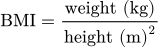
Weight in pounds and height in inches are converted to kilograms and meters before BMI is computed (BMI is always expressed in kg/m² regardless of the input units).
Below the 95th percentile — standard LMS method
For BMI under the 95th percentile, the calculator looks up the CDC LMS triple (L, M, S) for the child's exact age in months and sex, then computes a Z-score using the Box-Cox power transform:
Z score equals the quantity X divided by M, raised to the power L, minus 1, divided by L times S.
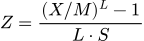
Where:
- X — the child's BMI in kg/m².
- M — the CDC median BMI at this age and sex.
- L — the Box-Cox skewness parameter.
- S — the coefficient of variation.
Z is then mapped through the standard normal CDF Φ(Z) to a percentile between 0 and 95.
At or above the 95th percentile — extended BMI formula
The LMS distribution compresses dramatically above the 95th percentile — a child at the “97th” on the legacy chart could genuinely be anywhere from the 96th to the 99.9th. The CDC 2022 extension replaces the upper tail with a half-normal distribution scaled by a CDC-provided standard deviation σ for each age-sex combination:
Extended Z score equals the inverse normal cumulative distribution at 0.95 plus BMI minus P 95 divided by sigma, which also equals 1.645 plus BMI minus P 95 divided by sigma.

Where:
- P₉₅ — the age- and sex-specific 95th-percentile BMI from the CDC table.
- σ — the CDC-published standard deviation that characterises BMI at and above the 95th percentile for that age-sex row.
- Φ⁻¹(0.95) ≈ 1.645 — the Z-score that anchors the extended distribution exactly at the 95th percentile.
The extended Z-score is mapped through the normal CDF to produce a percentile capped at 99.99. Alongside the percentile, the calculator reports “% of the 95th percentile” — a separate metric the CDC recommends for classifying obesity severity: 100-119% is Class I obesity, 120-139% is Class II (severe), and ≥ 140% is Class III.
The extended CDC BMI table spans 24 to 240 months in half-month steps, so fractional ages are handled by linear interpolation between the two bracketing rows.
Related Calculators
- BMI-for-Age (WHO, 5-19 yr) — standard WHO BMI chart for general pediatric screening
- Weight-for-Age (CDC, 2-20 yr)
- Stature-for-Age (CDC, 2-20 yr)
- Weight-for-Stature (CDC, 2-20 yr)
- Z-Score Calculator — Convert z-scores to percentiles and probabilities
Related Sites
- Medical Equations — Hemodynamic, pulmonary, and dosing calculators
- RN Calc — Nursing dosage and calculation tools
- AJ Designer — 200+ engineering and science calculators
- Dollars Per Hour — Weekly paycheck calculator with overtime
- CameraDOF — Depth of field calculator for photographers
- Percent Error Calculator — Calculate percent error between experimental and theoretical values