WHO BMI-for-Age Growth Chart (5-19 Years)
Plot a child or teen's BMI against WHO reference data for ages 5-19 years. The chart displays the standard percentile curves (3rd, 15th, 50th, 85th, 97th) with your child's BMI pinned on top — the WHO-recommended screening tool for overweight and obesity in school-age children and adolescents.
BMI = weight (kg) / height (m)² | LMS: Z = ((X/M)^L − 1) / (L × S)
How It Works
The WHO BMI-for-age chart converts a single weight + height measurement into a percentile that answers "out of 100 children of the same age and sex on the WHO reference, how many have a BMI below mine?" Under the hood the calculator first computes BMI = weight (kg) / height (m)², then looks up three parameters from the WHO Growth Reference 2007 LMS table — L (skewness), M (median BMI), and S (coefficient of variation) — for the child's exact age in months, computes a Z-score with the Box-Cox equation Z = ((X/M)^L − 1) / (L × S), and maps the Z-score through the standard normal CDF to a percentile. The WHO 5-19 BMI table covers months 60 through 228 (5 to 19 years) in 1-month steps, so fractional ages are handled by linear interpolation between adjacent rows. The WHO defines thinness as below the 3rd percentile, overweight as above the 85th, and obesity as above the 97th.
Example Problem
A 12-year-old girl is 152 cm tall and weighs 42 kg at her annual physical. Where does her BMI-for-age fall on the WHO 5-19 chart?
- Record the child's date of birth and the measurement date — about 12 years (144 months) apart — and note the sex as Girl.
- Convert the inputs to canonical units if needed. Height 152 cm and weight 42.0 kg are already in the WHO standard units, so no conversion is needed.
- Compute BMI from the formula BMI = weight / height². Substituting gives BMI = 42.0 / (1.52)² = 42.0 / 2.3104 ≈ 18.2 kg/m².
- Look up the WHO 5-19 LMS triple for girls at 144 months: L ≈ -1.40, M ≈ 18.00 kg/m², S ≈ 0.131.
- Compute the Z-score with Z = ((X/M)^L − 1) / (L × S). Substituting BMI 18.2 gives Z ≈ ((18.2/18.00)^-1.40 − 1) / (-1.40 × 0.131) ≈ 0.08.
- Map the Z-score through the standard normal CDF: Φ(0.08) ≈ 0.53, so the percentile is about the 53rd — right at the WHO median, in the healthy-weight band.
Key Concepts
A BMI-for-age percentile is a rank, not a grade. The 75th percentile means 75% of WHO reference children of the same age and sex have a lower BMI — it does not mean the child is "75% healthy." Childhood BMI interpretation is not the same as adult BMI: a BMI of 18 might be healthy for a 15-year-old but overweight for a 5-year-old, so the WHO and AAP recommend age- and sex-specific percentiles from age 2 onward rather than fixed cutoffs like BMI ≥ 25. The WHO 2007 categories are: below 3rd percentile = thinness (Z < -2), 3rd-85th = healthy weight, above 85th = overweight (Z > +1), above 97th = obesity (Z > +2). BMI does not distinguish between muscle and fat — a heavily trained athlete can rank above the 97th without excess adiposity — so clinicians pair BMI-for-age with waist circumference, skinfold thickness, or body composition measures before diagnosing obesity. Puberty changes the picture dramatically: BMI normally rises across adolescence, and the LMS parameters reflect that natural trajectory. Pediatricians focus on trajectory across visits (is the child steady on their channel?) rather than any single reading.
Applications
- School-based screening for overweight and obesity in children ages 5 and up — the WHO and AAP recommended age range for BMI-for-age.
- Well-child visits and adolescent wellness physicals from age 5 through 19.
- Monitoring BMI trajectory during childhood and puberty to flag rapid crossings of major percentile bands.
- International public-health surveys of childhood obesity — the WHO reference is the standard for cross-country comparisons.
- Evaluating effectiveness of lifestyle, nutrition, or medical interventions for pediatric obesity or undernutrition.
- Research on childhood obesity prevalence, global trends, and nutritional epidemiology.
Common Mistakes
- Using adult BMI categories (BMI ≥ 25 = overweight, ≥ 30 = obese) for children — children under 19 require age- and sex-specific percentiles, never fixed cutoffs.
- Not measuring height and weight accurately — a 1 cm or 0.5 kg error shifts BMI noticeably in a young child and can move a percentile reading by 10+ points.
- Confusing BMI percentile with BMI value — the same BMI number means different things at different ages (a BMI of 18 is the 85th percentile at age 5 but around the 25th at age 15).
- Ignoring that BMI does not distinguish between muscle and fat mass — an adolescent athlete above the 97th percentile may have normal body composition.
- Using this WHO 5-19 chart for children under 5 — below age 5 the WHO weight-for-height / weight-for-length reference is recommended.
- Using one reading as a diagnosis — trajectory across 2-3 visits is almost always more meaningful than a single BMI-for-age point, especially through puberty.
Frequently Asked Questions
What is the WHO BMI-for-age reference for 5-19 years?
BMI-for-age combines weight and height into a single screen for under- and over-weight in children 5–19 years old. The calculator computes BMI = weight ÷ height² and looks the value up on the WHO 2007 reference for the child's exact age and sex. The 50th is median; the 85th flags overweight and the 97th flags obesity by WHO criteria.
What BMI percentile is considered overweight or obese for a child?
The WHO 2007 reference defines overweight as a BMI-for-age above the 85th percentile (Z > +1) and obesity as above the 97th percentile (Z > +2). Thinness is defined as below the 3rd percentile (Z < -2). These are different from adult cutoffs (overweight ≥ 25, obese ≥ 30) — children require age- and sex-specific percentiles because BMI naturally shifts across childhood and puberty.
How is this different from an adult BMI calculator?
Adult BMI calculators use fixed cutoffs (25 and 30) that apply to everyone over 20. For children 5-19, the same BMI number means different things at different ages — BMI of 18 is the 85th percentile at age 5 but close to the median at age 15. This calculator compares BMI to age- and sex-specific WHO reference data to determine the percentile.
What's the difference between the WHO 5-19 and CDC 2-20 BMI-for-age charts?
The WHO 2007 Growth Reference is built from pooled international data and is the standard for most countries and global public-health use. The CDC 2000 charts are built from US NHANES data collected between 1963 and 1994 and are the AAP-recommended reference for US pediatric care. The two charts give slightly different percentiles — the WHO reference tends to classify slightly more children as overweight or obese than the CDC chart. Choose the WHO chart for international comparisons or if your clinician works under WHO guidelines; choose CDC for US-based clinical screening.
Why is BMI percentile used instead of just BMI?
Children's healthy BMI changes as they grow. A BMI of 18 might be healthy for a 15-year-old but overweight for a 5-year-old. Percentiles compare a child to others of the same age and sex, giving a more meaningful assessment than any single BMI number.
Should I be concerned if my child is above the 85th percentile?
A BMI above the 85th percentile meets the WHO overweight threshold, and above the 97th meets the obesity threshold. However, BMI doesn't distinguish between muscle and fat — a muscular adolescent athlete can rank high without excess adiposity. Discuss results above the 85th with your pediatrician, who can evaluate body composition, waist circumference, and growth trajectory before treating the percentile as a diagnosis.
How does puberty affect BMI percentiles?
Puberty brings a natural rise in BMI from both lean mass and fat. Girls typically start their growth spurt around ages 9-11 with the BMI rise lagging by 1-2 years; boys start around 11-13. The WHO LMS parameters already reflect these age-specific shifts, so a child who stays in their usual percentile channel through puberty is on track. A rapid upward shift across two or more percentile bands is the more common reason for clinical follow-up.
Is BMI-for-age the right way to screen for obesity in children?
Yes — the WHO, AAP, and most national pediatric bodies agree that BMI-for-age (not weight-for-age or weight alone) is the primary obesity-screening tool for children ages 2-19. BMI combines weight and height into one index, which corrects for the fact that a tall heavy child may have normal body composition while a short lighter child may be overweight. A high BMI-for-age reading is a screening flag, not a diagnosis — clinicians confirm with additional measurements.
Reference:
WHO Growth Reference 2007. World Health Organization. https://www.who.int/tools/growth-reference-data-for-5to19-years
Worked Examples
Underweight flag
A 7-year-old boy is 120 cm and 18 kg — is his BMI-for-age too low?
A parent is worried their 7-year-old son is falling behind his classmates in size. Height is 120 cm (3 ft 11 in) and weight is 18.0 kg (39.7 lb). BMI comes out low — the question is whether it is clinically low or just lean-and-healthy.
- Knowns: age 84 mo (7.0 yr), sex boy, weight 18.0 kg, height 120 cm
- BMI = 18.0 / (1.20)² = 12.5 kg/m²
- WHO 5-19 LMS at 84 mo (boys): L ≈ -1.25, M ≈ 15.48, S ≈ 0.0907
- Z = ((12.5 / 15.48)^-1.25 − 1) / (-1.25 × 0.0907) ≈ -2.70
- Φ(-2.70) ≈ 0.0035
~0.3 percentile (BMI ≈ 12.5 kg/m²) — well below the WHO 3rd-percentile thinness threshold.
BMI below the 3rd percentile (Z < -2) is classified as thinness by the WHO. The AAP recommends evaluation for malabsorption, endocrine conditions, or inadequate intake — but a persistently lean child who is otherwise thriving may simply track in their own channel.
Healthy-weight check-up
A 12-year-old girl is 152 cm and 42 kg — where does her BMI fall?
A pediatrician is reviewing a 12-year-old girl at her annual visit. Height is 152 cm (4 ft 11.8 in) and weight is 42.0 kg (92.6 lb). The provider wants a fast BMI-for-age percentile read.
- Knowns: age 144 mo (12.0 yr), sex girl, weight 42.0 kg, height 152 cm
- BMI = 42.0 / (1.52)² = 18.2 kg/m²
- WHO 5-19 LMS at 144 mo (girls): L ≈ -1.40, M ≈ 18.00, S ≈ 0.131
- Z = ((18.2 / 18.00)^-1.40 − 1) / (-1.40 × 0.131) ≈ 0.08
- Φ(0.08) ≈ 0.53
~53rd percentile (BMI ≈ 18.2 kg/m²) — right at the WHO median, squarely in the healthy-weight band.
A single reading at the 53rd percentile is unremarkable. Pediatricians watch whether she continues tracking her usual channel across successive visits, especially through the 10-14 growth spurt.
Adolescent obesity screening
A 16-year-old boy weighs 176 lb at 5 ft 10 in — is his BMI-for-age in the obesity range?
A 16-year-old boy is being screened at his sports physical. Weight is 176.0 lb and height is 5 ft 10 in (178 cm). The calculator converts pounds to kilograms internally (176.0 lb × 0.4536 = 79.8 kg) and computes BMI against the WHO 5-19 reference.
- Knowns: age 192 mo (16.0 yr), sex boy, weight 176 lb → 79.8 kg, height 178 cm
- BMI = 79.8 / (1.78)² = 25.2 kg/m²
- WHO 5-19 LMS at 192 mo (boys): L ≈ -1.35, M ≈ 20.50, S ≈ 0.126
- Z = ((25.2 / 20.50)^-1.35 − 1) / (-1.35 × 0.126) ≈ 1.43
- Φ(1.43) ≈ 0.924
~92nd percentile (BMI ≈ 25.2 kg/m²) — above the WHO 85th-percentile overweight threshold but below the 97th-percentile obesity cutoff.
A BMI ≥ 97th percentile meets the WHO obesity cutoff for children; the 85th–97th band is the overweight zone where lifestyle counseling is the first-line response. BMI does not distinguish muscle from fat — a heavily trained athlete can rank above the 85th without excess adiposity. Clinicians confirm with waist circumference, body composition, or skinfold measurements.
How the percentile is calculated
The calculator turns a weight and height into a BMI-for-age percentile in three stages. First, it computes BMI from the measurements:
BMI equals weight in kilograms divided by height in meters squared.
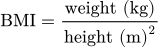
Weight in pounds and height in inches or feet+inches are converted to kilograms and meters before BMI is calculated (BMI is always expressed in kg/m²). Second, the calculator looks up three WHO parameters — L, M, and S — from the WHO Growth Reference 2007 table for the child's exact age in months and sex. L is the Box-Cox power transform (it accounts for the skew in BMI distributions, which becomes pronounced during puberty), M is the median BMI at that age, and S is the coefficient of variation. Third, it plugs those parameters into the LMS Z-score formula:
Z score equals the quantity X divided by M, raised to the power L, minus 1, divided by L times S.
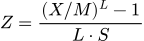
Where:
- X — the child's computed BMI in kg/m².
- M — the WHO median BMI at that age and sex.
- L — the Box-Cox skewness parameter.
- S — the coefficient of variation (a scaled standard deviation).
Finally, the Z-score is mapped to a percentile through the standard normal cumulative distribution function, Φ(Z). A Z of 0 maps to the 50th percentile, +1 to the 85th (WHO overweight threshold), and +2 to the 97th (WHO obesity threshold). The WHO 5-19 BMI-for-age table spans ages 60 to 228 months (5 to 19 years) in 1-month steps, so fractional ages are handled by linear interpolation between the two bracketing rows.
Related Calculators
- Height-for-Age (WHO, 5-19 yr)
- Weight-for-Age (WHO, 5-10 yr)
- Extended BMI-for-Age (CDC, 2-20 yr)
- Z-Score Calculator — Convert z-scores to percentiles and probabilities
- Weight Loss Calculator — Calculate calorie deficit for weight goals
Related Sites
- Medical Equations — Hemodynamic, pulmonary, and dosing calculators
- RN Calc — Nursing dosage and calculation tools
- Dollars Per Hour — Weekly paycheck calculator with overtime
- BOGO Discount — Buy-one-get-one discount calculator
- CameraDOF — Depth of field calculator for photographers
- LoanChop — Loan prepayment calculator