WHO Height-for-Age Growth Chart (5-19 Years)
Plot your child's standing height against WHO Growth Reference 2007 data for ages 5-19 years. This international standard covers the school-age and adolescent growth period including puberty.
LMS Method: Z = ((X/M)^L - 1) / (L x S)
How It Works
This calculator uses the WHO Growth Reference 2007 for monitoring height in children and adolescents aged 5 to 19 years. The WHO reference is an international standard based on data reconstructed from multiple countries, describing how healthy school-age children and adolescents grow. The LMS method computes Z-scores and percentiles by comparing height to age- and sex-specific reference values.
Example Problem
A 10-year-old boy measures 138.6 cm in standing height. What is his height-for-age percentile?
- Enter the child's date of birth and measurement date (10 years apart).
- Select 'Boy' for gender.
- Enter 138.6 cm for height.
- The calculator finds the LMS parameters for boys at age 10 and computes the Z-score.
- Result: approximately the 55th percentile (Z ≈ 0.13), slightly above the WHO median height for boys at age 10.
Key Concepts
Height-for-age in the 5-19 year range spans the pre-pubertal, pubertal, and post-pubertal periods. A percentile is a rank, not a grade — the 75th percentile means 75% of same-age, same-sex children are shorter than this child. Children usually track along one percentile channel after age 2-3, and crossing two or more major bands up or down is the more common reason for clinical follow-up. The pubertal growth spurt causes temporary acceleration in height gain, typically ages 10-14 for girls and 12-16 for boys, and children may temporarily shift percentile channels during puberty. Parental height is the single strongest predictor of adult height for typical children. Short stature (below the 3rd percentile or -2 Z-score) may be familial, constitutional, or may indicate growth hormone deficiency, chronic illness, or nutritional issues. Growth trends over time are more informative than a single measurement.
Applications
- Routine growth monitoring at annual check-ups and school screenings
- Evaluating short stature or tall stature concerns
- Monitoring growth during the pubertal growth spurt
- International height comparison using WHO reference data
- Tracking growth in adolescents with chronic conditions
Common Mistakes
- Not using a proper stadiometer — wall measurements with a book on the head are less accurate
- Not accounting for the pubertal growth spurt when interpreting percentile changes
- Using this chart for children under 5 — use WHO stature-for-age (2-5) or length-for-age (0-2) instead
- Measuring with shoes on or without proper positioning
- Comparing to CDC charts without noting that the reference populations differ
Frequently Asked Questions
What is the WHO 2007 height-for-age reference for 5-19 years?
It is the WHO 2007 growth reference that extends standardized height monitoring through school age and adolescence (5–19 years), reconstructed from the older NCHS/WHO 1977 chart. The percentile shows where a child's standing height ranks in the reference. Values between the 3rd and 97th are typical, and the chart is the WHO-recommended reference once children outgrow the 0–5 year standards.
Should I measure height in cm or inches?
You can use centimeters, inches, or feet and inches. The calculator converts automatically. For the most accurate result, use a stadiometer reading from your doctor’s office.
How is the WHO 5-19 chart different from the CDC 2-20 chart?
The WHO Growth Reference 2007 is an international standard based on data reconstructed from multiple countries; it describes how healthy children and adolescents grow. The CDC 2-20 charts are based on US data from the 1960s-1990s and describe how US children actually grew. The two charts agree closely through middle childhood but diverge slightly in puberty. Outside the US, the WHO chart is the preferred reference for 5-19 year-olds.
When does the pubertal growth spurt happen?
Girls typically begin their pubertal growth spurt between ages 10 and 12 and reach peak height velocity around age 12, adding 8-10 cm per year at the peak. Boys start about two years later, peak around age 14 at 9-11 cm per year, and generally finish growing later. A child whose percentile shifts upward during these windows is often simply spurting ahead of the median timeline rather than growing abnormally.
How much does genetics affect my child's height?
Genetics explains roughly 60-80% of adult height for a typical child. Mid-parental height (the average of father's and mother's height, adjusted +6.5 cm for boys and −6.5 cm for girls) gives a genetic target zone of about ±8.5 cm. A child whose percentile differs from this zone despite otherwise healthy growth may simply be reverting to the family mean. Our Adult Height Predictor uses the Khamis-Roche method to combine parental height with current measurements for a more precise adult-height estimate.
Can I estimate my child's adult height from this percentile?
Not from this calculator alone. Current percentile shows where the child sits today, but adult height depends on remaining growth potential (bone age, pubertal stage, parental height). For a projected adult height, use our Adult Height Predictor, which combines current height and weight with mid-parental height via the Khamis-Roche method — a peer-reviewed method accurate to within about ±2 inches.
When should I consult a pediatrician about my child’s height?
See your pediatrician if your child’s height is consistently below the 3rd percentile, above the 97th percentile, or crossing two or more major percentile lines up or down between visits. A single reading outside the normal band is less concerning than a persistent trend. Other triggers include a predicted adult height well outside the parental range, signs of early or delayed puberty alongside height changes, or rapid deceleration after a previously steady trajectory. This calculator is informational and is not a substitute for medical advice.
When do growth plates close?
The epiphyseal (growth) plates at the ends of long bones typically fuse around age 14-16 in girls and 16-18 in boys, after which linear growth effectively stops. Pediatric endocrinologists confirm growth potential with a bone-age X-ray of the left hand; the difference between bone age and chronological age estimates how much growth is still possible.
Reference:
WHO Growth Reference 2007. World Health Organization. https://www.who.int/tools/growth-reference-data-for-5to19-years
Worked Examples
Pre-puberty
Where does a 7-year-old boy measuring 122 cm tall sit on the WHO 5-19 chart?
A pediatrician is reviewing a 7-year-old boy at his annual well-child visit. Stadiometer reading (shoes off, heels against the board) comes in at 122.0 cm (48.0 in). The provider wants a quick percentile read using the WHO Growth Reference 2007 for 5-19 years.
- Knowns: age 84 mo, sex boy, standing height 122.0 cm
- WHO LMS lookup at 84 mo (boys): L = 1, M ≈ 121.74 cm, S ≈ 0.04383
- Z = ((122.0 / 121.74)^1 − 1) / (1 × 0.04383) ≈ +0.05
- Φ(+0.05) ≈ 0.520
~52nd percentile — right on the WHO median for 7-year-old boys.
A 7-year-old is still in the pre-pubertal steady-state. Persistent tracking along one channel is the expected pattern; any large channel crossing before the growth spurt warrants follow-up.
Peak growth spurt
A 12-year-old girl is 4' 11.5" tall — what percentile?
A parent brings a 12-year-old girl in for a routine visit. Height is recorded in feet and inches as 4'11.5" (151.1 cm). The WHO 5-19 chart shows most girls have begun their pubertal growth spurt by this age, making channel interpretation more nuanced.
- Knowns: age 144 mo, sex girl, standing height 4' 11.5" → 151.13 cm
- WHO LMS lookup at 144 mo (girls): L = 1, M ≈ 151.17 cm, S ≈ 0.04178
- Z ≈ ((151.13 / 151.17)^1 − 1) / (1 × 0.04178) ≈ −0.01
- Φ(−0.01) ≈ 0.497
~50th percentile — exactly at the WHO median for 12-year-old girls.
Peak height velocity for girls is around 12. Expect rapid change over 6-12 months, then a clear deceleration as growth plates approach closure.
Late adolescence
A 17-year-old boy is 69 inches tall — how tall is he for his age?
At 14 this boy sat on the 75th percentile. Now at 17 his standing height is 69.0 in (175.3 cm). The provider wants to confirm he has tracked his channel through the post-spurt plateau and that near-final adult height is reasonable.
- Knowns: age 204 mo, sex boy, standing height 69.0 in → 175.3 cm
- WHO LMS lookup at 204 mo (boys): L = 1, M ≈ 175.16 cm, S ≈ 0.0436
- Z ≈ ((175.3 / 175.16)^1 − 1) / (1 × 0.0436) ≈ +0.02
- Φ(+0.02) ≈ 0.507
~51st percentile — at the WHO median, consistent with a typical late-teen trajectory.
Most boys finish within 2-3 cm of their 17-year-old height. WHO data ends at 228 months (19 yr); after that, use adult references rather than pediatric percentiles.
How the percentile is calculated
The calculator turns one standing-height measurement into a percentile in three stages. First, it looks up three WHO parameters — L, M, and S — from the WHO Growth Reference 2007 table for the child's exact age and sex. L is the Box-Cox power transform (it accounts for skew in the height distribution; for WHO 5-19 height-for-age L is fixed at 1 across all ages, which collapses the Z-score to a simple z = (X − M) / (M × S) expression), M is the median height at that age in centimeters, and S is the coefficient of variation. Second, it plugs those parameters into the Z-score formula:
Z score equals the quantity X divided by M, raised to the power L, minus 1, divided by L times S.
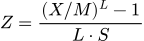
Where:
- X — the child's measured standing height in centimeters.
- M — the WHO median height at that age and sex.
- L — the Box-Cox skewness parameter (1 for WHO 5-19 height-for-age).
- S — the coefficient of variation (a scaled standard deviation).
Third, the Z-score is mapped to a percentile through the standard normal cumulative distribution function, Φ(Z). A Z of 0 maps to the 50th percentile, −1.88 to the 3rd, and +1.88 to the 97th. The WHO 5-19 table spans 60 to 228 months in one-month steps, so fractional ages are handled by linearly interpolating L, M, and S between the two bracketing rows.
Related Calculators
- BMI-for-Age (WHO, 5-19 yr)
- Weight-for-Age (WHO, 5-10 yr)
- Stature-for-Age (CDC, 2-20 yr)
- Adult Height Predictor (Khamis-Roche) — project adult height from parental height
- Z-Score Calculator — Convert z-scores to percentiles and probabilities
Related Sites
- Medical Equations — Hemodynamic, pulmonary, and dosing calculators
- RN Calc — Nursing dosage and calculation tools
- Dollars Per Hour — Weekly paycheck calculator with overtime
- BOGO Discount — Buy-one-get-one discount calculator
- CameraDOF — Depth of field calculator for photographers
- LoanChop — Loan prepayment calculator