WHO Weight-for-Age Growth Chart (5-10 Years)
Plot a school-age child's weight against WHO Growth Reference 2007 data for ages 5-10 years. The chart displays the standard percentile curves (3rd, 15th, 50th, 85th, 97th) with your child's measurement pinned on top. WHO publishes weight-for-age LMS parameters only through age 10 because adolescent weight is better interpreted through BMI-for-age.
LMS Method: Z = ((X/M)^L − 1) / (L × S), percentile = Φ(Z) × 100
How It Works
The WHO 5-10 weight-for-age chart converts a single weight measurement into a percentile that answers "out of 100 WHO-reference children of the same age and sex, how many weigh less than mine?" Under the hood the calculator looks up three LMS parameters — L (skewness), M (median weight in kg), and S (coefficient of variation) — from the WHO Growth Reference 2007 table for the child's exact age in months, computes a Z-score with the Box-Cox equation Z = ((X/M)^L − 1) / (L × S), and maps the Z-score through the standard normal CDF to a percentile. The WHO weight-for-age table covers months 60 through 120 (5 to 10 years) in 1-month steps, so fractional ages are handled by linear interpolation between adjacent rows. Beyond age 10, WHO does not publish weight-for-age parameters — adolescent weight changes with puberty and height, so BMI-for-age (5-19) becomes the recommended screening tool.
Example Problem
A 7-year-old boy weighs 22.9 kg at his annual check-up. Where does he fall on the WHO 5-10 weight-for-age chart?
- Record the child's date of birth and the date of today's measurement — about 7 years (84 months) apart — and note the sex as Boy.
- Convert the weight to kilograms if it was recorded in pounds. Here it is already 22.9 kg, so no conversion is needed.
- Look up the WHO 5-19 LMS triple for boys at 84 months: L ≈ -0.46, M ≈ 22.89 kg, S ≈ 0.142.
- Compute the Z-score with Z = ((X/M)^L − 1) / (L × S). Substituting gives Z ≈ ((22.9/22.89)^-0.46 − 1) / (-0.46 × 0.142) ≈ 0.00.
- Map the Z-score through the standard normal CDF: Φ(0.00) ≈ 0.50, so the percentile is about the 50th.
- Report the result: a 7-year-old boy at 22.9 kg sits right at the WHO median — half of reference boys his age weigh less, half weigh more.
Key Concepts
A percentile is a rank, not a grade. The 75th percentile means 75% of WHO-reference children of the same age and sex weigh less — it does not mean the child is "75% healthy" or "25% overweight." Most pediatricians treat the 3rd-to-97th percentile band as the normal range for weight-for-age, and focus on trajectory over time rather than any single reading. The WHO Growth Reference 2007 differs from the WHO Child Growth Standards (0-5 years): the 5-19 data is descriptive (reconstructed from historical WHO, NCHS, and CDC data to match the 0-5 standards at the 5-year boundary), while the 0-5 data is prescriptive (based on optimal growth in exclusively breastfed children). Weight-for-age in the 5-10 year range should always be interpreted alongside height-for-age, and once a child approaches puberty, BMI-for-age becomes the better screening tool because it accounts for the rapid height and body-composition changes of adolescence.
Applications
- Well-child visits from age 5 through age 10 — pediatricians plot each weight measurement to confirm steady growth along the child's usual channel.
- Screening for underweight (persistent tracking below the 3rd percentile) in school-age children — often a prompt to evaluate nutrition, malabsorption, or chronic illness.
- International weight comparison — the WHO reference is used worldwide and is the standard in most non-US pediatric guidelines.
- School health programs and nutritional assessments in low- and middle-income country settings.
- Complementary assessment alongside WHO height-for-age (5-19) and WHO BMI-for-age (5-19).
- Transitioning from the WHO 0-5 weight-for-age chart at the 5-year boundary.
Common Mistakes
- Using this chart for children over 10 — WHO does not publish weight-for-age parameters beyond 120 months. Switch to BMI-for-age (5-19 years) for older children.
- Using weight-for-age alone to screen for obesity — BMI-for-age is the WHO-recommended screening tool because it accounts for height.
- Confusing the WHO Growth Reference 2007 (5-19, descriptive) with the WHO Child Growth Standards (0-5, prescriptive) — they use different LMS tables even though both are "WHO" references.
- Mixing the WHO reference with the CDC reference — the two curves differ by a few percentile points, and a child at the 50th WHO may be at the 55th CDC.
- Not converting units — always verify whether the weight was recorded in kilograms or pounds before entering it.
- Reading a one-off measurement as a diagnosis — trajectory across 2-3 visits is almost always more meaningful than a single point.
Frequently Asked Questions
Why does WHO weight-for-age stop at age 10?
WHO weight-for-age stops at age 10 because puberty introduces wide individual variation in muscle, fat, and bone mass that weight alone cannot interpret well. For ages 5–10, the chart shows where a child's weight ranks against the WHO 2007 reference. After age 10, BMI-for-age becomes the recommended weight-status screen, and height-for-age covers stature monitoring through age 19.
Why does this calculator stop at age 10 — other charts go to 19?
The WHO Growth Reference 2007 publishes height-for-age and BMI-for-age parameters through age 19, but weight-for-age only through age 10 (120 months). WHO explicitly omits adolescent weight-for-age because, during puberty, weight changes dramatically with height and body composition — a tall, muscular 14-year-old and a short, slender 14-year-old of the same weight fall at very different places on a weight-only chart. Instead, WHO recommends BMI-for-age (5-19) for children and teens over age 10 because BMI combines weight and height into a single index that adjusts for stature.
What is the 50th percentile weight for a 7-year-old?
On the WHO 5-10 chart, the 50th-percentile weight for a 7-year-old (84 months) boy is approximately 22.9 kg (50.5 lb) and for a 7-year-old girl is about 22.2 kg (48.9 lb). The 50th percentile is the WHO median — half of reference children of the same age and sex weigh more, half weigh less. It is not a target every child should hit; tracking consistently in your own channel matters more than landing on the 50th.
What is the difference between the WHO and CDC weight-for-age charts?
The CDC 2000 growth charts are built from US NHANES survey data collected between 1963 and 1994, and the AAP recommends them for US children from age 2 onward. The WHO Growth Reference 2007 is used internationally and blends historical WHO, NCHS, and CDC data into a reference that aligns smoothly with the WHO 0-5 standards at age 5. The two charts usually agree within a few percentile points, but the WHO curves are slightly lower than the CDC curves at many ages — so a child at the 50th WHO may land near the 55th on the CDC chart. For US clinical care follow your pediatrician; for international or research use, WHO is the default.
Is weight-for-age the right chart to screen for obesity?
No. WHO and the AAP both recommend BMI-for-age as the primary obesity screening tool from age 2 onward because BMI combines weight and height into a single index. Weight-for-age alone can flag extremes, but a tall child at the 90th weight percentile may have a perfectly healthy BMI, while a short child at the 70th weight percentile may be overweight. Use this chart alongside a BMI-for-age reading, not in isolation.
What should I do when my child turns 10?
Switch to the WHO BMI-for-Age (5-19 years) calculator once your child reaches 10 years and 1 month. BMI-for-age is the WHO-recommended indicator of weight status for the 5-19 range and is the tool most pediatricians use for pre-adolescent and adolescent weight screening. If you want continued US-style weight-for-age tracking beyond 10, the CDC 2-20 Weight-for-Age chart extends to age 20.
What weight percentile is considered healthy?
Most pediatricians treat the 3rd-to-97th percentile band as the normal weight-for-age range. What matters more than hitting a specific percentile is consistent tracking — a child steady on the 15th or the 85th is growing well. Crossing two or more major percentile bands in either direction over a few visits is the more common reason for clinical follow-up. For obesity screening specifically, WHO uses BMI-for-age ≥ 95th percentile as the threshold, not weight-for-age.
What if my child is below the 3rd percentile for weight?
A consistent reading below the 3rd percentile (Z-score under about -1.88) is outside the WHO normal range and warrants a discussion with your pediatrician. The clinical question is always "is this a stable channel for this child, or a new drop from a higher channel?" A child who has always tracked at the 2nd and is otherwise thriving is very different from a child who was at the 40th last year and is at the 2nd today. Possible causes for a drop include malnutrition, malabsorption, thyroid disease, and chronic infection.
Reference:
WHO Growth Reference 2007, World Health Organization. https://www.who.int/tools/growth-reference-data-for-5to19-years
Worked Examples
Kindergarten check-up
Where does a 5-year-old girl weighing 18 kg fall on the WHO chart?
A pediatrician is reviewing a healthy 5-year-old girl at her well-child visit. Her recorded weight is 18.0 kg (39.7 lb) and the provider wants a quick WHO-reference percentile read.
- Knowns: age 60 mo (5.0 yr), sex girl, weight 18.0 kg
- WHO 5-19 LMS at 60 mo (girls): L ≈ -0.47, M ≈ 18.08 kg, S ≈ 0.142
- Z = ((18.0 / 18.08)^-0.47 − 1) / (-0.47 × 0.142) ≈ -0.03
- Φ(-0.03) ≈ 0.49
~49th percentile — right at the WHO median and squarely in the healthy range.
A single reading near the WHO median is unremarkable; pediatricians watch whether she continues tracking that channel at future visits.
Elementary-school screening
An 8-year-old boy weighs 58 lb at his school physical — what percentile?
A parent brings their 8-year-old son in for his school physical. The scale reads 58.0 lb. The WHO 5-10 chart converts pounds to kilograms internally (58.0 lb × 0.4536 = 26.31 kg) and computes the percentile.
- Knowns: age 96 mo (8.0 yr), sex boy, weight 58.0 lb → 26.31 kg
- WHO 5-19 LMS at 96 mo (boys): L ≈ -0.55, M ≈ 25.42 kg, S ≈ 0.143
- Z = ((26.31 / 25.42)^-0.55 − 1) / (-0.55 × 0.143) ≈ 0.24
- Φ(0.24) ≈ 0.59
~59th percentile — a touch above the WHO median, still comfortably inside the normal range.
Weight-for-age is a screening input, not a diagnosis. Pair a mid-range percentile with height-for-age to judge proportionality before drawing conclusions.
End-of-range assessment
A 10-year-old boy weighs 38 kg — where is he on the WHO chart?
A pediatrician is assessing a 10-year-old boy at his final WHO weight-for-age-eligible visit. His weight is 38.0 kg (83.8 lb). This is the upper age boundary of the WHO weight-for-age table, so the next visit will need to switch to BMI-for-age.
- Knowns: age 120 mo (10.0 yr), sex boy, weight 38.0 kg
- WHO 5-19 LMS at 120 mo (boys): L ≈ -0.68, M ≈ 31.16 kg, S ≈ 0.163
- Z = ((38.0 / 31.16)^-0.68 − 1) / (-0.68 × 0.163) ≈ 1.14
- Φ(1.14) ≈ 0.87
~87th percentile — above average but inside the 3rd-to-97th normal band.
This is the upper edge of the WHO weight-for-age reference. At the next visit, switch to WHO BMI-for-Age (5-19) because adolescent weight is best interpreted alongside height.
How the percentile is calculated
The calculator turns one weight measurement into a percentile in three stages. First, it looks up three WHO parameters — L, M, and S — from the WHO Growth Reference 2007 table for the child's exact age (in months) and sex. L is the Box-Cox power transform (it accounts for the skew in childhood weight distributions), M is the median weight at that age, and S is the coefficient of variation. Second, it plugs those parameters into the Z-score formula:
Z score equals the quantity X divided by M, raised to the power L, minus 1, divided by L times S.
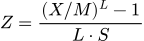
Where:
- X — the child's measured weight in kilograms.
- M — the WHO median weight at that age and sex.
- L — the Box-Cox skewness parameter.
- S — the coefficient of variation (a scaled standard deviation).
Third, the Z-score is mapped to a percentile through the standard normal cumulative distribution function, Φ(Z). A Z of 0 maps to the 50th percentile, -1.88 to the 3rd, and +1.88 to the 97th. The WHO weight-for-age table spans ages 60 to 120 months in 1-month steps, so fractional ages are handled by linearly interpolating L, M, and S between the two bracketing rows.
Related Calculators
- Height-for-Age (WHO, 5-19 yr) — paired stature assessment for the same age range
- BMI-for-Age (WHO, 5-19 yr) — recommended for children over 10
- Weight-for-Age (CDC, 2-20 yr) — US reference extending through age 20
- Weight-for-Age (WHO, 0-5 yr) — for younger children
- Z-Score Calculator — Convert z-scores to percentiles and probabilities
Related Sites
- Medical Equations — Hemodynamic, pulmonary, and dosing calculators
- RN Calc — Nursing dosage and calculation tools
- Dollars Per Hour — Weekly paycheck calculator with overtime
- BOGO Discount — Buy-one-get-one discount calculator
- CameraDOF — Depth of field calculator for photographers
- LoanChop — Loan prepayment calculator