CDC Weight-for-Age Growth Chart (2-20 Years)
Plot a child or teen's weight against CDC reference data for ages 2-20 years. The chart displays the standard percentile curves (3rd, 15th, 50th, 85th, 97th) with your child's measurement pinned on top so you can see exactly where they fall — and how their growth compares to peers through puberty.
LMS Method: Z = ((X/M)^L - 1) / (L × S), percentile = Φ(Z) × 100
How It Works
The CDC 2-20 weight-for-age chart converts a single weight measurement into a percentile that answers "out of 100 US children of the same age and sex, how many weigh less than mine?" Under the hood the calculator looks up three parameters from the CDC 2000 LMS table — L (skewness), M (median weight), and S (coefficient of variation) — for the child's exact age in months, computes a Z-score with the Box-Cox equation Z = ((X/M)^L − 1) / (L × S), and maps the Z-score through the standard normal CDF to a percentile. The CDC table covers months 24 through 240 (2 to 20 years) in 1-month steps, so fractional ages are handled by linear interpolation between adjacent rows. Weight-for-age is most informative from ages 2 to 10; once puberty starts, BMI-for-age becomes the preferred screening tool because it accounts for the rapid height changes of adolescence.
Example Problem
A 7-year-old boy weighs 23.0 kg at his annual check-up. Where does he fall on the CDC 2-20 weight-for-age chart?
- Record the child's date of birth and the date of today's measurement — about 7 years (84 months) apart — and note the sex as Boy.
- Convert the weight to kilograms if it was recorded in pounds. Here it is already 23.0 kg, so no conversion is needed.
- Look up the CDC 2-20 LMS triple for boys at 84 months: L ≈ -1.22, M ≈ 23.06 kg, S ≈ 0.147.
- Compute the Z-score with Z = ((X/M)^L − 1) / (L × S). Substituting gives Z ≈ ((23.0/23.06)^-1.22 − 1) / (-1.22 × 0.147) ≈ −0.02.
- Map the Z-score through the standard normal CDF: Φ(−0.02) ≈ 0.49, so the percentile is about the 49th.
- Report the result: a 7-year-old boy at 23.0 kg sits effectively at the CDC median — about half of US boys his age weigh less, half weigh more.
Key Concepts
A percentile is a rank, not a grade. The 75th percentile means 75% of US children of the same age and sex weigh less — it does not mean the child is "75% healthy" or "25% overweight." Most pediatricians treat the 3rd-to-97th percentile band as the normal range for weight-for-age, and focus on trajectory over time rather than any single reading. Weight-for-age in the 2-20 year range should always be interpreted alongside height and BMI-for-age — a child who looks heavy on this chart may be appropriately proportioned for an above-average height, and a child on the 85th weight percentile with the 95th height percentile is very different from a child on the 85th weight percentile with the 15th height percentile. Puberty changes the picture dramatically: the 9-to-14 range brings rapid weight gain from both lean mass and fat, and the timing of the growth spurt differs by 1-2 years between girls and boys. The CDC 2-20 charts are built from US national health survey data collected between 1963 and 1994 and are the AAP-recommended reference for children ages 2 and older in the United States.
Applications
- Well-child visits from age 2 through adolescence — pediatricians plot each weight measurement to confirm steady growth along the child's usual channel.
- Screening for underweight (persistent tracking below the 3rd percentile) in school-age children — often a prompt to evaluate nutrition, malabsorption, or chronic illness.
- Overweight and obesity surveillance — weight-for-age is an entry point, but BMI-for-age is the AAP-recommended primary screening tool from age 2 onward.
- Monitoring weight recovery after significant illness, hospitalization, or surgery — the chart shows whether the child has returned to their previous growth channel.
- Tracking weight in children with chronic conditions (cystic fibrosis, Crohn's, type 1 diabetes) or on medications that affect appetite or metabolism (stimulants, steroids).
- Pre-participation sports physicals and adolescent wellness visits through age 20.
Common Mistakes
- Using weight-for-age alone to diagnose obesity — BMI-for-age is the AAP-recommended screening tool for children over 2 because it accounts for height.
- Using the CDC 0-36 month chart for children aged 2-3 — the CDC 2-20 chart is the AAP recommendation from age 2 onward.
- Ignoring pubertal development when interpreting weight changes — a 12-year-old girl mid-growth-spurt will gain weight faster than the curves suggest, and that's normal.
- Confusing percentile with percentage — the 85th percentile does not mean the child is 85% of a healthy weight; it means 85% of peers weigh less.
- Not converting units — always verify whether the weight was recorded in kilograms or pounds before entering it.
- Reading a one-off measurement as a diagnosis — trajectory across 2-3 visits is almost always more meaningful than a single point, especially during puberty.
Frequently Asked Questions
What is the CDC weight-for-age chart for 2-20 years?
It is the CDC growth chart that tracks weight against US national health survey data from age 2 through 20. The American Academy of Pediatrics recommends switching from WHO to CDC at age 2 because CDC 2–20 captures US adolescent growth patterns the WHO standard does not extend to. Values between the 3rd and 97th percentile are typical. From mid-adolescence onward, BMI-for-age becomes the more interpretable weight-status screen.
What is the 50th percentile weight for a 10-year-old?
On the CDC 2-20 chart, the 50th-percentile weight for a 10-year-old boy is approximately 31.9 kg (70.4 lb) and for a 10-year-old girl is about 32.9 kg (72.6 lb). The 50th percentile is the median — half of US children weigh more, half weigh less. It is not a target every child should hit; staying in your own growth channel matters more than landing on the 50th.
Is weight-for-age the right chart to screen for obesity?
No. The AAP recommends BMI-for-age as the primary obesity screening tool from age 2 onward because BMI combines weight and height into a single index. Weight-for-age alone can flag extremes, but a tall child at the 90th weight percentile may have a perfectly healthy BMI, while a short child at the 70th weight percentile may be overweight. Use this chart alongside a BMI-for-age reading, not in isolation.
How does puberty affect weight percentiles?
Puberty brings rapid weight gain from both lean mass and fat. Girls typically start their growth spurt around age 9-11 and peak around 11-12; boys start around 11-13 and peak around 13-14. During the spurt, a child may appear to cross upward through percentile bands even without overeating — this is normal. Your pediatrician compares current weight to your child's own prior trajectory, not a fixed target percentile, when judging pubertal growth.
What weight percentile is considered healthy?
Most US pediatricians treat the 3rd-to-97th percentile band as the normal weight-for-age range. What matters more than hitting a specific percentile is consistent tracking — a child steady on the 15th or the 85th is growing well. Crossing two or more major percentile bands in either direction over a few visits is the more common reason for clinical follow-up. For obesity screening specifically, the AAP uses BMI-for-age ≥ 95th as the threshold, not weight-for-age.
My teen's weight percentile jumped during a growth spurt — should I worry?
Usually not. Adolescent growth spurts reliably push kids upward through weight-for-age percentiles for 12-18 months. If height percentile is moving up at the same time, the chart is simply catching a proportional growth surge. The situation to flag with a pediatrician is a weight-percentile jump without a matching height jump, or a downward shift — especially during a period when peers are growing rapidly.
What if my child is below the 3rd percentile for weight?
A consistent reading below the 3rd percentile (Z-score under about -1.88) is outside the CDC normal range and warrants a discussion with your pediatrician. The clinical question is always "is this a stable channel for this child, or a new drop from a higher channel?" — a child who has always tracked at the 2nd and is otherwise thriving is very different from a child who was at the 40th last year and is at the 2nd today. Underlying conditions that cause weight drops include malabsorption, thyroid disease, eating disorders, and chronic infection.
Does ethnicity affect CDC weight-for-age percentiles?
The CDC 2000 charts were built from broadly representative US NHANES survey samples and are designed to describe the full US child population. Growth patterns do vary modestly across ethnic groups, but the CDC charts are the standard US reference and are not ethnicity-specific. For populations with substantially different body types, country-specific charts (Chinese National, Indian IAP, or the WHO 5-19 reference) may fit better — most of those calculators are available on this site.
Reference:
CDC Growth Charts: United States. National Center for Health Statistics, 2000. https://www.cdc.gov/growthcharts/
Worked Examples
Preschool check-up
Where does a 3-year-old girl weighing 14 kg fall on the CDC chart?
A pediatrician is reviewing a healthy 3-year-old girl at her well-child visit. Her recorded weight is 14.0 kg (30.9 lb) and the provider wants a quick percentile read.
- Knowns: age 36 mo (3.0 yr), sex girl, weight 14.0 kg
- CDC 2-20 LMS at 36 mo (girls): L ≈ -1.02, M ≈ 13.87 kg, S ≈ 0.119
- Z = ((14.0 / 13.87)^-1.02 - 1) / (-1.02 × 0.119) ≈ 0.08
- Φ(0.08) ≈ 0.53
~53rd percentile — right at the CDC median and squarely in the healthy range.
A single reading at the 53rd percentile is unremarkable; pediatricians watch whether she continues tracking that channel at future visits.
Middle-school screening
A 10-year-old boy weighs 70 lb at his school physical — what percentile?
A parent brings their 10-year-old son in for his school physical. The scale reads 70.0 lb. The CDC 2-20 chart converts pounds to kilograms internally (70.0 lb × 0.4536 = 31.75 kg) and computes the percentile.
- Knowns: age 120 mo (10.0 yr), sex boy, weight 70.0 lb → 31.75 kg
- CDC 2-20 LMS at 120 mo (boys): L ≈ -1.21, M ≈ 31.94 kg, S ≈ 0.178
- Z ≈ ((31.75 / 31.94)^-1.21 - 1) / (-1.21 × 0.178) ≈ -0.03
- Φ(-0.03) ≈ 0.487
~49th percentile — right at the median for boys his age.
Weight-for-age in the 10-12 range should be interpreted alongside height; BMI-for-age is the recommended screening tool for overweight and obesity from age 2 onward.
Adolescent obesity screening
A 16-year-old girl weighs 80 kg — where is she on the CDC chart?
A 16-year-old girl is being screened for adolescent obesity. Her weight is 80.0 kg (176.4 lb). Her pediatrician uses the CDC 2-20 chart alongside BMI-for-age to interpret the result.
- Knowns: age 192 mo (16.0 yr), sex girl, weight 80.0 kg
- CDC 2-20 LMS at 192 mo (girls): L ≈ -1.64, M ≈ 53.88 kg, S ≈ 0.168
- Z = ((80.0 / 53.88)^-1.64 - 1) / (-1.64 × 0.168) ≈ 1.73
- Φ(1.73) ≈ 0.958
~96th percentile — above the 95th band and a signal to pair with a BMI-for-age reading for obesity screening.
Weight-for-age alone does not diagnose obesity. The AAP recommends BMI-for-age ≥ 95th percentile as the threshold for obesity screening in children 2-20.
How the percentile is calculated
The calculator turns one weight measurement into a percentile in three stages. First, it looks up three CDC parameters — L, M, and S — from the CDC 2000 reference table for the child's exact age (in months) and sex. L is the Box-Cox power transform (it accounts for the skew in childhood weight distributions, which becomes pronounced during adolescence), M is the median weight at that age, and S is the coefficient of variation. Second, it plugs those parameters into the Z-score formula:
Z score equals the quantity X divided by M, raised to the power L, minus 1, divided by L times S.
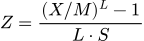
Where:
- X — the child's measured weight in kilograms.
- M — the CDC median weight at that age and sex.
- L — the Box-Cox skewness parameter.
- S — the coefficient of variation (a scaled standard deviation).
Third, the Z-score is mapped to a percentile through the standard normal cumulative distribution function, Φ(Z). A Z of 0 maps to the 50th percentile, -1.88 to the 3rd, and +1.88 to the 97th. The CDC 2-20 table spans ages 24 to 240 months in 1-month steps, so fractional ages are handled by linearly interpolating L, M, and S between the two bracketing rows.
Related Calculators
- Stature-for-Age (CDC, 2-20 yr)
- Weight-for-Stature (CDC, 2-20 yr)
- Extended BMI-for-Age (CDC, 2-20 yr) — recommended obesity screening tool
- CDC Weight-for-Age (0-36 mo) — for younger children
- Z-Score Calculator — Convert z-scores to percentiles and probabilities
Related Sites
- Medical Equations — Hemodynamic, pulmonary, and dosing calculators
- RN Calc — Nursing dosage and calculation tools
- Dollars Per Hour — Weekly paycheck calculator with overtime
- OptionsMath — Options trading profit and loss calculators
- CameraDOF — Depth of field calculator for photographers
- Percent Error Calculator — Calculate percent error between experimental and theoretical values