CDC Length-for-Age Growth Chart (0-36 Months)
Plot a child's recumbent length against CDC reference data for ages 0-36 months. The chart displays the standard percentile curves (3rd, 15th, 50th, 85th, 97th) and pins your child's measurement on top so you can see exactly where they fall.
LMS Method: Z = ((X/M)^L - 1) / (L × S), percentile = Φ(Z) × 100
How It Works
The CDC length-for-age chart converts a single recumbent length measurement into a percentile that answers "out of 100 US children of the same age and sex, how many are shorter than mine?" Under the hood the calculator looks up three parameters from the CDC LMS table — L (skewness), M (median length), and S (coefficient of variation) — for the child's exact age, computes a Z-score with the Box-Cox equation Z = ((X/M)^L − 1) / (L × S), and maps that Z-score through the standard normal CDF to a percentile between 0 and 100. The CDC length-for-age table uses half-month rows from 0 to 35.5 months, so fractional ages (e.g., 6.8 months) are handled by linearly interpolating L, M, and S between bracketing rows — no rounding.
Example Problem
A 6-month-old boy measures 68 cm in recumbent length at his well-child visit. Where does he fall on the CDC length-for-age chart?
- Record the child's date of birth and the date of today's measurement — 6 months apart — and note the sex as Boy.
- Confirm the measurement is recumbent length (child lying flat), not standing height. For children under 2, always use recumbent length.
- Convert the length to centimeters if it was recorded in inches. Here it is already 68 cm, so no conversion is needed.
- Interpolate the CDC LMS triple for boys at 6.0 months: L ≈ −1.467, M ≈ 66.99 cm, S ≈ 0.0390.
- Compute the Z-score with Z = ((X/M)^L − 1) / (L × S). Substituting gives Z ≈ ((68/66.99)^−1.467 − 1) / (−1.467 × 0.0390) ≈ +0.38.
- Map the Z-score through the standard normal CDF: Φ(+0.38) ≈ 0.65, so the percentile is about the 65th — modestly above the CDC median.
Key Concepts
A percentile is a rank, not a percentage or a grade. The 75th percentile means 75% of children of the same age and sex are shorter than this child — it does not mean the child is "75% healthy." Most pediatricians treat the 3rd to 97th percentile band as the normal range, with anything outside that band a prompt for follow-up. A single measurement is a snapshot; trajectory over multiple visits is almost always more clinically meaningful than a one-off number. The CDC 0-36 month charts are derived from US national health surveys and reflect how American children actually grew between 1963 and 1994 — the WHO 0-24 month standards describe how breastfed children grow under optimal conditions. The AAP recommends WHO for under-24-month tracking and CDC from age 2 onward, but CDC 0-36 length-for-age remains widely used in US pediatric practice. Standing height measured on a child 2+ is typically about 0.7 cm shorter than recumbent length because of gravity and spinal compression.
Applications
- Well-child visits: pediatricians plot each length measurement to confirm a steady growth trajectory.
- Failure-to-thrive screening: length that drops across two or more major percentile bands triggers further evaluation.
- Short-stature surveillance: measurements below the 3rd percentile prompt growth-hormone workups and endocrinology referrals.
- Post-illness recovery tracking: pediatricians watch for return to the previous growth channel after hospitalization or significant illness.
- NICU graduate monitoring: infants born preterm are tracked by corrected age until they catch up.
- Nutritional counseling: persistently low length-for-age is a marker of chronic undernutrition (stunting) and guides feeding plans.
Common Mistakes
- Measuring standing height instead of recumbent length for children under 2 — standing height is about 0.7 cm shorter than recumbent length.
- Confusing percentile with percentage — the 40th percentile does not mean the child is at 40% of a healthy length, it means 40% of same-age same-sex peers are shorter.
- Using the wrong chart for the child's age — this chart covers 0-36 months; switch to the CDC 2-20 stature-for-age chart for older children.
- Comparing a single reading to expected values instead of examining the growth trend across multiple visits.
- Not converting units — always verify whether the length was recorded in centimeters or inches before entering it.
- Ignoring prematurity — infants born before 37 weeks should be plotted by corrected age (chronological age minus weeks preterm) for the first 2-3 years.
Frequently Asked Questions
What is the CDC length-for-age chart for 0-36 months?
It is the CDC growth chart that tracks recumbent length from birth to 36 months against US national health survey data (1963–1994). Unlike the WHO standard (which describes ideal growth), the CDC chart describes actual historical US growth. The American Academy of Pediatrics recommends WHO from birth to age 2 and CDC from age 2 onward, but CDC 0–36 month length-for-age remains a reference families and clinicians sometimes request.
How do I use the CDC length-for-age growth chart?
Enter the child's date of birth, the date of measurement, sex, and current recumbent length in centimeters or inches. The calculator converts length to centimeters internally, computes a Z-score using the CDC LMS parameters for that exact age, and maps the result to a percentile. The chart plots the 3rd, 15th, 50th, 85th, and 97th percentile curves with the child's point overlaid so you can see the growth channel at a glance.
Is my baby too short?
Pediatricians typically treat the 3rd to 97th percentile range as normal for length. What matters most is trajectory — a child tracking steadily along any percentile line is growing well, even if that line is the 10th or the 90th. A length below the 3rd percentile (Z-score under about −1.88) or a drop of two or more percentile bands between visits is the more common reason for clinical follow-up and a possible endocrinology referral.
Should I measure recumbent length or standing height?
For children under 2 years use recumbent length (measured lying down on a length board with the head against a fixed stop and legs gently straightened). For children 2 years and older, standing height is typical. Standing height is about 0.7 cm shorter than recumbent length because of gravity and spinal compression, so the two are not interchangeable within this 0-36 month chart.
What if my baby was born premature?
For infants born before 37 weeks, plot by corrected age — chronological age minus weeks of prematurity — for the first 2-3 years. A baby born 8 weeks early and measured at 6 months chronological age should be plotted at 4 months corrected. After about age 2-3 the correction is usually dropped. Some pediatricians also use Fenton or Olsen preterm-specific length charts for the earliest weeks.
Should I use CDC or WHO length charts?
The American Academy of Pediatrics recommends WHO growth standards for children from birth to 24 months and CDC growth charts from age 2 onward. WHO describes how breastfed children grow under optimal conditions; CDC describes how US children actually grew in the reference years. Many US pediatricians still use CDC from birth. Either chart is defensible — just stay consistent across visits.
How often should length be measured in infancy?
Typical US well-child schedules include length checks at birth, 1 month, 2 months, 4 months, 6 months, 9 months, 12 months, 15 months, 18 months, 24 months, 30 months, and 36 months. Extra visits are added when a baby is not growing in length as expected or is recovering from illness.
Does ethnicity affect CDC length percentiles?
The CDC 2000 charts were built from broadly representative US national survey samples and are intended to describe the full US child population. Pediatric growth patterns do show small differences across ethnic groups, but the CDC charts are the standard US reference and are not ethnicity-specific. For populations with substantially different body types, country-specific charts (such as the Chinese National or Indian IAP length-for-age charts) may fit better.
Reference:
CDC Growth Charts: United States. National Center for Health Statistics, 2000. https://www.cdc.gov/growthcharts/
Worked Examples
Newborn screening
Where does a newborn girl measuring 50 cm fall on the CDC length chart?
A pediatrician is reviewing a healthy-term girl at her newborn discharge. Her recorded recumbent length is 50.0 cm (19.7 in) and the provider wants a quick percentile read before the family leaves.
- Knowns: age 0.0 mo, sex girl, length 50.0 cm
- CDC LMS lookup at 0 mo (girls): L ≈ −1.30, M ≈ 49.29 cm, S ≈ 0.0501
- Z = ((50.0 / 49.29)^−1.30 − 1) / (−1.30 × 0.0501) ≈ 0.28
- Φ(0.28) ≈ 0.611
~61st percentile — well inside the healthy range and just above the median for term girls.
A single measurement at discharge is a snapshot; the pediatrician watches whether she continues tracking a steady percentile channel at the 1-month and 2-month visits.
Well-child visit
A 12-month-old boy measures 30 in at his 1-year visit — what percentile?
A parent arrives at the 12-month well-child visit with a boy whose recumbent length on the exam board is 30.0 in. The CDC length-for-age chart converts this to centimeters internally (30.0 in × 2.54 = 76.2 cm) and computes the percentile.
- Knowns: age 12.0 mo, sex boy, length 30.0 in → 76.2 cm
- CDC LMS lookup at 12 mo (boys): L ≈ −0.828, M ≈ 75.52 cm, S ≈ 0.0387 (linear interpolation between the 11.5 mo and 12.5 mo rows)
- Z ≈ ((76.2 / 75.52)^−0.828 − 1) / (−0.828 × 0.0387) ≈ +0.23
- Φ(+0.23) ≈ 0.591
~59th percentile — slightly above the CDC median for 12-month-old boys.
Measuring recumbent length on a squirming 1-year-old is hard to repeat exactly — a 0.5 cm error can shift the percentile by 5-10 points, so trust the trajectory across visits more than any single reading.
Short-stature follow-up
A 24-month-old girl measures 80 cm — is she tracking below the 3rd percentile?
At 12 months this girl measured at the 25th percentile. At 24 months her length is 80.0 cm and her provider is assessing whether she has crossed into the short-stature zone. Crossing two major percentile bands downward is the warning signal for endocrinology referral.
- Knowns: age 24.0 mo, sex girl, length 80.0 cm
- CDC LMS lookup at 24 mo (girls): L ≈ 1.05, M ≈ 85.77 cm, S ≈ 0.0408
- Z = ((80.0 / 85.77)^1.05 − 1) / (1.05 × 0.0408) ≈ −1.66
- Φ(−1.66) ≈ 0.049
~5th percentile — technically still in range but at the lower edge, and the downward crossing from the 25th is the clinically relevant finding.
Short-stature workups depend on the trajectory, mid-parental height, and systemic signs — a single point below the 5th is a flag, not a diagnosis.
How the percentile is calculated
The calculator turns one recumbent length measurement into a percentile in three stages. First, it looks up three CDC parameters — L, M, and S — from the CDC 2000 reference table for the child's exact age and sex. L is the Box-Cox power transform (it accounts for the skew in childhood length distributions), M is the median length at that age, and S is the coefficient of variation. Second, it plugs those parameters into the Z-score formula:
Z score equals the quantity X divided by M, raised to the power L, minus 1, divided by L times S.
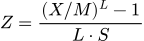
Where:
- X — the child's measured recumbent length in centimeters.
- M — the CDC median length at that age and sex.
- L — the Box-Cox skewness parameter (handles non-symmetric length distributions).
- S — the coefficient of variation (a scaled standard deviation).
Third, the Z-score is mapped to a percentile through the standard normal cumulative distribution function, Φ(Z). A Z of 0 maps to the 50th percentile, −1.88 to the 3rd, and +1.88 to the 97th. The CDC length-for-age table spans ages 0 to 35.5 months in half-month steps, so fractional ages are handled by linearly interpolating L, M, and S between the two bracketing rows.
Related Calculators
- Weight-for-Age (CDC, 0-36 mo)
- Head Circ-for-Age (CDC, 0-36 mo)
- Weight-for-Length (CDC, 0-36 mo)
- CDC Stature-for-Age (2-20 years) — for older children
- BSA Calculator — Body surface area for clinical dosing
Related Sites
- Dollars Per Hour — Weekly paycheck calculator with overtime
- Percent Off Calculator — Discount and sale price calculator
- AJ Designer — 200+ engineering and science calculators
- Compare 2 Loans — Side-by-side loan comparison calculator
- CameraDOF — Depth of field calculator for photographers
- Temperature Tool — Temperature unit converter