WHO Head Circumference-for-Age Growth Chart (0-24 Months)
Plot an infant's head circumference against WHO Child Growth Standards from birth through 24 months. The chart shows standard percentile curves (3rd, 15th, 50th, 85th, 97th) with your child's measurement pinned on top so you can see which growth channel they are tracking at a glance. This is the canonical chart pediatricians use at well-baby visits for the first two years.
LMS Method: Z = ((X/M)^L − 1) / (L × S), percentile = Φ(Z) × 100
How It Works
The WHO head-circumference-for-age chart for infants 0-24 months converts one tape-measure reading into a percentile that answers "out of 100 healthy infants of the same age and sex, how many have a smaller head?" Under the hood the calculator looks up three parameters from the WHO Child Growth Standards daily LMS table — L (skewness), M (median head circumference), and S (coefficient of variation) — for the child's exact age in days, computes a Z-score with the Box-Cox equation Z = ((X/M)^L − 1) / (L × S), and maps that Z-score through the standard normal cumulative distribution function to a percentile between 0 and 100. Head circumference is the primary growth measurement for brain volume in infancy and the main screening signal for microcephaly (abnormally small head) and macrocephaly (abnormally large head) during the first two years.
Example Problem
A 6-month-old boy has a head circumference of 43.0 cm at his half-birthday well-baby visit. Where does he fall on the WHO 0-24 month head-circumference-for-age chart?
- Record the child's date of birth and the date of today's measurement — about 6 months (~183 days) apart — and note the sex as Boy.
- Convert the head circumference to centimeters if it was recorded in inches. Here it is already 43.0 cm (16.9 in), so no conversion is needed.
- Look up the WHO daily LMS triple for boys at 183 days: L = 1, M ≈ 43.34 cm, S ≈ 0.0282.
- Compute the Z-score with Z = ((X/M)^L − 1) / (L × S). Substituting gives Z = ((43.0/43.34)^1 − 1) / (1 × 0.0282) ≈ −0.28.
- Map the Z-score through the standard normal CDF: Φ(−0.28) ≈ 0.39, so the percentile is about the 39th.
- Report the result: a 6-month-old boy at 43.0 cm sits below the WHO median. Pediatricians watch whether he continues to track that channel — not whether he hits the 50th percentile every visit.
Key Concepts
A head-circumference percentile is a rank, not a verdict. The 80th percentile means 80% of same-age same-sex infants have a smaller head — it does not mean a larger head is healthier. Pediatricians treat the 3rd to 97th percentile band as normal, with anything outside that band (Z < −2 or Z > +2) a prompt to investigate. A single measurement is a snapshot; trajectory across multiple visits matters more than any one number. Brain growth is fastest in the first year — head circumference typically grows about 10 cm in the first 12 months, another 2-3 cm in year two, and then slows dramatically. The WHO 0-24 month chart uses daily LMS values (not monthly), so the percentile changes day by day as the baby ages, matching how pediatricians compute it at each well-baby visit. WHO charts are prescriptive — they describe how infants should grow under optimal conditions (breastfed, non-smoking household, adequate nutrition). The American Academy of Pediatrics recommends WHO standards over CDC standards from birth through 24 months.
Applications
- Routine well-baby visits — head circumference is measured at every visit from birth through 24 months (2, 4, 6, 9, 12, 15, 18, 24 months in the standard schedule).
- Microcephaly screening — heads tracking below the 3rd percentile (Z < −2) can indicate genetic syndromes, in-utero infections (CMV, Zika, rubella), prenatal alcohol or drug exposure, or brain malformations; below the 0.1st percentile (Z < −3) is severe microcephaly.
- Macrocephaly screening — heads tracking above the 97th percentile (Z > +2) may warrant imaging to rule out hydrocephalus, subdural collections, megalencephaly, or be explained by benign familial macrocephaly.
- Premature infant follow-up — preterm babies are plotted on corrected age on this chart after discharge from the NICU, then transitioned off correction by age 2-3.
- Hydrocephalus surveillance — heads that rapidly cross percentile bands upward are a red flag even inside the normal range; trajectory matters more than the absolute percentile.
- Craniosynostosis detection — premature fusion of skull sutures can slow or divert head circumference growth; plotting detects the slowdown before head shape is obvious.
- Post-intraventricular-hemorrhage monitoring — infants with grade III-IV IVH are tracked weekly for shunt-dependent hydrocephalus by watching head-circumference trajectory.
- Global pediatric research — WHO standards are the worldwide reference for cross-population infant growth comparisons.
Common Mistakes
- Measuring at the wrong landmark — the tape must wrap around the largest circumference, just above the eyebrows and around the most prominent part of the back of the head (the occipital protuberance). A low reading taken across the forehead looks falsely like microcephaly.
- Using a stretchy tape — cloth or paper tapes stretch and under-read by 1-2 cm. Use a non-stretch pediatric tape (the disposable paper-plastic type clinics use) and take the largest of three consecutive readings.
- Confusing percentile with abnormality — an infant consistently at the 3rd or 97th percentile is usually tracking a familial pattern, not pathology. Deviation from the established channel is the clinical signal, not the percentile itself.
- Not using corrected age for premature infants — a baby born 8 weeks early and measured at 6 months chronological age should be plotted at 4 months corrected for the first 2-3 years. Enter the corrected birth date, not the actual one.
- Ignoring trajectory — crossing two major percentile bands upward in a few months is a stronger macrocephaly signal than a static 97th-percentile reading, and the same logic applies on the low end.
- Entering inches when the unit is set to centimeters (or vice versa) — a 43 cm head circumference (healthy 6-month-old) entered as 43 inches lands far outside any human range and will throw an invalid result.
- Taking the measurement when the infant is crying, has a tight hat line, or has matted hair — these can add 0.5-1 cm of noise. Measure when the baby is calm and the hair is flat.
- Comparing against the wrong chart — this calculator uses WHO 0-24 standards (recommended by the AAP for infants under 2). CDC head-circumference tables are more common in US clinics after age 2.
Frequently Asked Questions
What is the WHO head-circumference-for-age chart used for?
Head circumference monitoring from birth to 24 months screens for healthy brain growth using the WHO Child Growth Standards. The percentile compares the baby's measurement to a global reference of healthy breastfed infants. Values between the 3rd and 97th percentile are typical; readings below the 3rd (microcephaly screen) or above the 97th (macrocephaly screen) warrant pediatric follow-up alongside other developmental signs.
How do I measure my baby's head circumference at home?
Use a flexible, non-stretchable tape measure. Wrap it around the largest part of the head — just above the eyebrows and ears, around the most prominent point at the back of the head (the occipital protuberance). Pull it snug without compressing hair or ears. Take three measurements and use the largest. Clinic-grade readings use a disposable paper-plastic tape that is designed not to stretch; cloth sewing tapes can under-read by 1-2 cm. Measure when the baby is calm — crying, a tight knit cap, or pushed-up ears can add 0.5-1 cm of noise.
When should I call the pediatrician about my baby's head size?
Call the pediatrician if the head circumference crosses two or more major percentile bands (upward or downward) between well-baby visits, if the head looks visibly asymmetric or disproportionate to the face, if the soft spot (fontanelle) feels unusually tight, bulging, or sunken, if head growth has stopped while weight and length keep climbing, or if there are developmental concerns alongside an unusual reading. A single measurement outside the 3rd-97th band without other concerns is usually discussed at the next routine visit, not urgently. This calculator is a screening tool, not a diagnosis.
What is microcephaly and when is it diagnosed?
Microcephaly is a head circumference more than two standard deviations below the mean for age and sex (roughly the 3rd percentile or below, Z ≤ −2). Severe microcephaly is more than three standard deviations below (Z ≤ −3, roughly the 0.1st percentile). Causes include genetic syndromes, in-utero infections (CMV, Zika, rubella, toxoplasmosis), prenatal alcohol or drug exposure, severe malnutrition, and brain malformations. Diagnosis is clinical — the percentile is a screening flag, not a diagnosis. A pediatrician reviews the growth trend, developmental milestones, physical exam, and often neuroimaging or genetic testing before confirming microcephaly.
What is macrocephaly and how is it evaluated?
Macrocephaly is a head circumference more than two standard deviations above the mean (roughly the 97th percentile or higher, Z ≥ +2). The most common cause is benign familial macrocephaly — a large head that runs in the family with normal development and no other findings, so measure both parents' heads before worrying. Less common causes include hydrocephalus (cerebrospinal fluid buildup), subdural collections, megalencephaly, and rare metabolic or skeletal conditions. A rapidly rising head circumference crossing percentiles upward is a stronger signal for imaging than a stable reading at the 98th percentile with large-headed parents.
Should I use WHO or CDC head-circumference charts for my baby?
The American Academy of Pediatrics and the CDC both recommend WHO growth standards — which is what this calculator uses — for all children from birth to 24 months. WHO standards describe how healthy, breastfed infants grow under optimal conditions across six countries (prescriptive); CDC charts describe how US children actually grew in reference years (descriptive). For infants under 2, WHO is the global standard of care. CDC head-circumference charts are sometimes used in US clinical practice from age 2 to 36 months — see our CDC head-circumference calculator for that.
Does head circumference predict intelligence or developmental outcomes?
No — there is no reliable correlation between head circumference percentile and future intelligence or developmental ability within the normal range. A baby at the 20th percentile and a baby at the 80th percentile are equally likely to meet milestones on time. Head circumference matters clinically as a screening tool for conditions that can affect brain development (microcephaly, hydrocephalus, craniosynostosis), not as a proxy for cognitive potential. Pediatricians correlate head circumference with developmental milestones at each visit, and milestones — not head size — are the real signal.
What if my baby was born premature?
For infants born before 37 weeks, plot head circumference by corrected age — chronological age minus weeks of prematurity — for the first 2-3 years. A baby born 8 weeks early and measured at 6 months chronological age should be plotted at 4 months corrected. Some NICUs use the Fenton or Olsen preterm-specific head-circumference charts for the first weeks and then transition to WHO once the baby reaches term-equivalent age. This WHO 0-24 calculator expects chronological age; apply the correction by entering the corrected birth date, not the actual one. See our Olsen preterm head-circumference calculator for charts designed for the NICU period itself.
Reference:
WHO Child Growth Standards: Head circumference-for-age (0-24 months), daily LMS values from the WHO Anthro R package. World Health Organization, 2006. https://www.who.int/tools/child-growth-standards
Worked Examples
6-month well-baby visit
Where does a 6-month-old boy with a 43.0 cm head circumference fall on the WHO chart?
A pediatrician sees a healthy 6-month-old boy at his half-birthday well-baby visit. His measured head circumference is 43.0 cm (16.9 in) and the provider wants a quick percentile read before plotting the growth chart.
- Knowns: age 6.0 mo, sex boy, head circumference 43.0 cm
- WHO daily LMS at 183 days (boys): L = 1, M ≈ 43.34 cm, S ≈ 0.0282
- Z = ((43.0 / 43.34)^1 − 1) / (1 × 0.0282) ≈ −0.28
- Φ(−0.28) ≈ 0.39
~39th percentile — below the WHO median for a 6-month-old boy.
A single reading near the 39th percentile is unremarkable. What matters across well-baby visits is whether he continues to track that growth channel, not whether he hits any specific percentile.
Microcephaly screening (inches)
A 12-month-old girl measures 15.2 inches around the head — does that cross the microcephaly threshold?
A parent brings their 12-month-old girl in for a 1-year check because she seems small. The nurse measures 15.2 in (38.61 cm) around the head. The calculator converts to centimeters internally and flags microcephaly risk when the Z-score drops below −2 (roughly the 3rd percentile).
- Knowns: age 12.0 mo, sex girl, head circumference 15.2 in → 38.61 cm
- WHO daily LMS at 365 days (girls): L = 1, M ≈ 44.89 cm, S ≈ 0.0303
- Z = ((38.61 / 44.89)^1 − 1) / (1 × 0.0303) ≈ −4.62
- Φ(−4.62) < 0.0001
<0.01st percentile — well below the 3rd-percentile microcephaly threshold.
A Z-score near −4 is a strong screening signal, not a diagnosis. Pediatricians look at the full growth trajectory across multiple visits, birth history, developmental milestones, and physical exam before pursuing imaging or genetic testing. This calculator returns the snapshot; the pediatrician does the workup.
Macrocephaly follow-up
An 18-month-old boy has a 51.0 cm head circumference — is that in the macrocephaly range?
At earlier visits this boy tracked around the 90th percentile. At his 18-month visit his head circumference is 51.0 cm. Both parents have larger-than-average heads, a classic benign familial macrocephaly pattern. The pediatrician wants to confirm whether he has crossed above the 97th-percentile (Z > +2) macrocephaly cutoff.
- Knowns: age 18.0 mo, sex boy, head circumference 51.0 cm
- WHO daily LMS at 548 days (boys): L = 1, M ≈ 47.37 cm, S ≈ 0.0280
- Z = ((51.0 / 47.37)^1 − 1) / (1 × 0.0280) ≈ +2.74
- Φ(+2.74) ≈ 0.9969
~99th percentile — well above the 97th-percentile macrocephaly cutoff.
Z > +2 is above the macrocephaly threshold, and a value near +2.7 puts him meaningfully above the 97th-percentile band. Consistently tracking a familial channel is a much weaker concern than suddenly jumping bands, but at this magnitude the pediatrician still weighs family history, development, fontanelle findings, and trajectory carefully before imaging.
How the percentile is calculated
The calculator turns one head-circumference reading into a percentile in three stages. First, it looks up three WHO parameters — L, M, and S — from the WHO Child Growth Standards table for the child's exact age in days and sex. L is the Box-Cox power transform (it accounts for any skew in infant head-size distributions), M is the median head circumference at that age, and S is the coefficient of variation. WHO publishes daily LMS values from day 0 through day 1856 (60 months), and this calculator uses the 0-24 month window, so no interpolation is needed. Second, it plugs those parameters into the Z-score formula:
Z score equals the quantity X divided by M, raised to the power L, minus 1, divided by L times S.
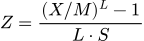
Where:
- X — the child's measured head circumference in centimeters.
- M — the WHO median head circumference at that exact age and sex.
- L — the Box-Cox skewness parameter. For WHO head circumference it is fixed at 1 across all ages because the distribution is close to normal.
- S — the coefficient of variation (a scaled standard deviation).
Third, the Z-score is mapped to a percentile through the standard normal cumulative distribution function, Φ(Z). A Z of 0 maps to the 50th percentile, −1.88 to the 3rd, and +1.88 to the 97th. Because the WHO tables are daily, the calculator uses exact-day lookup — no interpolation rounding — which makes percentile values stable as the baby ages day-to-day.
Related Calculators
- Weight-for-Age (WHO, 0-24 mo)
- Length-for-Age (WHO, 0-24 mo)
- Head Circ-for-Age (WHO, 0-5 yr) — Same measurement, wider age range
- Head Circ-for-Age (CDC, 0-36 mo) — CDC reference alternative
- Z-Score Calculator — Convert Z-scores to percentiles and probabilities
Related Sites
- Medical Equations — Hemodynamic, pulmonary, and dosing calculators
- RN Calc — Nursing dosage and calculation tools
- AJ Designer — 200+ engineering and science calculators
- LoanChop — Loan prepayment calculator
- Temperature Tool — Temperature unit converter
- Compare 2 Loans — Side-by-side loan comparison calculator