WHO Weight-for-Age Growth Chart (0-24 Months)
Plot your baby's weight against WHO growth standards for ages 0 to 24 months. The chart displays the standard percentile curves (3rd, 15th, 50th, 85th, 97th) and pins your child's measurement so you can see exactly where they fall on the WHO weight-for-age chart.
LMS Method: Z = ((X/M)^L − 1) / (L × S), percentile = Φ(Z) × 100
How It Works
The WHO weight-for-age chart converts a single weight measurement into a percentile that answers "out of 100 healthy breastfed infants of the same age and sex, how many weigh less than mine?" The calculator looks up three WHO parameters — L (skewness), M (median weight), and S (coefficient of variation) — from the WHO Multicentre Growth Reference Study table for the child's exact age in days, computes a Z-score with the Box-Cox equation Z = ((X/M)^L − 1) / (L × S), and maps that Z-score through the standard normal CDF to a percentile between 0 and 100. Because WHO publishes LMS values at daily resolution from birth through 1856 days, no interpolation is required in the 0-24 month window — every day of age has its own row of parameters.
Example Problem
A 6-month-old boy weighs 7.8 kg at a routine visit. What is his weight-for-age percentile on the WHO chart for 0-24 months?
- Record the child's date of birth and the date of today's measurement — 6 months apart — and note the sex as Boy.
- Convert the weight to kilograms if it was recorded in pounds. Here it is already 7.8 kg, so no conversion is needed.
- Compute the child's age in days: 6 months × 30.4375 ≈ 182 days.
- Look up the WHO daily LMS triple for boys at day 182: L ≈ 0.00, M ≈ 7.93 kg, S ≈ 0.110.
- Compute the Z-score. For L near zero WHO uses Z = ln(X / M) / S. Substituting: Z ≈ ln(7.8 / 7.93) / 0.110 ≈ −0.15.
- Map the Z-score through the standard normal CDF: Φ(−0.15) ≈ 0.44, so the percentile is approximately the 44th — right around the WHO median for his age and sex.
Key Concepts
A percentile is a rank, not a grade. The 50th percentile means half of healthy breastfed infants the same age and sex weigh less and half weigh more — it does not mean the baby is "50% healthy." Most pediatricians treat the 3rd-to-97th percentile band as the normal range, with values outside that band prompting follow-up. A single measurement is a snapshot; trajectory across several visits is almost always more clinically meaningful than any one-off number. The WHO 0-24 month growth standards are prescriptive — they describe how healthy breastfed infants grow under optimal conditions (adequate nutrition, non-smoking environment, standard pediatric care), not how the average infant in any one country has happened to grow. The American Academy of Pediatrics and the CDC both recommend the WHO charts for infants under 24 months in the United States.
Applications
- Well-baby visits: pediatricians plot each weight measurement to confirm a steady growth trajectory through the first two years.
- Breastfed-infant monitoring: WHO standards describe healthy breastfed growth, so they avoid the over-reading of "underweight" that CDC descriptive charts used to produce for exclusively breastfed babies.
- Undernutrition screening in global health programs: weights below the 3rd WHO percentile (Z ≤ −2) trigger nutritional follow-up.
- Overweight surveillance: measurements that climb above the 97th percentile prompt early conversations about feeding patterns.
- Catch-up growth tracking after illness: pediatricians watch for return to the previous growth channel after hospitalization, infection, or transient feeding problems.
- NICU graduate monitoring: infants born preterm are tracked on adjusted age (chronological age minus weeks preterm) until they catch up, typically through age 2.
Common Mistakes
- Confusing percentile with percentage — the 40th percentile does not mean the baby is at 40% of a healthy weight, it means 40% of same-age same-sex peers weigh less.
- Using the wrong chart for the child's age — this calculator covers 0 to 24 months; switch to the WHO 0-5 year or CDC 2-20 chart for older children.
- Panicking over a single reading — a baby consistently at the 15th percentile who is growing steadily is usually healthy.
- Not converting units — always verify whether the weight was recorded in kilograms or pounds before entering it.
- Comparing breastfed and formula-fed infants directly — breastfed infants may be leaner, which is normal on the WHO reference.
- Ignoring prematurity — infants born before 37 weeks should be plotted by corrected age for the first 2 years.
Frequently Asked Questions
What is the WHO weight-for-age chart for 0-24 months?
It is the World Health Organization growth standard that compares a baby's weight to a reference of healthy breastfed infants from birth to 24 months. WHO publishes the daily LMS parameters that drive the percentile curves (3rd, 15th, 50th, 85th, 97th); the 50th is the median weight at any age, and values between the 3rd and 97th are considered within the typical healthy range.
How does the WHO chart differ from the CDC chart?
The WHO standards are prescriptive — they describe how healthy breastfed children grow under optimal conditions, based on the Multicentre Growth Reference Study of infants from six countries. The CDC 2000 charts are descriptive — they describe how US children actually grew in national surveys from 1963-1994, a population that was largely formula-fed. The CDC and the American Academy of Pediatrics recommend WHO standards for all infants under 24 months in the US and switching to CDC charts from age 2 onward.
Is my baby too small if they are at the 10th percentile?
Not usually. Anywhere between the 3rd and 97th percentile is considered within the healthy range. What matters most is trajectory — a baby tracking steadily along the 10th percentile line at every visit is growing well. A baby who drops from the 50th to the 10th between visits is the more common reason for clinical follow-up, because crossing two major percentile bands signals a change in growth pattern worth investigating.
When should I worry about my baby's weight?
A weight below the 3rd percentile (Z-score under about −2) or above the 97th (Z-score over about +2) is outside the WHO normal range and warrants a conversation with your pediatrician. Clinicians also watch for rapid shifts in percentile channel, persistent weight loss after the newborn regaining period, or weight gain that stalls for multiple visits. A single measurement rarely triggers a diagnosis on its own.
Should I enter the weight in kilograms or pounds?
Either works — this calculator converts pounds to kilograms internally using 1 lb = 0.453592 kg before looking up the percentile, and the growth chart labels its Y-axis in whichever unit you selected. Use whatever unit your pediatrician's office recorded. Most US offices weigh infants in pounds and ounces, while most international offices use kilograms.
What if my baby was born premature?
For infants born before 37 weeks, plot by corrected age — chronological age minus weeks of prematurity — for the first 2 years. A baby born 6 weeks early and measured at 4 months chronological age should be entered at roughly 2.6 months corrected. After age 2 the correction is usually dropped. Some pediatricians also use Olsen or Fenton preterm-specific charts for the earliest weeks before transitioning to WHO.
How often should my baby be weighed in the first two years?
Typical US well-baby schedules include weight checks at birth, 3-5 days, 1 month, 2 months, 4 months, 6 months, 9 months, 12 months, 15 months, 18 months, and 24 months. WHO recommends similar intervals internationally. Extra visits are added when a baby is not gaining well, is recovering from illness, or is being tracked after a preterm birth.
Is the WHO weight-for-age chart the same for boys and girls?
No — WHO publishes separate LMS parameters for boys and girls at every day of age from birth to 1856 days. Boys are on average slightly heavier than girls at every age in the 0-24 month range, so the 50th percentile line for boys sits a little above the 50th for girls. Always select the correct sex on this calculator; picking the wrong one shifts the computed percentile by several points at most ages.
Reference:
WHO Child Growth Standards. World Health Organization, 2006. https://www.who.int/tools/child-growth-standards
Worked Examples
Newborn screening
Where does a 3-month-old girl weighing 5.8 kg fall on the WHO chart?
A pediatrician is reviewing a healthy-term girl at her 3-month well-baby visit. Her recorded weight is 5.8 kg (12.8 lb) and the provider wants a quick WHO percentile read before the appointment ends.
- Knowns: age 3.0 mo, sex girl, weight 5.8 kg
- WHO daily LMS lookup at day 91 (girls): L ≈ 0.04, M ≈ 5.84 kg, S ≈ 0.126
- Z = ((5.8 / 5.84)^0.04 − 1) / (0.04 × 0.126) ≈ −0.05
- Φ(−0.05) ≈ 0.479
~48th percentile — effectively at the WHO median for her age.
A single reading at the 48th percentile is healthy; a pediatrician watches whether she continues tracking that channel at future visits.
Formula-fed infant
A 12-month-old boy weighs 22 lb at his 1-year visit — what percentile?
A parent arrives at the 12-month well-baby visit with a boy who has been transitioning from breastmilk to family foods. The scale reads 22.0 lb. The WHO weight-for-age chart converts this to kilograms internally (22.0 lb × 0.4536 = 9.98 kg) and computes the percentile.
- Knowns: age 12.0 mo, sex boy, weight 22.0 lb → 9.98 kg
- WHO daily LMS lookup at day 365 (boys): L ≈ 0.06, M ≈ 9.65 kg, S ≈ 0.109
- Z ≈ ((9.98 / 9.65)^0.06 − 1) / (0.06 × 0.109) ≈ 0.31
- Φ(0.31) ≈ 0.622
~63rd percentile — comfortably inside the healthy range for his age.
Formula-fed infants often track slightly above the WHO median; WHO remains the recommended reference for all infants under 24 months.
Toddler check-up
An 18-month-old girl weighs 10.2 kg at her 1½-year visit — what percentile?
At her 18-month well-baby visit this girl measures 10.2 kg. Her provider is confirming she has tracked close to the same percentile band since her 12-month visit. Steady channel tracking is the reassuring finding.
- Knowns: age 18.0 mo, sex girl, weight 10.2 kg
- WHO daily LMS lookup at day 547 (girls): L ≈ −0.26, M ≈ 10.23 kg, S ≈ 0.123
- Z = ((10.2 / 10.23)^−0.26 − 1) / (−0.26 × 0.123) ≈ −0.02
- Φ(−0.02) ≈ 0.492
~49th percentile — right at the WHO median for toddler girls her age.
Growth slows in the toddler months; steady percentile tracking matters more than any single reading.
How the percentile is calculated
The calculator turns one weight measurement into a percentile in three stages. First, it computes the baby's age in days and looks up three WHO parameters — L, M, and S — from the WHO Child Growth Standards table for that exact day and sex. L is the Box-Cox power transform (it accounts for the skew in infant weight distributions), M is the median weight at that age, and S is the coefficient of variation. WHO publishes these values at daily resolution from birth through day 1856, so fractional ages inside the 0-24 month window are handled exactly with no interpolation. Second, it plugs those parameters into the Z-score formula:
Z score equals the quantity X divided by M, raised to the power L, minus 1, divided by L times S.
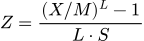
Where:
- X — the baby's measured weight in kilograms.
- M — the WHO median weight at that age and sex.
- L — the Box-Cox skewness parameter (handles non-symmetric weight distributions).
- S — the coefficient of variation (a scaled standard deviation).
Third, the Z-score is mapped to a percentile through the standard normal cumulative distribution function, Φ(Z). A Z of 0 maps to the 50th percentile, −1.88 to the 3rd, and +1.88 to the 97th. For Z-scores outside ±3 WHO applies a linear extrapolation based on the SD interval width at the nearest edge — this keeps extreme tails physically reasonable instead of letting the Box-Cox equation blow up. The CDC 0-36 month chart, by contrast, indexes its LMS values at half-month intervals and interpolates between rows; this WHO 0-24 chart goes straight to the daily row with no interpolation step.
Related Calculators
- Length-for-Age (WHO, 0-24 mo)
- Head Circumference-for-Age (WHO, 0-24 mo)
- Weight-for-Length (WHO, 0-24 mo)
- Weight-for-Age (WHO, 0-5 yr) — older-age overlap reference
- BSA Calculator — Body surface area for clinical dosing
- Dosage by Weight Calculator — Weight-based pediatric medication dosing
Related Sites
- AJ Designer — 200+ engineering and science calculators
- Percent Off Calculator — Discount and sale price calculator
- Compare 2 Loans — Side-by-side loan comparison calculator
- LoanChop — Loan prepayment calculator
- Temperature Tool — Temperature unit converter
- Z-Score Calculator — Z-score, percentile, and probability calculator