WHO Stature-for-Age Growth Chart (2-5 Years)
Plot a child's standing height against the WHO Child Growth Standards for ages 2-5 years. The chart displays the 3rd, 15th, 50th, 85th, and 97th percentile curves and pins your child's measurement on top so you can see exactly where they fall in the stature channel.
LMS Method: Z = ((X/M)^L - 1) / (L × S), percentile = Φ(Z) × 100
How It Works
The WHO stature-for-age chart converts a single standing-height measurement into a percentile that answers "out of 100 healthy children of the same age and sex, how many are shorter than mine?" At age 2 the WHO standard transitions from recumbent length (measured lying down) to standing stature — standing height is roughly 0.7 cm shorter than the same child's recumbent length. The calculator looks up three WHO parameters — L (skewness), M (median stature), and S (coefficient of variation) — from the daily LMS table for the child's exact age in days, computes a Z-score with Z = ((X/M)^L − 1) / (L × S), and maps that Z through the standard normal CDF to a percentile between 0 and 100. Because the WHO table is indexed by day rather than by half-month, no interpolation is needed — the percentile is exact for the entered birth and measurement dates.
Example Problem
A 3-year-old girl measures 95.1 cm in standing height at her well-child visit. Where does she fall on the WHO stature-for-age chart for ages 2-5 years?
- Record the child's date of birth and the date of today's measurement — 36 months apart — and note the sex as Girl. The calculator computes the exact age in days (about 1,096 days).
- Make sure the measurement is standing height, not recumbent length. At age 2+ the WHO standard uses stature (upright). If the child was measured lying down, subtract about 0.7 cm before entering.
- Convert the height to centimeters if it was recorded in inches. Here 95.1 cm is already in centimeters.
- Look up the WHO LMS triple for girls at day 1096: L ≈ 1.00, M ≈ 95.08 cm, S ≈ 0.0396.
- Compute the Z-score with Z = ((X/M)^L − 1) / (L × S). Substituting gives Z ≈ ((95.1/95.08)^1.00 − 1) / (1.00 × 0.0396) ≈ 0.005.
- Map the Z-score through the standard normal CDF: Φ(0.005) ≈ 0.502, so the percentile is the 50th. A 3-year-old girl at 95.1 cm sits right on the WHO median — half of healthy same-age girls worldwide are shorter, half are taller.
Key Concepts
A percentile is a rank, not a grade. The 25th percentile means 25% of healthy same-age same-sex children are shorter than this child — it does not mean the child is "below target" or "underperforming." Height is largely genetic: a child at the 10th percentile with two short parents is almost always growing normally, while a child at the 90th percentile with two tall parents follows the same pattern on the upper side. Pediatricians look at trajectory over time rather than any single number — a child tracking steadily along the 15th percentile is growing well, while a child who drops from the 75th to the 25th between visits is the more common reason for follow-up. The WHO 2-5 year standard is prescriptive: it was built from six countries of children raised under optimal conditions (breastfeeding, non-smoking mothers, adequate nutrition), so it describes how children should grow rather than how average children do grow in any particular region.
Applications
- Well-child visits: pediatricians plot each stature measurement to confirm a steady growth channel.
- Transition from length to stature: at age 2 the measurement method changes; this chart handles the standing-height side of that transition.
- Short-stature evaluation: stature below the 3rd percentile (Z < −1.88) triggers workup for constitutional delay, familial short stature, endocrine causes, or chronic illness.
- Tall-stature evaluation: stature above the 97th percentile with accelerating velocity is the uncommon but clinically relevant pattern.
- Chronic-condition monitoring: children with cystic fibrosis, inflammatory bowel disease, or coeliac disease are tracked on this chart for linear growth.
- International growth comparison: the WHO standard is used in most countries outside the US, so this chart supports consistent international monitoring.
Common Mistakes
- Entering recumbent length instead of standing height for a child over 24 months — the WHO 2-5 chart expects stature. Using length shifts the result roughly one percentile band up.
- Using this chart for a child younger than 2 years — use the WHO 0-2 length-for-age chart instead, which expects a recumbent measurement.
- Using this chart for a child over 5 years — switch to the WHO 5-19 height-for-age chart for older children.
- Comparing a single reading to a target value rather than examining the growth trend across multiple visits.
- Ignoring parental height — a child at the 10th percentile with two parents at the 10th is following the family pattern and usually does not need intervention.
- Confusing the WHO prescriptive standard with the US CDC reference — WHO describes optimal growth worldwide, CDC describes how US children actually grew between 1963 and 1994.
Frequently Asked Questions
What is the WHO stature-for-age chart for 2-5 years?
It is the WHO standard that compares a child's standing height (stature) to a global reference of healthy children from age 2 to 5. The 2–5 chart is distinct from the 0–24 month length chart because standing height is about 0.7 cm shorter than recumbent length and the references are calibrated for stance. Percentiles between the 3rd and 97th are within the typical healthy range.
Is my child's height percentile healthy?
Pediatricians typically treat the 3rd to 97th percentile range as normal. Trajectory matters more than a single number — a child tracking steadily along any percentile line is growing well, whether that line is the 10th or the 90th. Crossing two or more major percentile bands over a few visits is the more common trigger for clinical follow-up, particularly if growth velocity is slowing.
Do growth spurts show up on this chart?
Short-term growth spurts during the toddler and preschool years are usually too small to shift a child's percentile band — linear growth between ages 2 and 5 is a steady ~6-8 cm per year. The visible jumps on growth charts happen later, during the adolescent growth spurt (around ages 10-14 for girls and 12-16 for boys). On this 2-5 year chart you should see a smooth, roughly parallel path through the percentile curves.
How much does genetics affect height?
Height is roughly 80% heritable. Mid-parental height (the average of a child's two biological parents, adjusted up 6.5 cm for boys or down 6.5 cm for girls) is the strongest single predictor of final adult stature. A child who consistently falls at the 10th percentile with parents who are also at the 10th is likely growing exactly as their genetics predict. Persistent stature well below the mid-parental target is the more clinically meaningful finding.
What is the difference between the WHO and CDC stature charts?
The WHO Child Growth Standards are prescriptive — they describe how children should grow under optimal conditions (breastfed, non-smoking mothers, adequate nutrition) from six countries. The CDC growth charts are descriptive — they describe how US children actually grew between 1963 and 1994. WHO curves tend to run slightly taller in the first two years and very similar afterward. The American Academy of Pediatrics recommends WHO for ages 0-2 and CDC from age 2 onward in the United States, but WHO is used widely for all ages outside the US.
When should I worry about a short or tall child?
A child below the 3rd percentile (Z < −1.88), above the 97th (Z > +1.88), or crossing two or more major percentile bands between visits is the common threshold for workup. Short stature evaluation may include a bone-age X-ray, thyroid and growth-hormone screening, and a review of nutrition and chronic illness. Tall stature evaluation is rarer but checks for endocrine causes when the trajectory is accelerating. A single measurement outside the normal band is rarely alarming on its own — the trajectory over two or three visits is what drives the decision.
Can I predict my child's adult height from the 2-5 year percentile?
Partially. The percentile at age 2-5 is a reasonable indicator of adult height channel, but parental height is a stronger predictor. A common rule of thumb is mid-parental height: (father's height + mother's height) / 2, then add 6.5 cm for boys or subtract 6.5 cm for girls. Clinical height-prediction tools such as the Khamis-Roche method combine current height, weight, and mid-parental height for a tighter estimate. Actual adult height typically lands within 8-10 cm of the prediction.
Can I enter height in inches?
Yes. The calculator accepts either centimeters or inches. Internally it converts inches to centimeters (1 in = 2.54 cm) before looking up the WHO LMS parameters, and the percentile curves on the chart are rendered in the unit you selected. Switching units does not change the percentile — it only changes the display scale.
Reference:
WHO Multicentre Growth Reference Study Group. WHO Child Growth Standards: Length/height-for-age, weight-for-age, weight-for-length, weight-for-height and body mass index-for-age. Methods and development. Geneva: World Health Organization, 2006. https://www.who.int/tools/child-growth-standards
Worked Examples
2-year well-child visit
Where does a 2-year-old boy standing 87.1 cm tall fall on the WHO chart?
A pediatrician is reviewing a healthy-term boy at his 24-month well-child visit. He has just transitioned from recumbent length to standing stature this visit. The standing measurement is 87.1 cm (34.3 in).
- Knowns: age 24.0 mo, sex boy, standing stature 87.1 cm
- WHO LMS lookup at day 731 (boys): L ≈ 1.00, M ≈ 87.13 cm, S ≈ 0.0351
- Z = ((87.1 / 87.13)^1.00 − 1) / (1.00 × 0.0351) ≈ −0.01
- Φ(−0.01) ≈ 0.496
~50th percentile — right on the WHO median at the length-to-stature transition.
At age 2 the measurement method changes; recumbent length at this age would read about 0.7 cm taller and yield a slightly higher percentile.
Preschool check-in
A 3-year-old girl stands 37.4 in tall — what percentile?
A parent brings a preschool-age girl to her 36-month well-child visit. The scale at the clinic records her standing height as 37.4 in. The WHO calculator converts this to centimeters internally (37.4 in × 2.54 = 95.0 cm) before computing the percentile.
- Knowns: age 36.0 mo, sex girl, standing stature 37.4 in → 95.0 cm
- WHO LMS lookup at day 1096 (girls): L ≈ 1.00, M ≈ 95.08 cm, S ≈ 0.0396
- Z ≈ ((95.0 / 95.08)^1.00 − 1) / (1.00 × 0.0396) ≈ −0.02
- Φ(−0.02) ≈ 0.492
~49th percentile — right at the WHO median for 3-year-old girls.
Height is roughly 80% heritable — the mid-parental height is a stronger long-term predictor than any single reading.
Short-stature follow-up
A 5-year-old boy has drifted from the 25th to the 3rd percentile — how do we read the chart today?
At age 3 this boy tracked at the 25th percentile. At 60 months he measures 102.5 cm, and his pediatrician is assessing whether he has crossed into the short-stature workup zone. Crossing two major percentile bands downward is the warning signal.
- Knowns: age 60.0 mo, sex boy, standing stature 102.5 cm
- WHO LMS lookup at day 1826 (boys): L ≈ 1.00, M ≈ 109.96 cm, S ≈ 0.0421
- Z = ((102.5 / 109.96)^1.00 − 1) / (1.00 × 0.0421) ≈ −1.61
- Φ(−1.61) ≈ 0.054
~6th percentile — near the 3rd-percentile threshold, and the downward crossing from the 25th is the clinically relevant finding.
A single snapshot never diagnoses short stature; the decision rests on trajectory, mid-parental target, bone age, and a broader clinical workup.
How the percentile is calculated
The calculator turns one standing-height measurement into a percentile in three stages. First, it looks up three WHO parameters — L, M, and S — from the WHO Child Growth Standards daily LMS table for the child's exact age in days. L is the Box-Cox power transform (it accounts for the skew in childhood stature distributions), M is the median stature at that age, and S is the coefficient of variation. Second, it plugs those parameters into the Z-score formula:
Z score equals the quantity X divided by M, raised to the power L, minus 1, divided by L times S.
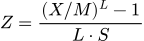
Where:
- X — the child's measured standing height in centimeters.
- M — the WHO median stature at that age and sex.
- L — the Box-Cox skewness parameter (handles non-symmetric stature distributions; typically near 1 for height).
- S — the coefficient of variation (a scaled standard deviation).
Third, the Z-score is mapped to a percentile through the standard normal cumulative distribution function, Φ(Z). A Z of 0 maps to the 50th percentile, −1.88 to the 3rd, and +1.88 to the 97th. Unlike the CDC reference (which is half-monthly and needs linear interpolation), the WHO daily table is indexed one row per day from day 731 (24 months) to day 1826 (60 months), so no interpolation is needed — the percentile is exact for the entered birth and measurement dates. Note that the WHO standard is prescriptive (how children should grow under optimal conditions) while the CDC reference is descriptive (how US children actually grew) — the two charts are not interchangeable.
Related Calculators
- Weight-for-Age (WHO, 0-5 yr)
- Head Circ-for-Age (WHO, 0-5 yr)
- Weight-for-Height (WHO, 2-5 yr)
- Height-for-Age (WHO, 5-19 yr) — for older children
- BSA Calculator — Body surface area for clinical dosing
- Z-Score Calculator — Convert z-scores to percentiles and probabilities
Related Sites
- Dollars Per Hour — Weekly paycheck calculator with overtime
- RN Calc — Nursing dosage and calculation tools
- AJ Designer — 200+ engineering and science calculators
- Hourly Salaries — Hourly wage to annual salary converter
- CameraDOF — Depth of field calculator for photographers
- LoanChop — Loan prepayment calculator