English | 中文版
Chinese National Head Circumference-for-Age Growth Chart (0-6 Years)
Plot a child's head circumference against the Chinese National Standard reference for ages 0-6 years. The chart displays standard percentile curves (3rd, 15th, 50th, 85th, 97th) with your child's measurement pinned on top so you can see the growth channel at a glance.
LMS Method: Z = ((X/M)^L - 1) / (L × S), percentile = Φ(Z) × 100
How It Works
The Chinese National Standard head-circumference-for-age chart converts one tape-measure reading into a percentile that answers "out of 100 Chinese children of the same age and sex, how many have a smaller head?" Under the hood the calculator looks up three parameters from the Chinese national LMS table — L (skewness), M (median head circumference), and S (coefficient of variation) — for the child's exact age in months, computes a Z-score with the Box-Cox equation Z = ((X/M)^L − 1) / (L × S), and maps that Z-score through the standard normal CDF to a percentile between 0 and 100. Head circumference is one of the three routine growth measurements of early childhood and the primary screening signal for microcephaly (abnormally small head) and macrocephaly (abnormally large head).
Example Problem
A 6-month-old Chinese boy has a head circumference of 43.0 cm at his well-child visit. Where does he fall on the Chinese National head-circumference-for-age chart?
- Record the child's date of birth and the date of today's measurement — 6 months apart — and note the sex as Boy.
- Convert the head circumference to centimeters if it was recorded in inches. Here it is already 43.0 cm (16.93 in), so no conversion is needed.
- Look up the Chinese National LMS triple for boys at 6 months: L ≈ −0.22, M ≈ 43.6 cm, S ≈ 0.0303.
- Compute the Z-score with Z = ((X/M)^L − 1) / (L × S). Substituting gives Z ≈ ((43.0/43.6)^(−0.22) − 1) / (−0.22 × 0.0303) ≈ −0.46.
- Map the Z-score through the standard normal CDF: Φ(−0.46) ≈ 0.32, so the percentile is about the 32nd.
- Report the result: a 6-month-old boy at 43.0 cm sits near the 32nd percentile for head circumference on the Chinese reference — slightly below the median but well inside the healthy band.
Key Concepts
A head-circumference percentile is a rank, not a verdict. The 80th percentile means 80% of same-age same-sex Chinese children have a smaller head — it does not mean a larger head is healthier. Most pediatricians treat the 3rd to 97th percentile band as normal, with anything outside that band a prompt to investigate. A single measurement is a snapshot; trajectory across multiple visits matters more than one number. Brain growth is fastest in the first year and head circumference roughly doubles between birth and age 2; after age 3 the rate flattens noticeably and after age 6 the measurement drops out of routine use. Familial head size is a strong predictor — measure both parents' heads before worrying about a baby who tracks at the 97th or 3rd percentile consistently. The Chinese National Standard is built on large-scale national surveys of how Chinese children actually grow, so for a child of Chinese descent it is typically a closer fit than the WHO standard (which describes optimally fed children of all ethnicities) or the CDC reference (US children).
Applications
- Routine well-child visits in Chinese pediatric clinics — head circumference is measured at every visit through age 3 and at annual visits to age 6.
- Microcephaly screening — heads tracking below the 3rd percentile (Z < −2) can indicate genetic, metabolic, or in-utero exposure conditions.
- Macrocephaly screening — heads tracking above the 97th percentile (Z > +2) may warrant imaging to rule out hydrocephalus or benign familial macrocephaly.
- Population-specific reference — for a Chinese child the national chart usually fits the population mean better than WHO or CDC at the same age.
- NICU graduate follow-up — preterm infants are tracked on corrected age until they catch up to term peers.
- Craniosynostosis surveillance — premature fusion of skull sutures distorts head shape and can slow circumference growth.
- Hydrocephalus monitoring — heads that cross percentile bands upward quickly are a red flag even inside the normal range.
Common Mistakes
- Measuring at the wrong landmark — the tape must wrap around the largest circumference, just above the eyebrows and the most prominent part of the back of the head. A low measurement taken at the wrong level looks like microcephaly.
- Using a stretchy tape — cloth or paper tapes stretch and under-read. Use a non-stretch pediatric tape and take the largest of three readings.
- Confusing percentile with abnormality — a child consistently at the 3rd or 97th percentile is usually tracking a familial pattern, not pathology. Deviation from the established channel is the signal, not the percentile itself.
- Mixing reference standards across visits — pick one chart (Chinese, WHO, or CDC) and stay with it; switching mid-track introduces apparent percentile shifts that are not real growth changes.
- Not using corrected age for premature infants — a baby born 8 weeks early and measured at 6 months chronological age should be plotted at 4 months corrected for the first 2-3 years.
- Ignoring trajectory — crossing two major percentile bands upward in a few months is a stronger macrocephaly signal than a static 97th-percentile reading, and the same logic applies on the low end.
- Entering inches when the input is set to centimeters (or vice versa) — a 47 cm head circumference (healthy 18-month-old) entered as 47 inches lands in the macrocephaly range and will scare parents unnecessarily.
Frequently Asked Questions
What is the Chinese national head-circumference reference for 0-6 years?
It is the Ji 2009 growth reference for head circumference adopted across mainland China for ages 0–6. The chart screens brain growth against Chinese population norms rather than the WHO global standard. Readings between the 3rd and 97th are typical; persistent values outside that band prompt microcephaly or macrocephaly follow-up alongside developmental milestones.
How should I measure my baby's head circumference at home?
Use a flexible, non-stretchable tape measure. Wrap it around the largest part of the head — just above the eyebrows and ears, around the most prominent point at the back of the head. Pull it snug without compressing the skin. Take three measurements and use the largest. Clinic-grade readings use a disposable paper-plastic tape designed to not stretch; cloth tapes can read 1-2 cm low.
Is a 3rd-percentile or 97th-percentile head circumference a problem?
Not automatically. A child who has always tracked the 3rd or 97th percentile is usually following a familial pattern — measure both parents' heads. What pediatricians watch for is crossing percentile bands: a baby who drops from the 50th to the 3rd, or jumps from the 50th to the 97th, across a few visits is more concerning than a baby who has always been at either extreme. Persistent Z-scores below −2 or above +2 combined with developmental concerns are the standard trigger for further evaluation.
When should I call the pediatrician about my baby's head size?
Call when the head circumference has crossed two or more major percentile bands upward or downward between visits, when the head looks visibly asymmetric or disproportionate, when the fontanelle feels unusually tight or bulging, or when there are developmental delays alongside an unusual reading. A single measurement outside the 3rd-97th band without other concerns is usually discussed at the next routine visit, not urgently.
What is microcephaly and when is it diagnosed?
Microcephaly is a head circumference more than two standard deviations below the mean for age and sex (roughly the 2nd percentile or below). Severe microcephaly is more than three standard deviations below (roughly the 0.1st percentile). Causes include genetic syndromes, in-utero infections (CMV, Zika), prenatal alcohol or drug exposure, and brain malformations. Diagnosis is clinical — this calculator returns a percentile, but interpretation requires a pediatrician reviewing the growth trend, development, and birth history.
What is macrocephaly and how is it evaluated?
Macrocephaly is a head circumference more than two standard deviations above the mean (roughly the 98th percentile or higher). The most common cause is benign familial macrocephaly — a large head that runs in the family with no other findings. Other causes include hydrocephalus (fluid buildup), subdural collections, and rare metabolic or skeletal conditions. A rapidly rising head circumference crossing percentiles upward is a stronger signal than a stable reading at the 98th.
Should I use the Chinese National chart or the WHO/CDC chart?
For a child of Chinese descent the Chinese National Standard typically fits the population mean better at any given age than the WHO Multicentre Growth Reference (which describes optimally fed children of multiple ethnicities) or the CDC chart (US children, 1963-1994 reference period). The differences are usually small (1-2 cm at the median), but they can shift a child's percentile by 5-15 points near the tails. Pick one chart and use it consistently across visits — switching mid-track creates apparent percentile changes that are not real growth changes.
What if my baby was born premature?
For infants born before 37 weeks, plot head circumference by corrected age — chronological age minus weeks of prematurity — for the first 2-3 years. A baby born 8 weeks early and measured at 6 months chronological age should be plotted at 4 months corrected. After about age 2-3 the correction is usually dropped. Some NICUs use the Fenton or Olsen preterm-specific head-circumference charts for the first weeks and then transition to the population reference.
Reference:
Chinese National Standards for Growth and Development of Children. National Health Commission of the People's Republic of China. https://www.nhc.gov.cn/
Worked Examples
Well-child visit
Where does a 6-month-old Chinese boy with a 43 cm head circumference fall on the Chinese chart?
A pediatrician is reviewing a healthy 6-month-old boy at his well-child visit. His recorded head circumference is 43.0 cm (16.93 in) and the provider wants a quick percentile read against the Chinese National Standard before the appointment ends.
- Knowns: age 6.0 mo, sex boy, head circumference 43.0 cm
- Chinese LMS lookup at 6 mo (boys): L ≈ −0.22, M ≈ 43.6 cm, S ≈ 0.0303
- Z = ((43.0 / 43.6)^(−0.22) − 1) / (−0.22 × 0.0303) ≈ −0.46
- Φ(−0.46) ≈ 0.32
~32nd percentile — slightly below the median but solidly inside the healthy growth channel.
A single reading near the 32nd percentile is unremarkable; pediatricians watch whether he continues to track that channel at future visits, not whether he hits any specific number.
Microcephaly screening
A 12-month-old girl measures 16.0 inches around the head — does that cross the microcephaly threshold?
A parent brings their 12-month-old girl in because her head looks small. The nurse measures 16.0 in (40.64 cm). The calculator converts to centimeters internally and flags microcephaly risk when the Z-score drops below −2 (3rd percentile) on the Chinese reference.
- Knowns: age 12.0 mo, sex girl, head circumference 16.0 in → 40.64 cm
- Chinese LMS lookup at 12 mo (girls): L ≈ −0.62, M ≈ 45.1 cm, S ≈ 0.0285
- Z = ((40.64 / 45.1)^(−0.62) − 1) / (−0.62 × 0.0285) ≈ −3.77
- Φ(−3.77) ≈ 0.00008
<0.1st percentile — well below the 3rd-percentile microcephaly threshold.
A Z-score of −3.61 is a strong screening signal, not a diagnosis. Pediatricians look at the full growth trajectory across multiple visits, birth history, family history, developmental milestones, and physical exam. This calculator returns the snapshot; the pediatrician does the workup.
Macrocephaly follow-up
A 36-month-old boy has a 52.0 cm head circumference — is that in the macrocephaly range?
At 24 months this boy was tracking near the 85th percentile. At his 3-year visit his head circumference is 52.0 cm and the pediatrician wants to confirm whether he has crossed above the 97th-percentile (Z > +2) macrocephaly cutoff. Both parents have larger-than-average heads.
- Knowns: age 36.0 mo, sex boy, head circumference 52.0 cm
- Chinese LMS lookup at 36 mo (boys): L ≈ 0.40, M ≈ 49.6 cm, S ≈ 0.0262
- Z = ((52.0 / 49.6)^0.40 − 1) / (0.40 × 0.0262) ≈ +1.82
- Φ(+1.82) ≈ 0.966
~97th percentile — right at the macrocephaly threshold, not clearly over it.
A Z of +1.86 sits right at the 97th-percentile line. Both parents have larger-than-average heads, which is the textbook pattern for benign familial macrocephaly. A pediatrician weighs family history, development, fontanelle findings, and trajectory before considering imaging — this calculator returns the snapshot, not the diagnosis.
How the percentile is calculated
The calculator turns one head-circumference reading into a percentile in three stages. First, it looks up three Chinese National Standard parameters — L, M, and S — for the child's exact age and sex. L is the Box-Cox power transform (it accounts for the skew in childhood head-size distributions, which is strongly skewed in the first months), M is the median head circumference at that age, and S is the coefficient of variation. The Chinese National table is published at irregular age intervals (every month through 6 mo, then 8, 10, 12, 15, 18, 21, 24, 30, 36, 42, 48, 54, 60, 66, 72 mo); the calculator linearly interpolates L, M, and S between bracketing rows for any age in between. Second, it plugs those parameters into the Z-score formula:
Z score equals the quantity X divided by M, raised to the power L, minus 1, divided by L times S.
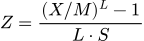
Where:
- X — the child's measured head circumference in centimeters.
- M — the Chinese National median head circumference at that age and sex.
- L — the Box-Cox skewness parameter (handles non-symmetric head-size distributions, which are strongly skewed in the first months).
- S — the coefficient of variation (a scaled standard deviation).
Third, the Z-score is mapped to a percentile through the standard normal cumulative distribution function, Φ(Z). A Z of 0 maps to the 50th percentile, −1.88 to the 3rd, and +1.88 to the 97th. Microcephaly is conventionally defined as a Z below −2 (about the 2nd percentile); macrocephaly is a Z above +2 (about the 98th percentile). Both are screening thresholds, not diagnoses.
Related Calculators
- Weight-for-Age (Chinese, 0-18 yr)
- Length-for-Age (Chinese, 0-3 yr)
- Head Circ-for-Age (CDC, 0-36 mo) — CDC alternative
- Head Circ-for-Age (WHO, 0-5 yr) — WHO alternative
- BSA Calculator — Body surface area for clinical dosing
Related Sites
- Z-Score Calculator — Z-score, percentile, and probability calculator
- RN Calc — Nursing dosage and calculation tools
- AJ Designer — 200+ engineering and science calculators
- Dollars Per Hour — Weekly paycheck calculator with overtime
- CameraDOF — Depth of field calculator for photographers
- LoanChop — Loan prepayment calculator