English | 中文版
Chinese National Weight-for-Length Growth Chart (45-110 cm)
Plot a child's weight against Chinese National Standard reference data using recumbent length — not age — as the independent variable. The chart displays the standard percentile curves (3rd, 15th, 50th, 85th, 97th) for boys or girls and pins your child's point so you can see whether their weight is proportionate to their body size on a China-specific reference.
LMS Method: Z = ((X/M)^L - 1) / (L × S), percentile = Φ(Z) × 100
How It Works
The Chinese National weight-for-length chart answers a different question from weight-for-age: instead of asking "how does this child's weight compare to peers of the same age," it asks "how does this child's weight compare to peers of the same body length on a China-specific reference?" The calculator looks up three parameters from the Chinese National weight-for-length LMS table — L (skewness), M (the median weight at that length), and S (coefficient of variation) — for the child's exact recumbent length in centimeters, regardless of age. It then computes a Z-score using the Box-Cox equation Z = ((X/M)^L − 1) / (L × S) and maps that Z-score through the standard normal CDF to a percentile. The Chinese table is indexed at 5-cm intervals from 45 cm to 110 cm, so intermediate lengths are handled by linearly interpolating L, M, and S between bracketing rows. The reference data come from large-scale Chinese national growth surveys and are the recommended standard for clinical use in mainland China.
Example Problem
A boy with a recumbent length of 70 cm weighs 8.5 kg. Where does he fall on the Chinese National weight-for-length chart?
- Select Boy for sex and confirm the weight and length units (kg and cm in this example).
- Enter the recumbent length: 70.0 cm. Note that age is not used — only the measured length matters.
- Enter the weight: 8.5 kg.
- Look up the Chinese National weight-for-length LMS triple for boys at 70 cm: L ≈ -0.30, M ≈ 8.69 kg, S ≈ 0.0867.
- Compute the Z-score with Z = ((X/M)^L − 1) / (L × S). Substituting gives Z ≈ ((8.5/8.69)^-0.30 − 1) / (-0.30 × 0.0867) ≈ −0.26.
- Map the Z-score through the standard normal CDF: Φ(−0.26) ≈ 0.40, so the percentile is approximately the 40th.
- Report the result: a boy 70 cm long weighing 8.5 kg sits just below the Chinese median weight for his length.
Key Concepts
Weight-for-length is a proportionality check, not an age check. A tall 12-month-old who is heavy for her age may be perfectly proportioned for her length; a short 12-month-old who looks average on weight-for-age may in fact be heavy-for-length. The Chinese National standard treats weight-for-length below the 3rd percentile (Z ≈ −2) as a wasting signal and above the 97th (Z ≈ +2) as overweight that warrants follow-up. The measurement used here is recumbent length — measured lying flat on a board — not standing height. Standing height runs about 0.7 cm shorter than recumbent length in the same child, so mixing the two can shift percentiles. The Chinese weight-for-length chart covers lengths from 45 cm to 110 cm (about 17.7 to 43.3 in); once a child is typically measured standing, clinicians switch to the Chinese weight-for-stature chart.
Applications
- Well-child visits in mainland China: pediatricians check weight-for-length to confirm proportional growth alongside weight-for-age and length-for-age on a China-specific reference.
- Wasting screening in Chinese clinical settings: a weight-for-length below the 3rd percentile is the primary screen for acute malnutrition on the Chinese standard.
- Overweight surveillance in Chinese infants and toddlers: when weight-for-length exceeds the 97th percentile, a nutritional conversation is typically initiated.
- Population-specific proportionality screening when WHO or CDC charts over- or under-estimate normal Chinese body proportions.
- Post-illness recovery in Chinese pediatric care — tracks whether a child has regained proportional weight after illness or hospitalization.
- Overseas Chinese families and clinicians who want a China-specific percentile alongside the WHO or CDC value.
Common Mistakes
- Confusing weight-for-length with weight-for-age — they answer different questions; a child can be average on one and outside the normal range on the other.
- Using standing height instead of recumbent length — standing measurements understate the child's length by about 0.7 cm and shift the percentile downward.
- Entering length in inches without switching the unit selector — verify the unit dropdown matches the measurement before typing.
- Using this chart for a child whose length exceeds 110 cm (about 43.3 in) — switch to the Chinese weight-for-stature chart once the child is being measured standing.
- Treating a single high weight-for-length percentile as a diagnosis — a solidly built child may always sit above the 85th without being unhealthy; trajectory matters more than a single point.
- Mixing references across visits — once you start a child on the Chinese National weight-for-length chart, stay on it rather than flipping between WHO, CDC, and Chinese values at each visit.
Frequently Asked Questions
What is the Chinese weight-for-length reference?
It is the Zong & Li 2013 reference for weight-for-length within a Chinese pediatric population, used alongside the age-based Ji 2009 weight-for-age chart. The chart asks whether a baby's weight is proportional to their length, regardless of age. Length coverage runs up to about 110 cm. Values between the 3rd and 97th percentile are considered proportionate within Chinese population norms.
How is weight-for-length different from weight-for-age?
Weight-for-age compares the child's weight to peers of the same age; weight-for-length compares weight to peers of the same body length. A tall 12-month-old may be at the 90th on weight-for-age but only the 55th on weight-for-length — perfectly proportioned, just larger. A short 12-month-old may be at the 40th on weight-for-age but the 90th on weight-for-length — heavy for her body size even though her raw weight looks average. Pediatricians read both together, not in isolation.
Why does this calculator ignore age?
The Chinese National weight-for-length table is indexed by length only — the LMS parameters are looked up using the measured recumbent length in centimeters, not the child's age. This is deliberate: weight-for-length is designed to assess body proportionality independently of age, which is exactly what's useful when you want to know whether a child's weight is in balance with their body size. If you need an age-based read, use the Chinese weight-for-age or length-for-age calculators.
What length range does this calculator cover?
The Chinese National weight-for-length table covers recumbent lengths from 45 cm to 110 cm (about 17.7 to 43.3 in) in 5-cm steps. Lengths outside this range are not part of the Chinese weight-for-length reference. For taller children, switch to the Chinese weight-for-stature calculator (standing height).
Should I measure recumbent length or standing height?
This chart uses recumbent length — measured with the child lying flat on a length board, legs extended. Standing height is typically about 0.7 cm shorter than recumbent length in the same child, so using a standing measurement here will shift the percentile slightly downward. If your child is already being measured standing, use the Chinese weight-for-stature chart instead for a clean match between the measurement and the reference.
How does the Chinese National chart differ from WHO weight-for-length?
The WHO weight-for-length chart is built from a multinational breastfed reference sample (WHO Multicentre Growth Reference Study, 2006) and describes how children should grow under optimal feeding and care conditions. The Chinese National chart is built from large-scale surveys of Chinese children and describes how Chinese children actually grow. Chinese children are, on average, slightly lighter for length than the WHO median in the 6-24 month range, so the same weight may read near the Chinese 50th but below the WHO 50th. Either reference is defensible in the right setting — the Chinese chart is the clinical standard in mainland China, while the WHO chart is the AAP-recommended reference under 24 months in the United States.
What does "proportional growth" mean on a weight-for-length chart?
Proportional growth means weight and length are tracking along the same channel over time. A baby at the 50th percentile for weight-for-length on every visit is proportionally growing even if her raw weight keeps rising. A baby who jumps from the 50th to the 90th on weight-for-length (while her length-for-age stays at the 50th) is gaining weight faster than length — the chart flags that imbalance. The single-point percentile answers "is weight proportionate to length right now?" and the trend across visits answers "is growth staying proportional over time?"
When does a child transition from weight-for-length to weight-for-stature?
Around the age when a child reliably stands still enough to be measured standing (typically around 2 years on the Chinese standard, matching clinical practice elsewhere), pediatricians switch from the Chinese weight-for-length chart (recumbent length) to the Chinese weight-for-stature chart (standing height). The two measurements differ by about 0.7 cm — standing height reads shorter than recumbent length in the same child — and the Chinese National reference publishes separate tables for each. Stay on one chart until the transition visit so percentiles don't jump artificially.
Reference:
Chinese National Standards for Growth and Development of Children. National Health Commission of the People's Republic of China. See also: Zong X-N, Li H. Construction of a new growth references for China based on urban Chinese children: comparison with the WHO growth standards. PLoS One. 2013;8(3):e59569. https://doi.org/10.1371/journal.pone.0059569
Worked Examples
Healthy proportion check
A boy 70 cm long weighing 8.5 kg — where does he fall on the Chinese chart?
A pediatrician in Shanghai is reviewing a healthy-term boy whose recumbent length is 70 cm and weight is 8.5 kg. The Chinese National weight-for-length chart ignores age entirely — the LMS lookup is purely by length.
- Knowns: sex boy, length 70.0 cm, weight 8.5 kg
- Chinese LMS lookup at 70 cm (boys): L ≈ -0.30, M ≈ 8.69 kg, S ≈ 0.0867
- Z = ((8.5 / 8.69)^-0.30 − 1) / (-0.30 × 0.0867) ≈ -0.26
- Φ(-0.26) ≈ 0.40 → ~40th percentile
~40th percentile — just below the Chinese National median weight for his length.
A single reading just under the median is reassuring; clinicians track whether the child continues along the same channel at subsequent visits.
US-units well-child visit
A girl 25 in long weighing 15 lb — what Chinese percentile?
A parent reports their daughter's recumbent length as 25 in and weight as 15 lb. The calculator converts both to the canonical units (25 in × 2.54 = 63.5 cm; 15 lb × 0.4536 = 6.80 kg) before the Chinese LMS lookup.
- Knowns: sex girl, length 25 in → 63.5 cm, weight 15 lb → 6.80 kg
- Chinese LMS lookup at 63.5 cm (girls): L, M, S linearly interpolated between the 60 cm and 65 cm rows
- Z ≈ ((6.80 / M)^L − 1) / (L × S) ≈ -0.11
- Φ(-0.11) ≈ 0.46 → ~46th percentile
~46th percentile — essentially at the Chinese median for her length.
Chart values are for recumbent length — a standing measurement would read about 0.7 cm shorter and shift the percentile slightly.
Wasting screen
A boy 80 cm long weighing 8.8 kg — is there a wasting concern?
A toddler presents at a follow-up visit measuring 80 cm long and 8.8 kg. Weight-for-length below the 3rd percentile is the primary acute-malnutrition screen on the Chinese National standard.
- Knowns: sex boy, length 80.0 cm, weight 8.8 kg
- Chinese LMS lookup at 80 cm (boys): L ≈ -0.50, M ≈ 10.71 kg, S ≈ 0.082
- Z ≈ ((8.8 / 10.71)^-0.50 − 1) / (-0.50 × 0.082) ≈ -2.52
- Φ(-2.52) ≈ 0.006 → below the 1st percentile
below the 1st percentile — past the −2 Z-score threshold flagged as wasting.
A single low reading warrants clinical assessment — nutrition history, illness, and growth trajectory together determine whether intervention is needed.
How the percentile is calculated
The calculator turns one pair of measurements — recumbent length and weight — into a percentile in three stages. First, it looks up three Chinese National parameters — L, M, and S — from the Chinese weight-for-length reference table at the child's length in centimeters. Age is not used — the independent variable on this chart is length, not time. L is the Box-Cox power transform that accounts for skew in the weight distribution at that length, M is the median weight of same-sex Chinese children at that length, and S is the coefficient of variation. Second, it plugs those parameters into the Z-score formula:
Z score equals the quantity X divided by M, raised to the power L, minus 1, divided by L times S.
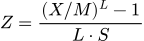
Where:
- X — the child's measured weight in kilograms.
- M — the Chinese median weight at that length and sex.
- L — the Box-Cox skewness parameter at that length.
- S — the coefficient of variation at that length.
Third, the Z-score is mapped to a percentile through the standard normal cumulative distribution function, Φ(Z). A Z of 0 maps to the 50th percentile, −1.88 to the 3rd, and +1.88 to the 97th. The Chinese National weight-for-length table is published at 5-cm steps from 45 cm to 110 cm, so fractional lengths are handled by linearly interpolating L, M, and S between the two bracketing rows. Length is the only input to the lookup — a child whose length falls in this range can be looked up at any age, though most Chinese clinicians switch to the Chinese weight-for-stature chart once the child is routinely measured standing.
Related Calculators
- Weight-for-Age (Chinese, 0-18 yr)
- Length-for-Age (Chinese, 0-3 yr)
- Weight-for-Stature (Chinese) — for taller children measured standing
- BSA Calculator — Body surface area for clinical dosing
- Z-Score Calculator — Convert z-scores to percentiles and probabilities
Related Sites
- Hourly Salaries — Hourly wage to annual salary converter
- RN Calc — Nursing dosage and calculation tools
- AJ Designer — 200+ engineering and science calculators
- Dollars Per Hour — Weekly paycheck calculator with overtime
- CameraDOF — Depth of field calculator for photographers
- LoanChop — Loan prepayment calculator