English | 中文版
Chinese National Stature-for-Age Growth Chart (3-18 Years)
Plot your child's standing height against the Chinese National Standard reference for ages 3-18 years. The chart shows the 3rd, 15th, 50th, 85th, and 97th percentile curves for Chinese boys and girls with your child's measurement pinned on top so you can see the growth channel at a glance.
LMS Method: Z = ((X/M)^L − 1) / (L × S), percentile = Φ(Z) × 100
How It Works
The Chinese National stature-for-age chart converts one standing-height measurement into a percentile that answers "out of 100 Chinese children of the same age and sex, how many are shorter than mine?" The calculator looks up three LMS parameters from the Chinese national reference table — L (Box-Cox skewness), M (median stature in cm), and S (coefficient of variation) — for the child's exact age and sex, computes a Z-score with Z = ((X/M)^L − 1) / (L × S), and maps that Z-score through the standard normal cumulative distribution function Φ(Z) to a percentile between 0 and 100. The Chinese reference spans ages 36 to 216 months (3 to 18 years) in six-month steps, so fractional ages are handled by linearly interpolating L, M, and S between the two bracketing rows.
Example Problem
A 10-year-old Chinese girl measures 140 cm in standing height at her annual check-up. Where does she sit on the Chinese National stature-for-age chart?
- Record the child's date of birth and today's date — 10 years (120 months) apart — and select Girl.
- Confirm the measurement is standing height: shoes off, heels/buttocks/shoulders against the wall, chin level. If recorded in inches, the calculator converts to centimeters internally (1 in = 2.54 cm).
- Look up the Chinese LMS triple for girls at 120 months: L = 0.81, M = 140.1 cm, S = 0.045.
- Compute the Z-score with Z = ((X/M)^L − 1) / (L × S). Substituting gives Z ≈ ((140 / 140.1)^0.81 − 1) / (0.81 × 0.045) ≈ −0.02.
- Map the Z-score through the standard normal CDF: Φ(−0.02) ≈ 0.493, so the percentile is the 49th — essentially the median.
- Report the result: a 10-year-old Chinese girl at 140 cm sits right at the Chinese National median — half of Chinese girls her age are shorter, half are taller.
Key Concepts
A percentile is a rank, not a grade. The 70th percentile means 70 out of 100 Chinese children of the same age and sex are shorter — it does not mean the child is "70% tall" or healthier than average. Chinese pediatricians treat the 3rd through 97th percentile band as the normal range. The Chinese National Standard is descriptive: it reflects how Chinese children in large nationwide surveys actually grew, so it captures the genetic and nutritional profile of Chinese populations rather than the WHO prescriptive ideal. Compared with WHO or CDC charts, Chinese curves typically sit 1-4 cm lower at the 50th percentile in middle childhood, reflecting genuine population differences in height rather than under-growth. Tracking matters more than any single snapshot — a child tracking steadily along the 25th percentile channel is growing well; a child dropping from the 75th to the 25th over two visits is the more common reason for follow-up.
Applications
- Routine growth monitoring at annual well-child visits in Chinese pediatric clinics.
- Evaluating short stature (below the 3rd percentile) against Chinese population norms before proceeding with growth-hormone or endocrine workup.
- Tracking pre-pubertal and pubertal growth in children of Chinese descent, including those in diaspora communities where WHO or CDC charts may over- or under-call percentile placement.
- Monitoring growth through the adolescent spurt — girls typically peak around age 12 and boys around age 14 in the Chinese reference.
- Comparing growth trajectories of Chinese children against WHO or CDC charts for cross-population research.
- Evaluating growth in children with chronic conditions such as congenital heart disease, chronic kidney disease, or coeliac disease where early stature deficits are clinically important.
Common Mistakes
- Using recumbent length instead of standing height for children over 3 — Chinese standing-height charts expect upright measurement; recumbent length runs about 0.5-1 cm taller.
- Entering heights for a child younger than 3 on this chart — use the Chinese length-for-age calculator for infants and toddlers.
- Using this chart beyond 18 years — adult height does not have a pediatric percentile; the 216-month upper bound is exact.
- Comparing a Chinese child's percentile directly to WHO or CDC charts — the Chinese reference runs 1-4 cm lower at the median through middle childhood, so a child at the 50th percentile here may plot at the 25th-30th on CDC.
- Interpreting a single crossed percentile line as abnormal — children shift channels slightly through puberty; persistent crossing of two or more major bands is the clinical threshold.
- Measuring with shoes on, feet not flat, or without proper positioning (heels, buttocks, and shoulders against the wall).
Frequently Asked Questions
What is the Chinese national stature-for-age reference for 3-18 years?
It is the Ji 2009 reference adopted across mainland China for standing height ages 3–18. The chart picks up where the 0–3 year length reference ends and tracks growth through adolescence to adult final height. Mean Chinese stature differs slightly from the WHO 5–19 reference, reflecting regional growth patterns. The 50th percentile is the Chinese median; values between the 3rd and 97th are within the typical healthy range.
Which ages does this calculator cover?
The Chinese National stature-for-age reference covers ages 3 to 18 years (36 to 216 months). Under 3 years use the Chinese length-for-age calculator, which expects a recumbent (lying-down) measurement. Entries beyond 18 years return an error — adult height is not a pediatric percentile.
Can I enter height in inches?
Yes. Select inches from the unit dropdown and the calculator converts to centimeters internally (1 in = 2.54 cm). The chart Y-axis and the reference table below the chart both re-render in the unit you select, so switching between cm and inches never changes the percentile — only the display scale.
How is the Chinese National standard different from WHO or CDC charts?
The Chinese National Standard is descriptive and built from large-scale national surveys of healthy Chinese children — it reflects how Chinese children actually grow. The WHO standard is prescriptive (how children should grow under optimal conditions worldwide) and CDC is descriptive for US children. Through middle childhood the Chinese 50th percentile typically runs about 1-4 cm lower than CDC and slightly lower than WHO, so using a non-Chinese chart for a Chinese child often over-calls short stature.
When does the pubertal growth spurt happen for Chinese children?
Chinese girls typically begin the pubertal growth spurt between ages 9 and 11 and reach peak height velocity around age 11-12, adding 7-10 cm per year at the peak. Boys start roughly two years later, peak near age 13-14 at 8-10 cm per year, and generally finish growing around age 17-18. Chinese population puberty timing is a little earlier in girls and similar in boys compared with US references — the curves in this calculator reflect that.
When should I consult a pediatrician or pediatric endocrinologist?
Talk to a pediatrician if your child's height is consistently below the 3rd percentile or above the 97th percentile on this chart, or if it has crossed two or more major percentile lines up or down between visits. Referral to a pediatric endocrinologist is common when short stature persists below the 3rd percentile with growth velocity under ~4 cm per year, when bone age lags chronological age by more than 2 years, or when there are signs of precocious or delayed puberty alongside the height finding.
Does parental height affect the percentile interpretation?
Yes — genetics explains roughly 60-80% of adult height. Mid-parental height (father's + mother's height / 2, adjusted +6.5 cm for boys or −6.5 cm for girls) gives a genetic target range of roughly ±8.5 cm. A Chinese child consistently at the 15th percentile with two parents also near the 15th is usually growing exactly as their genetics predict; persistent stature well below the mid-parental target is the more clinically meaningful pattern.
At what age should I switch from length to stature measurements?
The transition is at age 3 for the Chinese National reference. Children under 3 are measured lying down (recumbent length); children 3 and older are measured standing (stature). Recumbent length reads about 0.5-1 cm taller than the same child's standing height because gravity compresses the spine, so expect a small downward shift when the method changes at the 3-year visit.
Reference:
Chinese National Standards for Growth and Development of Children. National Health Commission of the People's Republic of China. Derived from the Chinese National Survey on Physical Growth and Development of Children. https://www.nhc.gov.cn/
Worked Examples
Pre-school entry
Where does a 4-year-old boy standing 104 cm tall sit on the Chinese chart?
A pediatrician is reviewing a 4-year-old boy at a pre-school entry visit in a Beijing clinic. Standing height (shoes off, heels against the wall) measures 104.0 cm (40.9 in). The family wants a quick percentile read against the Chinese National reference before comparing to the WHO chart.
- Knowns: age 48 mo, sex boy, standing stature 104.0 cm
- Chinese LMS lookup at 48 mo (boys): L = 0.46, M = 104.1 cm, S = 0.0385
- Z = ((104.0 / 104.1)^0.46 − 1) / (0.46 × 0.0385) ≈ −0.03
- Φ(−0.03) ≈ 0.490
~49th percentile — essentially at the Chinese National median for a 4-year-old boy.
At age 3-4 the measurement method has just switched from recumbent length to standing stature; expect a 0.5-1 cm downward step from the length-for-age chart.
Pre-teen well-child visit
A 10-year-old girl measures 55.1 inches tall — what Chinese percentile?
A parent brings a 10-year-old girl to an annual well-child visit. Height is recorded as 55.1 in (140.0 cm). The calculator converts inches to centimeters internally and looks up the Chinese LMS parameters for girls at 120 months.
- Knowns: age 120 mo, sex girl, standing stature 55.1 in → 140.0 cm
- Chinese LMS lookup at 120 mo (girls): L = 0.81, M = 140.1 cm, S = 0.045
- Z ≈ ((140.0 / 140.1)^0.81 − 1) / (0.81 × 0.045) ≈ −0.02
- Φ(−0.02) ≈ 0.493
~49th percentile — right at the Chinese National median for 10-year-old girls.
Chinese girls begin the pubertal spurt earlier than Chinese boys — many 10-year-olds are about to start accelerating off the pre-pubertal channel on this chart.
Teen growth spurt
A 15-year-old boy stands 175 cm tall — how does he track on the Chinese chart?
At 12 this boy sat on the 50th percentile. By 15 his standing height is 175 cm (5'8.9"). The provider wants to confirm he is tracking inside the expected Chinese band as his pubertal spurt peaks.
- Knowns: age 180 mo, sex boy, standing stature 175.0 cm
- Chinese LMS lookup at 180 mo (boys): L = 1.09, M = 169.8 cm, S = 0.0384
- Z ≈ ((175.0 / 169.8)^1.09 − 1) / (1.09 × 0.0384) ≈ +0.80
- Φ(+0.80) ≈ 0.788
~79th percentile — comfortably above the Chinese median and on-track for a strong pubertal spurt.
Peak height velocity in Chinese boys is typically around age 13-14. Growth usually slows noticeably by 16-17 as the epiphyseal plates near closure.
How the percentile is calculated
The calculator turns one standing-height measurement into a percentile in three stages. First, it looks up three LMS parameters — L, M, and S — from the Chinese National reference table for the child's exact age and sex. L is the Box-Cox power transform (it accounts for skew in the stature distribution), M is the median stature at that age in centimeters, and S is the coefficient of variation. Second, it plugs those parameters into the Z-score formula:
Z score equals the quantity X divided by M, raised to the power L, minus 1, divided by L times S.
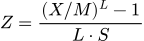
Where:
- X — the child's measured standing height in centimeters.
- M — the Chinese National median stature at that age and sex.
- L — the Box-Cox skewness parameter (handles non-symmetric stature distributions; typically near 0.5-1.1 for Chinese stature).
- S — the coefficient of variation (a scaled standard deviation).
Third, the Z-score is mapped to a percentile through the standard normal cumulative distribution function, Φ(Z). A Z of 0 maps to the 50th percentile, −1.88 to the 3rd, and +1.88 to the 97th. The Chinese reference table is indexed in six-month steps from month 36 to month 216, so fractional ages are handled by linearly interpolating L, M, and S between the two bracketing rows. Unlike the WHO prescriptive standard, the Chinese National reference is descriptive — it describes how Chinese children in large national surveys actually grew, so it captures real population differences in height that WHO and CDC charts do not.
Related Calculators
- Weight-for-Age (Chinese, 0-18 yr)
- Weight-for-Stature (Chinese)
- Length-for-Age (Chinese, 0-3 yr) — for younger children
- BSA Calculator — Body surface area for clinical dosing
- Z-Score Calculator — Convert z-scores to percentiles and probabilities
Related Sites
- Hourly Salaries — Hourly wage to annual salary converter
- RN Calc — Nursing dosage and calculation tools
- AJ Designer — 200+ engineering and science calculators
- Dollars Per Hour — Weekly paycheck calculator with overtime
- CameraDOF — Depth of field calculator for photographers
- LoanChop — Loan prepayment calculator