Down Syndrome Head Circumference-for-Age Growth Chart (Zemel 2015, 1-36 Months)
Plot your child's head circumference against the Down syndrome-specific growth standards (Zemel 2015) for ages 1-36 months. CDC and WHO head-circumference curves consistently read low for children with Trisomy 21 — the Zemel DS-specific chart is the standard recommended by the American Academy of Pediatrics for DS growth monitoring from birth to age 3.
LMS Method: Z = ((X/M)^L − 1) / (L × S), percentile = Φ(Z) × 100
How It Works
This calculator uses the Down syndrome-specific LMS parameters published by Zemel et al. (2015) from the Down Syndrome Growing Up Study (DSGS), which followed 637 participants with Trisomy 21 across the United States from birth through age 20. For a given age and sex it looks up three DS-specific parameters — L (skewness), M (DS median head circumference), and S (coefficient of variation) — computes a Z-score with the Box-Cox LMS equation Z = ((X/M)^L − 1) / (L × S), and maps that Z-score through the standard normal CDF to a percentile between 0 and 100. The Zemel table is spaced at 1-month intervals from 1 to 36 months, so fractional ages are handled by linearly interpolating L, M, and S between the two bracketing rows. The critical point: M here is the median head circumference among children with Down syndrome, not among all US children. That is why a 12-month-old with DS measuring 44.2 cm reads near the 50th DS percentile here but closer to the 3rd on the CDC chart — same child, fair comparison.
Example Problem
A 12-month-old boy with Down syndrome has a head circumference of 44.2 cm at his 1-year well-child visit. Where does he fall on the Zemel 2015 DS-specific head-circumference-for-age chart, and how does that compare to a CDC reading?
- Record the child's date of birth and the date of today's measurement — 12 months apart — and note the sex as Boy with Down syndrome.
- Measure head circumference at the largest point — above the eyebrows and ears, around the occipital protuberance — using a flexible non-stretch tape. Repeat three times and use the largest value.
- Look up the Zemel 2015 DS LMS triple for boys at 12 months: L ≈ 3.861, M ≈ 44.169 cm, S ≈ 0.027.
- Compute the Z-score with Z = ((X/M)^L − 1) / (L × S). Substituting gives Z ≈ ((44.2/44.169)^3.861 − 1) / (3.861 × 0.027) ≈ +0.03.
- Map the Z-score through the standard normal CDF: Φ(+0.03) ≈ 0.51, so the percentile is approximately the 51st on the DS-specific chart — right at the DS median.
- Compare with CDC: the same 44.2 cm at 12 months on the CDC chart reads near the 3rd percentile, which would flag a healthy DS child as borderline microcephalic. The Zemel result is the clinically appropriate reading for a child with Trisomy 21.
Key Concepts
Children with Down syndrome have distinctive head growth patterns that differ from the general pediatric population. Brachycephaly — a shorter, broader skull — is a near-universal feature of Trisomy 21, driven by early closure of some cranial sutures and midface hypoplasia, and it goes hand-in-hand with a head circumference that runs about 2-3 cm smaller than CDC norms by the second year. Using standard CDC or WHO head-circumference curves for a child with DS will classify most healthy children as microcephalic. The Zemel 2015 DS-specific chart — built from ~637 US children with Trisomy 21 — gives a fair, DS-to-DS comparison: the 50th DS percentile is the median head circumference among children with Down syndrome at that exact age and sex. What matters clinically is whether the child tracks steadily along any DS percentile channel over time. Trisomy 21 commonly co-occurs with congenital heart disease, hypothyroidism, obstructive sleep apnea, and neurological conditions such as infantile spasms, each of which can influence head growth, so a sudden change in the head-circumference trajectory on the Zemel chart is more meaningful than a single point.
Applications
- Well-child visits: pediatricians and DS specialty clinics plot each head-circumference reading against Zemel DS-specific curves to confirm a steady brain-growth trajectory.
- Brachycephaly documentation: DS head shape is broader and shorter than typical — the Zemel chart quantifies the expected DS head circumference so brachycephaly is not mistaken for microcephaly.
- Hydrocephalus screening: a crossing-upward trajectory across two or more Zemel percentile bands with a bulging fontanelle or sunset-sign eyes warrants neurology referral and imaging.
- Neurology follow-up: infants with DS being evaluated for infantile spasms, seizures, or developmental regression have head circumference tracked alongside EEG and developmental milestones.
- Post-surgical monitoring: after cardiac or GI repair, a resumed upward head-circumference trajectory on the Zemel chart is a reassuring brain-growth signal.
- Early intervention programs: head-growth trajectories complement DS-specific developmental milestones (Bayley-III, gross-motor timelines).
Common Mistakes
- Using the CDC or WHO head-circumference chart for a child with Trisomy 21 — these curves will read around the 3rd percentile for the DS median and trigger unnecessary microcephaly workups.
- Mistaking brachycephaly for microcephaly: a short, broad DS skull can have the same circumference as a round non-DS skull at the same age, but DS-specific curves are the right reference.
- Comparing a Zemel DS percentile to a CDC percentile as if they were the same scale — they describe different reference populations.
- Judging head growth from a single measurement rather than the trajectory across visits — a single point at the 10th DS percentile, tracking steadily, is not a clinical concern.
- Incorrect tape placement: the largest circumference is above the eyebrows and ears, around the occipital protuberance. Take three readings and use the largest.
- Missing a new crossing-upward trajectory that may signal hydrocephalus (especially post-cardiac-surgery in DS) — a DS percentile climbing two bands warrants neurology evaluation even if the raw number looks small.
- Not correcting for prematurity when a baby with DS was also born preterm — use corrected age for the first 2-3 years on top of the Zemel chart.
Frequently Asked Questions
Why use a Down syndrome-specific head-circumference chart instead of CDC or WHO?
Brachycephaly — a flatter, shorter skull shape — is a typical Down syndrome feature, and head circumference is generally smaller than CDC or WHO norms. Plotting against CDC or WHO can produce a falsely-low percentile that triggers unwarranted microcephaly workup. The Zemel 2015 DS-specific head-circumference chart compares only to other children with DS, separating expected DS variation from medical microcephaly screening. AAP 2022 recommends Zemel from birth to age 3.
Is brachycephaly in Down syndrome the same thing as microcephaly?
No. Brachycephaly describes skull shape — a shorter, broader head — and is a near-universal feature of Trisomy 21 driven by midface hypoplasia and early fusion of some cranial sutures. Microcephaly is a circumference measurement below the 3rd DS percentile or below −2 SD on the DS chart. Most children with DS have brachycephaly but a head circumference inside the typical DS range on the Zemel chart. Microcephaly on the Zemel chart (below the 3rd DS percentile) is uncommon and does warrant neurology evaluation.
What age range does this calculator cover?
The calculator covers ages 1 to 36 months using the Zemel 2015 Down syndrome head-circumference-for-age LMS table. The Zemel reference starts at month 1 (there is no month-0 DS-specific head-circumference row), so the calculator rejects ages under 1 month rather than extrapolating. After 36 months head circumference is no longer routinely tracked at well-child visits — trajectory to that point is the more useful signal.
What is a typical head circumference for a baby with Down syndrome?
On the Zemel DS-specific chart, the 50th-percentile head circumference for a 12-month-old boy with DS is about 44.2 cm and for a 12-month-old girl is about 42.8 cm — roughly 2 cm smaller than the CDC median for typically developing peers at the same age. At 24 months the DS medians are about 46.0 cm (boys) and 45.0 cm (girls). Any value inside the 3rd-to-97th DS percentile band, tracking steadily, is considered typical DS head growth.
Is the DS head-circumference percentile correlated with developmental milestones?
Head circumference reflects brain volume growth and is a rough proxy for neurological development, but it is not diagnostic. Children with DS reach developmental milestones on a delayed but predictable timeline (sitting, walking, first words) that is tracked separately with tools like the Bayley Scales or DS-specific milestone charts. A steady Zemel head-circumference trajectory alongside expected DS milestone progression is reassuring. Flat or dropping head growth combined with a plateau or regression in milestones is what warrants neurology evaluation — not the head-circumference percentile alone.
When should I call my pediatrician or neurologist about my child's head size?
Contact your pediatrician or DS specialty clinic if the Zemel percentile drops across two or more major DS bands between visits (a possible sign of a growth concern), climbs across two or more DS bands rapidly — especially with a bulging fontanelle, sunset-sign eyes, or vomiting (possible hydrocephalus, which is more common after DS cardiac surgery) — plots below the 3rd DS percentile, or is accompanied by developmental regression, seizures, or new focal neurological signs. This calculator is an educational tool — it does not replace clinical evaluation, and any concern about head growth should go to your child's medical team.
Should I use this chart if my baby with Down syndrome was also born preterm?
Yes — use the Zemel DS chart, but plot by corrected age (chronological age minus weeks of prematurity) for the first 2-3 years. A baby born at 34 weeks with DS and measured at 6 months chronological age should be plotted at 4 months corrected on the Zemel chart. Preterm birth is common in Trisomy 21, and correcting for it prevents an artificially low DS head-circumference percentile during infancy.
Where does the Zemel 2015 data come from?
The LMS parameters used here are from Zemel BS et al., "Growth Charts for Children With Down Syndrome in the United States," Pediatrics 2015;136(5):e1204-e1211. The study pooled data from the Down Syndrome Growing Up Study (DSGS) with 637 participants across 10 US sites, combining over 3,800 measurements from birth through age 20, and fit LMS curves specifically to the DS population. The charts were endorsed by the American Academy of Pediatrics 2022 Health Supervision guidelines as the standard for DS-specific growth tracking from birth to age 3.
Reference:
Zemel BS, Pipan M, Stallings VA, et al. Growth Charts for Children With Down Syndrome in the United States. Pediatrics. 2015;136(5):e1204-e1211. https://publications.aap.org/pediatrics/article/136/5/e1204/33890/Growth-Charts-for-Children-With-Down-Syndrome-in
Worked Examples
Early infancy
Where does a 3-month-old boy with Down syndrome measuring 38.5 cm fall on the Zemel chart?
A pediatrician is seeing a 3-month-old boy with Trisomy 21 at his well-child visit. The nurse records a head circumference of 38.5 cm (15.2 in). Babies with DS typically have smaller heads than CDC peers, so the CDC chart would read near the 3rd percentile — the Zemel DS-specific chart gives the fair comparison.
- Knowns: age 3.0 mo, sex boy, head circumference 38.5 cm (DS)
- Zemel 2015 DS LMS at 3 mo (boys): L ≈ 3.861, M ≈ 38.776 cm, S ≈ 0.027
- Z = ((38.5 / 38.776)^3.861 − 1) / (3.861 × 0.027) ≈ −0.27
- Φ(−0.27) ≈ 0.394
~39th percentile on the DS-specific chart — well inside the expected DS range.
On the CDC chart, 38.5 cm at 3 months would read near the 3rd percentile — a reminder that CDC/WHO head-circumference curves are not appropriate for babies with Down syndrome and will over-diagnose microcephaly.
First birthday (inches, brachycephaly)
A 12-month-old girl with Down syndrome measures 17.0 in around the head — is that microcephaly?
A parent arrives at the 12-month well-child visit with a daughter who has Down syndrome. The clinic tape reads 17.0 inches (43.18 cm). Brachycephaly is common in DS — the head is broader and shorter than typical — which can make a DS head-circumference reading look alarmingly small on the CDC chart but unremarkable on the Zemel DS-specific chart.
- Knowns: age 12.0 mo, sex girl, head circumference 17.0 in → 43.18 cm (DS)
- Zemel 2015 DS LMS at 12 mo (girls): L ≈ 3.049, M ≈ 42.837 cm, S ≈ 0.030
- Z = ((43.18 / 42.837)^3.049 − 1) / (3.049 × 0.030) ≈ +0.27
- Φ(+0.27) ≈ 0.606
~61st percentile on the DS-specific chart — healthy range for girls with DS.
This same 43.2 cm at 12 months would read below the 3rd percentile on the CDC chart, flagging an incorrect microcephaly workup. The Zemel reading confirms a typical DS head circumference; brachycephaly is a skull-shape finding, not a circumference deficit.
Hydrocephalus screening (post-cardiac repair)
A 24-month-old boy with Down syndrome post-AVSD repair measures 49 cm — should we image his brain?
A toddler with Trisomy 21 and a repaired atrioventricular septal defect is being tracked post-surgery. At 18 months his head circumference plotted at the 60th DS percentile; at 24 months it now reads 49 cm. Post-cardiac-surgery hydrocephalus is a recognized (if uncommon) complication in DS, so the care team wants a DS-specific percentile alongside neuro exam findings.
- Knowns: age 24.0 mo, sex boy, head circumference 49 cm (DS, post-cardiac-repair)
- Zemel 2015 DS LMS at 24 mo (boys): L ≈ 3.861, M ≈ 45.826 cm, S ≈ 0.027
- Z = ((49 / 45.826)^3.861 − 1) / (3.861 × 0.027) ≈ +2.83
- Φ(+2.83) ≈ 0.998
~99.8th percentile on the DS-specific chart — well above the 97th DS cutoff, crossing two bands upward from 18 mo.
A head circumference above the 97th DS percentile, especially with a rapid upward crossing across multiple visits, warrants neurology referral and imaging for hydrocephalus — even more so post-cardiac-repair. The absolute number is less concerning than the trajectory; a single point above the 97th in a child whose parents also have large heads may still be benign familial macrocephaly.
How the percentile is calculated
The calculator turns one head-circumference measurement into a Down syndrome-specific percentile in three stages. First, it looks up three parameters — L, M, and S — from the Zemel 2015 DS-specific reference table for the child's exact age and sex. L is the Box-Cox power transform (it accounts for skew in childhood head-size distributions), M is the median head circumference at that age among children with Down syndrome, and S is the coefficient of variation. Second, it plugs those parameters into the standard LMS Z-score formula:
Z score equals the quantity X divided by M, raised to the power L, minus 1, divided by L times S.
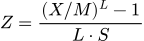
Where:
- X — the child's measured head circumference in centimeters.
- M — the Zemel DS median head circumference at that age and sex (not the CDC or WHO median).
- L — the Box-Cox skewness parameter for the DS population. DS head-circumference distributions are more sharply peaked than general-population curves, and Zemel's L values reflect that.
- S — the coefficient of variation for the DS population.
Third, the Z-score is mapped to a percentile through the standard normal cumulative distribution function, Φ(Z). A Z of 0 maps to the 50th percentile among children with Down syndrome, −1.88 to the 3rd, and +1.88 to the 97th.
Why CDC and WHO charts are not appropriate for children with Down syndrome. Babies and toddlers with Trisomy 21 have smaller head circumference and a broader, shorter skull (brachycephaly) than the general pediatric population. Plotted on the CDC chart, the DS median head circumference reads near the 3rd percentile — the same tracing that plots near the 50th on the Zemel chart. The American Academy of Pediatrics 2022 Health Supervision guidelines recommend Zemel 2015 for DS-specific growth monitoring from birth to age 3, and they underpin this calculator.
The Zemel head-circumference table is spaced at 1-month intervals from 1 to 36 months, so fractional ages (e.g., 6.8 months) are handled by linearly interpolating L, M, and S between the two bracketing rows. Ages under 1 month are rejected — there is no month-0 DS-specific head-circumference row in the Zemel reference.
Related Calculators
- DS Weight-for-Age (0-36 mo)
- DS Length-for-Age (1-36 mo)
- DS Weight-for-Length
- CDC Head Circ-for-Age (0-36 mo) — general-population comparison
- Dosage by Weight Calculator — Weight-based pediatric medication dosing
Related Sites
- Medical Equations — Hemodynamic, pulmonary, and dosing calculators
- LoanChop — Loan prepayment calculator
- AJ Designer — 200+ engineering and science calculators
- Z-Score Calculator — Z-score, percentile, and probability calculator
- Hourly Salaries — Hourly wage to annual salary converter
- Temperature Tool — Temperature unit converter