Down Syndrome Height-for-Age Growth Chart (Zemel 2015, 2-20 Years)
Plot your child's standing height against the Down syndrome-specific growth standards (Zemel 2015) for ages 2-20 years. CDC and WHO height curves consistently misclassify children with Trisomy 21 as "short for age" because they are built on the general pediatric population — the Zemel DS-specific chart gives a fair DS-to-DS comparison and is the reference endorsed by the American Academy of Pediatrics for DS growth monitoring.
LMS Method: Z = ((X/M)^L − 1) / (L × S), percentile = Φ(Z) × 100
How It Works
This calculator uses the Down syndrome-specific LMS parameters published by Zemel et al. (2015) from the Down Syndrome Growing Up Study (DSGS), which followed 637 participants with Trisomy 21 across 10 US sites from birth through age 20. For a given age and sex it looks up three DS-specific parameters — L (skewness), M (DS median standing height), and S (coefficient of variation) — computes a Z-score with the Box-Cox LMS equation Z = ((X/M)^L − 1) / (L × S), and maps that Z-score through the standard normal CDF to a percentile between 0 and 100. The table spans 24 to 240 months in 1-month intervals, so fractional ages are handled by linearly interpolating L, M, and S between the two bracketing rows. The critical point: the M value here is the median standing height among children with Down syndrome, not among all US children. That is why a 10-year-old girl with DS at 125 cm reads near the 27th DS percentile here but below the 3rd on the CDC chart — same child, fair comparison. Short stature is a characteristic feature of Trisomy 21, not a growth failure, and the Zemel curves reflect the DS population's natural height distribution.
Example Problem
A 10-year-old girl with Down syndrome measures 125 cm (49.2 in) in standing height. Where does she fall on the Zemel 2015 DS-specific height-for-age chart, and how does that compare to a CDC reading?
- Record the child's date of birth and the date of today's measurement — 10 years (120 months) apart — and note the sex as Girl with Down syndrome.
- Confirm the measurement is standing height (shoes off, heels against the wall). If recorded in inches or feet-inches, the calculator converts to centimeters automatically.
- Look up the Zemel 2015 DS LMS triple for girls at 120 months: L ≈ 1.957, M ≈ 128.8 cm, S ≈ 0.049.
- Compute the Z-score with Z = ((X/M)^L − 1) / (L × S). Substituting gives Z ≈ ((125.0/128.8)^1.957 − 1) / (1.957 × 0.049) ≈ −0.60.
- Map the Z-score through the standard normal CDF: Φ(−0.60) ≈ 0.27, so the percentile is approximately the 27th on the DS-specific chart — below the DS median but well within the typical DS growth range for 10-year-old girls.
- Compare with CDC: 125 cm at 10 years plotted on the CDC girls stature chart reads near the 2nd percentile (below the 3rd), well below the DS-specific reading. CDC under-rates typical DS heights and Zemel gives the clinically appropriate read for a child with Trisomy 21.
Key Concepts
Individuals with Down syndrome have shorter stature than the general population — this is a characteristic of Trisomy 21, not a sign of growth failure. Adult heights for DS are typically around 156 cm (5 ft 2 in) for men and 144 cm (4 ft 9 in) for women, compared with about 175 cm and 162 cm for the general US population. The Zemel 2015 DS-specific charts — built from ~637 US children with Trisomy 21 — give a fair DS-to-DS comparison: the 50th DS percentile is the median standing height among children with Down syndrome at that exact age and sex. A percentile on this chart is still a rank, not a grade or a target; any steady channel between the 3rd and 97th DS percentiles is normal DS growth. What matters most is the trajectory across visits. Puberty is often delayed in Trisomy 21, so the adolescent growth spurt typically starts and finishes 1-2 years later than in the general population. Growth-hormone therapy is not routinely recommended in DS; endocrinology referral is usually reserved for children whose height drops across two or more DS percentile bands, crosses below the 3rd DS percentile, or who show signs of hypothyroidism, celiac disease, or nutritional compromise on top of short stature.
Applications
- Well-child and DS specialty clinic visits: pediatricians and DS clinics plot standing height against the Zemel chart to confirm steady growth along a DS percentile channel.
- Evaluating a plateau or drop in height velocity on top of characteristic DS short stature — the trigger for hypothyroidism, celiac, or endocrinology workup.
- Tracking growth through the delayed pubertal spurt typical of Trisomy 21 (often 1-2 years later than the general population).
- Monitoring post-surgical recovery (cardiac repair, sleep apnea intervention) where catch-up growth is expected.
- Separating expected DS short stature from genuine clinical concerns before ordering growth-hormone stimulation testing.
- Contextualizing adult height expectations for families and care teams — median DS adult height is ~156 cm (males) / 144 cm (females).
Common Mistakes
- Using the CDC or WHO stature charts for a child with Trisomy 21 — a DS 10-year-old girl at 125 cm reads below the 3rd CDC percentile but around the 27th DS percentile (Zemel median for that age is ~129 cm).
- Treating DS short stature as growth failure and ordering growth-hormone evaluation before ruling out the usual DS medical comorbidities (hypothyroidism, celiac disease, obstructive sleep apnea).
- Comparing a Zemel DS percentile to a CDC percentile as if they were the same scale — they describe different reference populations.
- Using recumbent length for a child over 2 years — the Zemel 2-20 chart expects standing height.
- Judging growth from a single measurement rather than the trajectory across visits — a single point at the 10th DS percentile is not, by itself, a clinical concern.
- Assuming growth-hormone therapy results can be interpreted against these untreated-growth charts — Zemel 2015 is based on children not receiving GH.
- Not accounting for the delayed DS pubertal spurt — a 13-year-old with DS at the 15th DS percentile may still be pre-pubertal, with catch-up to follow.
Frequently Asked Questions
Why should I use Down syndrome-specific height charts instead of CDC or WHO?
Short stature persists into adolescence and adulthood for individuals with Down syndrome, with mean adult height typically 5–8 inches below the general population. Plotting against CDC 2–20 charts mislabels typical DS stature as growth failure. The Zemel 2015 DS-specific height-for-age chart compares standing height to other children and adolescents with DS, giving a percentile that reflects DS norms rather than general-population norms.
What age range does this calculator cover?
This calculator covers ages 2 to 20 years (24 to 240 months) using the Zemel 2015 DS-specific height-for-age LMS table. For children under 2, use the DS Length-for-Age calculator (1-36 months, recumbent length). The 2-20 chart uses standing height, so measurements should be taken shoes-off with the child standing against a wall.
What is the typical adult height for a person with Down syndrome?
On the Zemel 2015 chart, the median height at age 20 is about 156.5 cm (5 ft 2 in) for males and 144.8 cm (4 ft 9 in) for females with Down syndrome — compared with about 175 cm (5 ft 9 in) and 162 cm (5 ft 4 in) in the general US population. Individual adult height varies with parental stature, comorbidities, and pubertal timing, but short stature is a characteristic feature of Trisomy 21, not a growth failure.
When should I talk to endocrinology about my child's height?
Endocrinology referral is usually reserved for children with DS whose height crosses downward through two or more major DS percentile bands between visits, whose height drops below the 3rd DS percentile, or who show short stature on top of other concerning signs (cold intolerance, fatigue, GI symptoms, delayed bone age). Most pediatric DS clinics first rule out hypothyroidism (a TSH/free T4 panel), celiac disease, nutritional issues, and obstructive sleep apnea before considering growth-hormone stimulation testing. Growth hormone is not routinely given to children with DS.
Where does the Zemel 2015 data come from?
The LMS parameters used here are from Zemel BS et al., "Growth Charts for Children With Down Syndrome in the United States," Pediatrics 2015;136(5):e1204-e1211. The study pooled data from the Down Syndrome Growing Up Study (DSGS) with 637 participants across 10 US sites, combining over 3,800 measurements from birth through age 20, and fit LMS curves specifically to the DS population. The charts were endorsed by the American Academy of Pediatrics 2022 Health Supervision guidelines as the standard DS-specific growth reference.
Why do the CDC and WHO charts mislabel my child with Down syndrome as "too short"?
CDC and WHO curves describe the general pediatric population, in which DS-specific growth patterns are absent. The median 10-year-old girl on the CDC chart is about 138 cm; the median 10-year-old girl with DS on the Zemel chart is about 125 cm. Plotted on the CDC chart, a typical girl with DS of either age looks like she is in a pathologic short-stature zone. Plotted on the Zemel chart, she is at the DS median. The two charts are not interchangeable and should not be compared percentile-to-percentile.
Does growth-hormone therapy change how I read this chart?
The Zemel 2015 charts were built from children with Down syndrome not receiving growth hormone, so percentiles for a child on GH therapy are not directly comparable to these curves. GH is not routinely recommended for DS and is typically used only when co-existing GH deficiency is documented by an endocrinologist. If your child is on GH, your endocrinology team will track growth velocity and bone age alongside the Zemel chart rather than using the percentile in isolation.
Can I estimate adult height from my child's current DS percentile?
Most pediatric DS clinics track each child along their DS percentile channel rather than applying a general-population adult-height predictor. Methods like Khamis-Roche are built on non-DS children and overestimate adult height in Trisomy 21. A child tracking along the 50th DS percentile can be expected to reach an adult height near the Zemel 50th at age 20 (about 156 cm for males, 145 cm for females); a child tracking the 10th or 90th DS percentile will generally land near that same DS channel as an adult. Your care team can refine this estimate with bone age and pubertal timing.
Reference:
Zemel BS, Pipan M, Stallings VA, et al. Growth Charts for Children With Down Syndrome in the United States. Pediatrics. 2015;136(5):e1204-e1211. https://publications.aap.org/pediatrics/article/136/5/e1204/33890/Growth-Charts-for-Children-With-Down-Syndrome-in
Worked Examples
Young child
Where does a 3-year-old boy with Down syndrome standing 87 cm tall sit on the Zemel chart?
A pediatric DS clinic is seeing a 3-year-old boy with Trisomy 21 at his annual visit. Standing height (shoes off, heels against the wall) comes in at 87.0 cm (34.3 in). The CDC chart would read near the 1st percentile and trigger a short-stature workup — the Zemel DS-specific chart is the appropriate reference.
- Knowns: age 36 mo, sex boy, standing height 87.0 cm (DS)
- Zemel 2015 DS LMS at 36 mo (boys): L ≈ 0.453, M ≈ 87.22 cm, S ≈ 0.046
- Z ≈ ((87.0 / 87.22)^0.453 − 1) / (0.453 × 0.046) ≈ −0.06
- Φ(−0.06) ≈ 0.48
~48th percentile on the DS-specific chart — squarely at the DS median for 3-year-old boys.
On the CDC chart, 87.0 cm at 36 months reads near the 1st percentile. Short stature is characteristic of Trisomy 21 — not a growth failure — and the Zemel reading is the clinically appropriate one.
Mid-childhood
A 10-year-old girl with Down syndrome is 125 cm tall — what percentile?
A parent brings their daughter with Trisomy 21 in for a well-child visit. Standing height is measured at 125.0 cm (49.2 in). They want to know where she sits on the DS-specific Zemel chart — and why the CDC chart would read very differently.
- Knowns: age 120 mo, sex girl, standing height 125.0 cm (DS)
- Zemel 2015 DS LMS at 120 mo (girls): L ≈ 1.957, M ≈ 128.8 cm, S ≈ 0.049
- Z ≈ ((125.0 / 128.8)^1.957 − 1) / (1.957 × 0.049) ≈ −0.60
- Φ(−0.60) ≈ 0.27
~27th percentile on the DS-specific chart — below the DS median but within the typical DS growth range for 10-year-old girls.
On the CDC chart, 125 cm at 10 years reads near the 2nd percentile (below the 3rd). The Zemel chart pulls the same measurement up to the 27th DS percentile because the DS median height is lower — about 129 cm at this age — and that is the clinically appropriate frame of reference for a child with Trisomy 21.
Late adolescence
A 17-year-old boy with Down syndrome is 5 ft 1 in tall — is he tracking within the expected range?
A 17-year-old boy with Trisomy 21 is being seen at his transition-to-adult-care visit. Standing height is 5 ft 1 in (155.0 cm). Puberty is typically delayed 1-2 years in DS, so late adolescents may still be finishing their pubertal spurt. The care team wants to confirm he is tracking within the expected DS band.
- Knowns: age 204 mo, sex boy, standing height 155.0 cm → 5 ft 1.0 in (DS)
- Zemel 2015 DS LMS at 204 mo (boys): L ≈ 0.453, M ≈ 155.6 cm, S ≈ 0.045
- Z ≈ ((155.0 / 155.6)^0.453 − 1) / (0.453 × 0.045) ≈ −0.09
- Φ(−0.09) ≈ 0.47
~47th percentile on the DS-specific chart — a normal late-adolescent DS channel.
Median adult DS height is about 156 cm (5 ft 2 in) for males and 145 cm (4 ft 9 in) for females. A 17-year-old with DS tracking near the 50th DS percentile is on pace for a typical DS adult height.
How the percentile is calculated
The calculator turns one standing-height measurement into a Down syndrome-specific percentile in three stages. First, it looks up three parameters — L, M, and S — from the Zemel 2015 DS-specific reference table for the child's exact age and sex. L is the Box-Cox power transform (it accounts for skew in childhood height distributions), M is the median standing height at that age among children with Down syndrome, and S is the coefficient of variation. Second, it plugs those parameters into the standard LMS Z-score formula:
Z score equals the quantity X divided by M, raised to the power L, minus 1, divided by L times S.
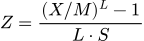
Where:
- X — the child's measured standing height in centimeters.
- M — the Zemel DS median standing height at that age and sex (not the CDC or WHO median).
- L — the Box-Cox skewness parameter for the DS population.
- S — the coefficient of variation for the DS population.
Third, the Z-score is mapped to a percentile through the standard normal cumulative distribution function, Φ(Z). A Z of 0 maps to the 50th percentile among children with Down syndrome, −1.88 to the 3rd, and +1.88 to the 97th.
Short stature is characteristic of Trisomy 21, not growth failure. Children with Down syndrome have measurably shorter stature than the general pediatric population throughout childhood — median adult DS height is about 156 cm (5 ft 2 in) for males and 145 cm (4 ft 9 in) for females, compared with roughly 175 cm and 162 cm in the general US population. The Zemel curves reflect this DS-population height distribution: the 50th DS percentile is the median height among children with Down syndrome at that age and sex. That is why a 10-year-old girl with DS at 125 cm reads around the 27th DS percentile here but near the 2nd CDC percentile — the two charts describe different populations and are not interchangeable.
The Zemel 2-20 table is spaced at 1-month intervals (24 to 240 months inclusive), so fractional ages are handled by linearly interpolating L, M, and S between the two bracketing rows. The American Academy of Pediatrics 2022 Health Supervision guidelines recommend Zemel 2015 as the standard DS-specific growth reference — which is the chart this calculator implements.
Related Calculators
- DS BMI-for-Age (2-20 yr) — for weight-to-height ratio in older DS children
- DS Weight-for-Age (0-36 mo)
- DS Length-for-Age (1-36 mo) — for infants and toddlers with Down syndrome
- Adult Height Predictor (Khamis-Roche) — general-population adult-height estimate
- Dosage by Weight Calculator — Weight-based pediatric medication dosing
Related Sites
- Medical Equations — Hemodynamic, pulmonary, and dosing calculators
- LoanChop — Loan prepayment calculator
- Z-Score Calculator — Z-score, percentile, and probability calculator
- AJ Designer — 200+ engineering and science calculators
- Temperature Tool — Temperature unit converter
- Percent Off Calculator — Discount and sale price calculator