Down Syndrome BMI-for-Age Growth Chart (Zemel 2015, 2-20 Years)
Plot a child or teen with Down syndrome's BMI against DS-specific reference data (Zemel 2015) for ages 2-20 years. The chart displays the DS-specific percentile curves (3rd, 15th, 50th, 85th, 97th) with your child's BMI pinned on top — the AAP-recommended screening tool for overweight and obesity in children with Trisomy 21, who have a higher prevalence of obesity than typically developing peers.
BMI = weight (kg) / height (m)² | LMS: Z = ((X/M)^L − 1) / (L × S)
How It Works
This calculator uses Down syndrome-specific growth charts developed by Zemel et al. (2015) for BMI-for-age assessment in children and adolescents with DS aged 2 to 20 years. The workflow has three stages: first, BMI is computed from weight and height (BMI = weight (kg) / height (m)²). Second, the calculator looks up three DS-specific parameters — L (skewness), M (DS median BMI), and S (coefficient of variation) — from the Zemel 2015 table for the child's exact age in months and sex. Third, it computes a Z-score with the Box-Cox LMS equation Z = ((X/M)^L − 1) / (L × S) and maps that Z through the standard normal CDF to a percentile between 0 and 100. The critical point: M is the median BMI among children with Down syndrome, not among all US children. Children with DS have a higher prevalence of overweight and obesity than typically developing peers — hypothyroidism, lower activity levels, shorter stature, and metabolic differences all contribute — so CDC or WHO BMI charts underestimate DS obesity risk. The Zemel chart gives a fair DS-to-DS comparison and is endorsed by the American Academy of Pediatrics 2022 Down Syndrome Health Supervision guidelines.
Example Problem
A 10-year-old boy with Down syndrome is 125 cm tall and weighs 30 kg. What is his BMI-for-age percentile on the Zemel 2015 DS-specific chart, and how does that compare to a CDC reading?
- Record the child's date of birth and the measurement date — about 10 years (120 months) apart — and note the sex as Boy with Down syndrome.
- Convert the inputs to canonical units if needed. Height 125 cm and weight 30.0 kg are already in standard SI units, so no conversion is needed.
- Compute BMI from the formula BMI = weight / height². Substituting gives BMI = 30.0 / (1.25)² = 30.0 / 1.5625 = 19.2 kg/m².
- Look up the Zemel 2015 DS LMS triple for boys at 120 months: L ≈ -1.435, M ≈ 18.577 kg/m², S ≈ 0.147.
- Compute the Z-score with Z = ((X/M)^L − 1) / (L × S). Substituting BMI 19.2 gives Z ≈ ((19.2/18.577)^-1.435 − 1) / (-1.435 × 0.147) ≈ 0.22.
- Map the Z-score through the standard normal CDF: Φ(0.22) ≈ 0.59, so the percentile is about the 59th on the DS-specific chart — just above the DS median, inside the healthy-weight band.
Key Concepts
A DS BMI-for-age percentile is a rank among children with Down syndrome of the same age and sex, not among all children. The 50th percentile means half of children with DS at that age have a lower BMI — it does not mean the child is average compared to typically developing peers. Down syndrome carries a higher baseline prevalence of overweight and obesity than the general pediatric population, and several DS-specific risk factors drive this: congenital and acquired hypothyroidism (subclinical hypothyroidism is common and suppresses metabolism), lower spontaneous activity and exercise tolerance, shorter stature that inflates BMI at the same weight, and sleep-disordered breathing that disrupts metabolic regulation. Standard BMI cutoffs underestimate obesity in DS — a Zemel 2015 DS-specific reading is consistently higher than the CDC reading for the same child. The Zemel 2015 BMI-for-age categories are: below 3rd DS percentile = thinness (Z < -2), 3rd-85th = healthy weight for DS, above 85th = overweight for DS (Z > +1), above 97th = obesity for DS (Z > +2). BMI does not distinguish muscle from fat — though this is less of a confound in the DS population, where lean-body-mass athletes are rare at these ages — and pediatricians pair BMI-for-age with waist circumference, body composition, and trajectory over time before treating a single reading as a diagnosis. Comorbid cardiac disease (especially unrepaired or recently repaired AVSD) can slow weight gain and temporarily lower BMI, just as untreated hypothyroidism can raise it.
Applications
- DS-specialty-clinic BMI screening from age 2 through 20 — the Zemel chart is the AAP 2022 recommended reference for DS-specific growth tracking.
- Annual well-child visits for children and adolescents with Down syndrome, where BMI trajectory guides lifestyle counseling and lab screening.
- Identifying overweight and obesity risk specific to the DS population — standard CDC/WHO BMI charts underestimate DS obesity.
- Monitoring the effectiveness of dietary, exercise, and endocrine (levothyroxine) interventions in children with DS.
- Pre- and post-cardiac-surgery weight and BMI tracking (AVSD repair, Tetralogy of Fallot) where early BMI rebound is expected.
- Research on DS-specific pediatric obesity prevalence, metabolic syndrome, and cardiometabolic outcomes.
Common Mistakes
- Using standard CDC or WHO BMI-for-age charts for a child with Trisomy 21 — these references underestimate DS obesity risk and misclassify DS-specific overweight as healthy.
- Comparing a Zemel DS percentile to a CDC or WHO percentile as if they were the same scale — they describe different reference populations entirely.
- Using adult BMI categories (BMI ≥ 25 = overweight, ≥ 30 = obese) for children with DS — children under 19 require age- and sex-specific DS percentiles, never fixed cutoffs.
- Not measuring height and weight accurately — a 1 cm or 0.5 kg error shifts BMI noticeably in a shorter child and can move a DS percentile reading by 10+ points.
- Judging DS growth from a single BMI reading rather than the trajectory across visits — a single point above the 85th DS percentile is a screening flag, not a diagnosis.
- Ignoring DS comorbidities that affect BMI: untreated or subclinical hypothyroidism (raises BMI), obstructive sleep apnea, celiac disease, unrepaired cardiac defects (suppress weight gain), and medication side effects.
- Using this 2-20 BMI-for-age calculator for children under 2 — below age 2 the DS weight-for-length chart is the appropriate adiposity screen.
Frequently Asked Questions
What is the DS-specific BMI-for-age chart used for?
It is the Zemel 2015 BMI-for-age reference for children and adolescents (2–20 years) with Down syndrome. Children with DS are at elevated risk for higher BMI due to lower resting metabolic rate and reduced muscle tone. Comparing against general-population CDC charts can over- or under-call weight status; the DS-specific chart provides a percentile against other children with DS, supporting more meaningful clinical and family decisions.
Why is BMI monitoring especially important for children with Down syndrome?
Children and adolescents with Down syndrome have a higher prevalence of overweight and obesity than typically developing peers. Estimates from DS clinic cohorts place overweight/obesity prevalence around 30-50% in school-age children with DS, compared to roughly 30% in the general US pediatric population. The increased risk is driven by hypothyroidism (both congenital and acquired, including subclinical forms), lower spontaneous activity and exercise tolerance, shorter stature that inflates BMI at the same weight, obstructive sleep apnea, and metabolic differences. Early identification via DS-specific BMI-for-age lets families intervene before downstream cardiometabolic complications develop.
Why can't I use a standard CDC or WHO BMI calculator for my child with DS?
CDC and WHO BMI-for-age references are built from typically developing children and do not reflect the distinct body composition and shorter stature of the DS population. Using them for children with Trisomy 21 underestimates obesity risk — a child with DS at the 75th CDC BMI percentile may actually be at the 85th or 90th on the Zemel DS-specific chart, meaning the CDC reading can miss DS-specific overweight that warrants clinical attention. The American Academy of Pediatrics 2022 Down Syndrome Health Supervision guidelines specifically recommend the Zemel 2015 DS-specific BMI-for-age chart for children with Trisomy 21 aged 2 through 20.
What BMI percentile range is considered healthy for a child with Down syndrome?
On the Zemel 2015 DS-specific chart, a BMI between roughly the 3rd and 85th DS percentile is generally considered a healthy weight. Below the 3rd DS percentile may suggest underweight (and in DS, this raises concern for cardiac comorbidities, thyroid dysfunction, celiac disease, or feeding difficulty). Above the 85th DS percentile meets the DS-specific overweight threshold, and above the 97th meets the DS-specific obesity threshold — both warrant clinical follow-up. Trajectory across visits matters more than any single reading: a child tracking steadily along any DS channel is growing well, while a rapid upward crossing of two or more DS percentile bands is the stronger clinical signal.
How does thyroid screening fit into DS growth monitoring?
Hypothyroidism (both congenital and acquired) is the most common endocrine disorder in Down syndrome, and it directly affects weight and BMI. The AAP 2022 Down Syndrome Health Supervision guidelines recommend thyroid function testing (TSH ± free T4) at birth, 6 months, 12 months, and annually thereafter for all children with DS. A rising BMI-for-age trajectory on the Zemel chart, especially if paired with fatigue, constipation, dry skin, or growth velocity slowing, should prompt a thyroid recheck. Conversely, a falling BMI is rarely due to hyperthyroidism in DS — nutritional, cardiac, and GI causes are more common and warrant their own workup.
How do cardiac and metabolic comorbidities affect DS BMI percentiles?
Down syndrome co-occurs with congenital heart disease in roughly 40-50% of cases (atrioventricular septal defect being the most common), and unrepaired or recently repaired cardiac defects can suppress weight gain, lowering BMI below the DS median. After surgical repair, weight typically rebounds and BMI climbs back into the expected DS channel. Other DS comorbidities that shift BMI include obstructive sleep apnea (poorly controlled OSA is associated with higher BMI via hormonal dysregulation), celiac disease (common in DS; untreated celiac suppresses weight gain), gastroesophageal reflux, and polypharmacy (some psychotropic medications used for co-occurring behavioral conditions raise weight). A DS BMI reading should always be interpreted in the context of the child's cardiac, thyroid, GI, and sleep history rather than as an isolated number.
What does the AAP 2022 DS Health Supervision guideline say about BMI monitoring?
The American Academy of Pediatrics 2022 Health Supervision for Children and Adolescents with Down Syndrome guideline recommends using the Zemel 2015 DS-specific growth charts — including BMI-for-age from age 2 through 20 — at every well-child visit. It advises assessing weight, height, and BMI annually, plotting on the DS-specific chart, and screening for cardiometabolic risk (fasting lipids, glucose/HbA1c) starting at age 9-11 in children with DS who meet DS-specific overweight criteria. The guideline also emphasizes annual thyroid screening, OSA screening, and celiac screening as standard care — each of which intersects with weight and BMI trajectory. This calculator implements the chart reference portion of that guideline.
Is my child's DS BMI-for-age result a diagnosis?
No — this calculator is an educational tool. A BMI percentile on the Zemel DS chart is a screening result: high-percentile readings flag the need for clinical evaluation (physical exam, labs, diet and activity review), and low-percentile readings flag the need to investigate thyroid, cardiac, GI, or feeding contributors. Your pediatrician or DS specialty clinic interprets the percentile in the context of your child's full medical history, comorbidities, trajectory across visits, and physical findings. Do not start or stop any intervention based on a single calculator reading.
Reference:
Zemel BS, Pipan M, Stallings VA, et al. Growth Charts for Children With Down Syndrome in the United States. Pediatrics. 2015;136(5):e1204-e1211. https://publications.aap.org/pediatrics/article/136/5/e1204/33890/Growth-Charts-for-Children-With-Down-Syndrome-in
Worked Examples
Underweight flag (DS)
A 5-year-old boy with Down syndrome is 99.5 cm and 13.5 kg — is his BMI-for-age too low on the Zemel chart?
A pediatrician is seeing a 5-year-old boy with Trisomy 21 who has had feeding difficulties and a repaired cardiac defect. Height is 99.5 cm (3 ft 3 in) and weight is 13.5 kg (29.8 lb). BMI comes out low on the Zemel DS-specific chart — the team wants the DS-to-DS percentile, not a CDC reading.
- Knowns: age 60 mo (5.0 yr), sex boy with DS, weight 13.5 kg, height 99.5 cm
- BMI = 13.5 / (0.995)² ≈ 13.6 kg/m²
- Zemel 2015 DS LMS at 60 mo (boys): L ≈ −1.435, M ≈ 16.89 kg/m², S ≈ 0.102
- Z = ((13.6 / 16.89)^−1.435 − 1) / (−1.435 × 0.102) ≈ −2.49
- Φ(−2.49) ≈ 0.006
~0.6 percentile on the Zemel DS chart (BMI ≈ 13.6 kg/m²) — well below the DS-specific thinness threshold.
A BMI below the 3rd DS percentile warrants nutritional and endocrine workup in the DS population: hypothyroidism, celiac disease, reflux, oromotor feeding issues, and post-cardiac-repair recovery are all common contributors. The Zemel chart is the clinically appropriate reference — a CDC or WHO BMI reading here would be even lower and less actionable.
Healthy-weight DS check-up
A 10-year-old boy with Down syndrome is 125 cm and 30 kg — where does his BMI fall?
A pediatrician is reviewing a 10-year-old boy with Down syndrome at his annual visit. Height is 125 cm (4 ft 1 in) and weight is 30.0 kg (66.1 lb). The provider wants a fast DS-specific BMI-for-age percentile read.
- Knowns: age 120 mo (10.0 yr), sex boy with DS, weight 30.0 kg, height 125 cm
- BMI = 30.0 / (1.25)² = 19.2 kg/m²
- Zemel 2015 DS LMS at 120 mo (boys): L ≈ −1.435, M ≈ 18.58 kg/m², S ≈ 0.147
- Z = ((19.2 / 18.58)^−1.435 − 1) / (−1.435 × 0.147) ≈ 0.22
- Φ(0.22) ≈ 0.59
~59th percentile on the Zemel DS chart (BMI ≈ 19.2 kg/m²) — just above the DS median, inside the healthy-weight band for children with Down syndrome.
A single reading in the 50–85th DS percentile band is unremarkable. Pediatricians watch whether he continues tracking his usual DS channel across successive visits. On the CDC 2-20 BMI chart the same BMI of 19.2 at age 10 reads near the 75th percentile — a reminder that the two references classify DS children differently.
Adolescent DS overweight screening
A 14-year-old girl with Down syndrome weighs 145 lb at 4 ft 10 in — is her BMI-for-age above the DS overweight threshold?
A 14-year-old girl with Trisomy 21 is being screened at her annual visit. Weight is 145.0 lb and height is 4 ft 10 in (147 cm). Overweight and obesity are more prevalent in the DS population than in typically developing peers, so the Zemel DS-specific chart gives the fair comparison. The calculator converts pounds and feet/inches internally.
- Knowns: age 168 mo (14.0 yr), sex girl with DS, weight 145 lb → 65.8 kg, height 147 cm
- BMI = 65.8 / (1.47)² ≈ 30.4 kg/m²
- Zemel 2015 DS LMS at 168 mo (girls): L ≈ −0.868, M ≈ 23.16 kg/m², S ≈ 0.207
- Z = ((30.4 / 23.16)^−0.868 − 1) / (−0.868 × 0.207) ≈ 1.18
- Φ(1.18) ≈ 0.88
~88th percentile on the Zemel DS chart (BMI ≈ 30.4 kg/m²) — above the DS 85th-percentile overweight threshold, below the 97th obesity cutoff.
Adolescents with Down syndrome have a higher prevalence of overweight and obesity than typically developing peers, driven by hypothyroidism, lower activity levels, and metabolic differences. A BMI in the DS 85th-97th band meets the DS-specific overweight cutoff and is the signal for lifestyle counseling, thyroid re-check, and cardiometabolic screening (fasting lipids, glucose) per the AAP 2022 Down Syndrome Health Supervision guidance.
How the percentile is calculated
The calculator turns a weight and height into a Down syndrome-specific BMI-for-age percentile in three stages. First, it computes BMI from the measurements:
BMI equals weight in kilograms divided by height in meters squared.
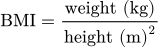
Weight in pounds and height in inches or feet+inches are converted to kilograms and meters before BMI is calculated (BMI is always expressed in kg/m²). Second, the calculator looks up three parameters — L, M, and S — from the Zemel 2015 Down syndrome-specific reference table for the child's exact age in months and sex. L is the Box-Cox power transform (it accounts for skew in DS BMI distributions), M is the median BMI at that age among children with Down syndrome, and S is the coefficient of variation for the DS population. Third, it plugs those parameters into the standard LMS Z-score formula:
Z score equals the quantity X divided by M, raised to the power L, minus 1, divided by L times S.
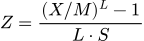
Where:
- X — the child's computed BMI in kg/m².
- M — the Zemel DS median BMI at that age and sex (not the CDC or WHO median).
- L — the Box-Cox skewness parameter for the DS population.
- S — the coefficient of variation for the DS population.
Finally, the Z-score is mapped to a percentile through the standard normal cumulative distribution function, Φ(Z). A Z of 0 maps to the 50th percentile among children with Down syndrome, +1 to the ~85th (DS overweight threshold), and +2 to the ~97th (DS obesity threshold).
Why CDC and WHO BMI charts are not appropriate for children with Down syndrome. Children and adolescents with Trisomy 21 have a higher prevalence of overweight and obesity than typically developing peers, driven by hypothyroidism, lower activity levels, shorter stature, and metabolic differences. At the same time, their shorter stature means BMI (weight ÷ height²) inflates at a different trajectory across childhood. Using CDC or WHO BMI-for-age underestimates obesity risk in the DS population — a child with Trisomy 21 at the 75th CDC BMI percentile may be at the 85th or 90th on the Zemel DS chart. The AAP 2022 Down Syndrome Health Supervision guidelines recommend Zemel 2015 for DS-specific growth tracking from age 2 through 20, and they underpin this calculator.
The Zemel BMI-for-age table is spaced at 6-month intervals from age 2 to 20, so fractional ages (e.g., 10.4 years) are handled by linearly interpolating L, M, and S between the two bracketing rows.
Related Calculators
- DS Height-for-Age (2-20 yr)
- DS Weight-for-Age (0-36 mo)
- DS Weight-for-Length
- CDC Extended BMI (2-20 yr) — typically developing peers reference
- Dosage by Weight Calculator — Weight-based pediatric medication dosing
Related Sites
- Medical Equations — Hemodynamic, pulmonary, and dosing calculators
- LoanChop — Loan prepayment calculator
- Z-Score Calculator — Z-score, percentile, and probability calculator
- AJ Designer — 200+ engineering and science calculators
- Temperature Tool — Temperature unit converter
- Percent Off Calculator — Discount and sale price calculator