Down Syndrome Length-for-Age Growth Chart (Zemel 2015, 1-36 Months)
Plot your child's recumbent length against Down syndrome-specific growth standards (Zemel 2015) for ages 1 to 36 months. CDC and WHO length curves consistently overestimate where a child with Trisomy 21 falls — the Zemel DS-specific chart is the standard recommended by the American Academy of Pediatrics for DS linear-growth monitoring from infancy through age 3.
LMS Method: Z = ((X/M)^L − 1) / (L × S), percentile = Φ(Z) × 100
How It Works
This calculator uses the Down syndrome-specific LMS parameters published by Zemel et al. (2015) from the Down Syndrome Growing Up Study (DSGS), which followed 637 US participants with Trisomy 21 from birth through age 20. For a given age and sex it looks up three DS-specific parameters — L (skewness), M (DS median length), and S (coefficient of variation) — computes a Z-score with the Box-Cox LMS equation Z = ((X/M)^L − 1) / (L × S), and maps that Z-score through the standard normal CDF to a percentile between 0 and 100. The length table is spaced at 1-month intervals starting at month 1 (recumbent length measurements at birth in DS are often complicated by medical stabilization, feeding-tube setups, and pulmonary issues), so fractional ages such as 6.8 months are handled by linearly interpolating L, M, and S between the two bracketing rows. The critical point: the M value here is the median length among children with Down syndrome, not among all US children. That is why a 12-month-old girl with DS measuring 70 cm reads near the 50th DS percentile here but only around the 3rd on the CDC chart — same child, fair comparison.
Example Problem
A 12-month-old girl with Down syndrome measures 70 cm (27.6 in) at her 1-year well-child visit. Where does she fall on the Zemel 2015 DS-specific length-for-age chart, and how does that compare to a CDC reading?
- Record the child's date of birth and the date of today's measurement — 12 months apart — and note the sex as Girl with Down syndrome.
- Measure length recumbent (lying down), not standing — standing height and recumbent length differ by 1-2 cm in toddlers and using the wrong modality throws the percentile off.
- Convert the measurement to centimeters if it was recorded in inches. Here it is already 70 cm, so no conversion is needed.
- Look up the Zemel 2015 DS LMS triple for girls at 12 months: L ≈ 1.957, M ≈ 70.357 cm, S ≈ 0.041.
- Compute the Z-score with Z = ((X/M)^L − 1) / (L × S). Substituting gives Z ≈ ((70/70.357)^1.957 − 1) / (1.957 × 0.041) ≈ −0.12.
- Map the Z-score through the standard normal CDF: Φ(−0.12) ≈ 0.45, so the percentile is approximately the 45th on the DS-specific chart — squarely within the expected DS range.
- Compare with CDC: the same 70 cm at 12 months on the CDC length chart reads near the 3rd percentile, which would incorrectly flag a healthy DS child as having short stature. The Zemel result is the clinically appropriate reading for a child with Trisomy 21.
Key Concepts
Children with Down syndrome have distinct linear-growth patterns that differ from the general pediatric population. Lower birth length, slower length velocity during the first 24 months, and musculoskeletal differences (generalized hypotonia, cervical-spine ligamentous laxity, subtle skeletal dysplasia phenotypes) all contribute to shorter length at a given age. Standard CDC or WHO curves therefore classify many healthy DS children as short or having growth failure. The Zemel 2015 DS-specific length chart — built from ~637 US children with Trisomy 21 — gives a fair DS-to-DS comparison: the 50th DS percentile is the median length among children with Down syndrome at that exact age and sex. A percentile on this chart is still a rank (not a grade or a target); what matters clinically is whether the child tracks steadily along any DS percentile channel over time. Trisomy 21 commonly co-occurs with congenital hypothyroidism, growth-hormone responsiveness issues, celiac disease, and cardiac comorbidities, each of which can affect linear growth, so a flattening trajectory on the Zemel chart is more meaningful than a single point.
Applications
- Well-child visits: pediatricians and DS specialty clinics plot each recumbent length against Zemel DS-specific curves to confirm a steady linear-growth trajectory.
- Thyroid management: congenital and acquired hypothyroidism are common in DS and can blunt length velocity — the DS length chart is tracked alongside TSH and free T4 labs.
- Celiac surveillance: celiac disease is over-represented in Trisomy 21 and classically suppresses linear growth before any GI symptoms show up.
- Growth-hormone evaluation: a persistent downward length trajectory on the Zemel chart combined with low IGF-1 can trigger an endocrine work-up, but only after DS-appropriate comparators have been applied.
- Post-cardiac-surgery follow-up: infants with AVSD or other congenital heart defects are expected to recover linear growth post-repair, and Zemel provides the correct baseline.
- Separating expected DS growth patterns (short-for-CDC, typical-for-DS) from true clinical short stature before ordering further workup.
Common Mistakes
- Using the CDC or WHO length chart for a child with Trisomy 21 — these curves run significantly longer than the DS population and will read artificially low.
- Measuring standing height instead of recumbent length for a child under 2-3 years — the two modalities differ and the Zemel 1-36 mo table is specifically for recumbent length.
- Expecting Zemel length data at birth — the table starts at 1 month because newborn DS length measurements are frequently unreliable.
- Comparing a Zemel DS length percentile to a CDC length percentile as if they were the same scale — they describe different reference populations.
- Treating the 50th DS percentile as a target rather than the midpoint of DS children; any steady channel between the 3rd and 97th DS percentiles is normal.
- Ignoring DS comorbidities that can suppress linear growth: untreated hypothyroidism, celiac disease, obstructive sleep apnea, and growth-hormone responsiveness issues.
- Not correcting for prematurity when a baby with DS was also born preterm — use corrected age for the first 2-3 years on top of the Zemel chart.
Frequently Asked Questions
Why should I use Down syndrome-specific length charts instead of CDC or WHO?
Children with Down syndrome characteristically have shorter stature than typically-developing peers — a feature, not a growth failure. Plotting length against CDC or WHO charts can mislabel a healthy DS child as growth-delayed. The Zemel 2015 DS-specific length-for-age chart compares length only to other children with DS. AAP 2022 guidelines recommend Zemel as the DS standard from birth to age 3.
Why does this chart start at 1 month instead of birth?
The Zemel 2015 DS length-for-age data begins at 1 month because reliable recumbent length measurements at birth are often complicated by medical conditions common in newborns with Trisomy 21 — NICU positioning, feeding tubes, cardiac monitoring setup, and treatment for transient myeloproliferative disorder all interfere with a clean length measurement. A month of stabilization produces a much more reliable starting point, so the table is indexed from month 1.
What is a typical length for a baby with Down syndrome?
On the Zemel DS-specific chart, the 50th-percentile recumbent length for a 12-month-old boy with DS is about 72.4 cm (28.5 in) and for a 12-month-old girl is about 70.4 cm (27.7 in) — noticeably shorter than CDC medians for typically developing peers at the same age. At 24 months the DS medians are about 81.5 cm (boys) and 79.4 cm (girls). Any length in the 3rd to 97th DS percentile range, tracking steadily, is considered typical linear growth for a child with Trisomy 21.
How do hypothyroidism or celiac disease affect the length percentile?
Congenital and acquired hypothyroidism are markedly more common in Down syndrome than in the general pediatric population, and both blunt length velocity. Celiac disease is also over-represented in Trisomy 21 and classically presents as linear-growth failure before GI symptoms appear. A child with DS whose length trajectory flattens on the Zemel chart — even while weight is stable — should trigger a review of TSH, free T4, anti-tTG IgA, and total IgA. The Zemel chart is still the correct reference; these comorbidities explain why a child might drop across percentile bands.
Is my child's Zemel length percentile "healthy"?
The 3rd to 97th DS percentile band is generally treated as the expected DS range. What matters most is the trajectory: a child tracking steadily along any DS percentile channel is growing well, even the 10th or the 90th. The stronger clinical signal is crossing two or more major DS percentile bands downward across a few visits, especially when combined with weight stalling, feeding changes, or lab abnormalities. A Zemel percentile is a data point for your pediatrician or DS specialist, not a diagnosis.
When should I call my pediatrician about my child's length?
Contact your pediatrician or DS specialty clinic if your child's length trajectory crosses two or more major DS percentile bands downward between visits, the length plots below the 3rd DS percentile at any single visit, growth slows in parallel with weight stalling or unexplained weight loss, or if you suspect a thyroid or celiac issue (new fatigue, constipation, diarrhea, abdominal bloating, pallor). This calculator is an educational tool — it does not replace clinical evaluation, and any concern about growth should go to your child's medical team.
Where does the Zemel 2015 data come from?
The LMS parameters used here are from Zemel BS et al., "Growth Charts for Children With Down Syndrome in the United States," Pediatrics 2015;136(5):e1204-e1211. The study pooled data from the Down Syndrome Growing Up Study (DSGS) with 637 participants across 10 US sites, combining over 3,800 measurements from birth through age 20, and fit LMS curves specifically to the DS population. The charts were endorsed by the American Academy of Pediatrics 2022 Health Supervision guidelines as the standard for DS-specific growth tracking from birth to age 3.
Should I use this chart if my baby with Down syndrome was also born preterm?
Yes — use the Zemel DS length chart, but plot by corrected age (chronological age minus weeks of prematurity) for the first 2-3 years. A baby born at 34 weeks with DS and measured at 6 months chronological age should be plotted at 4 months corrected on the Zemel chart. Preterm birth is more common in Trisomy 21; correcting for it prevents an artificially low DS length percentile during infancy.
Reference:
Zemel BS, Pipan M, Stallings VA, et al. Growth Charts for Children With Down Syndrome in the United States. Pediatrics. 2015;136(5):e1204-e1211. https://publications.aap.org/pediatrics/article/136/5/e1204/33890/Growth-Charts-for-Children-With-Down-Syndrome-in
Worked Examples
Early infancy
Where does a 3-month-old boy with Down syndrome measuring 57 cm fall on the Zemel chart?
A pediatrician is seeing a 3-month-old boy with Trisomy 21 at his well-child visit. Recumbent length is 57 cm (22.4 in). Babies with DS have shorter birth length and slower linear-growth velocity than typically developing peers, so the CDC length chart would read too low — the Zemel DS-specific chart gives the fair comparison.
- Knowns: age 3.0 mo, sex boy, length 57 cm (DS)
- Zemel 2015 DS LMS at 3 mo (boys): L ≈ 0.453, M ≈ 57.45 cm, S ≈ 0.040
- Z = ((57 / 57.45)^0.453 − 1) / (0.453 × 0.040) ≈ −0.20
- Φ(−0.20) ≈ 0.42
~42nd percentile on the DS-specific chart — within the expected DS range.
On the CDC length chart, 57 cm at 3 months reads near the 3rd percentile — a reminder that CDC/WHO length curves are not appropriate for babies with Down syndrome.
First birthday
A 12-month-old girl with Down syndrome measures 27.6 in at her 1-year visit — what percentile?
A parent arrives at the 12-month well-child visit with a daughter who has Down syndrome. The measurement reads 27.6 in (70.1 cm) recumbent. The calculator converts to centimeters internally and reads against the Zemel 2015 DS-specific girls length curve, not the CDC curve.
- Knowns: age 12.0 mo, sex girl, length 27.6 in → 70.1 cm (DS)
- Zemel 2015 DS LMS at 12 mo (girls): L ≈ 1.957, M ≈ 70.357 cm, S ≈ 0.041
- Z = ((70.1 / 70.357)^1.957 − 1) / (1.957 × 0.041) ≈ −0.09
- Φ(−0.09) ≈ 0.46
~46th percentile on the DS-specific chart — healthy range for girls with DS.
This same 70.1 cm length would read below the 5th percentile on the CDC length chart. For a child with DS, the correct reading is the Zemel result.
Toddler follow-up
A 24-month-old boy with Down syndrome and treated hypothyroidism is 80 cm — should we worry?
A toddler with Trisomy 21 and a 6-month history of levothyroxine-treated congenital hypothyroidism is being tracked on the Zemel chart. At 24 months he measures 80 cm (31.5 in) recumbent. The care team wants both the DS-specific percentile and a look at the trajectory across the thyroid treatment window.
- Knowns: age 24.0 mo, sex boy, length 80 cm (DS, treated hypothyroidism)
- Zemel 2015 DS LMS at 24 mo (boys): L ≈ 0.453, M ≈ 81.511 cm, S ≈ 0.044
- Z = ((80 / 81.511)^0.453 − 1) / (0.453 × 0.044) ≈ −0.43
- Φ(−0.43) ≈ 0.334
~33rd percentile on the DS-specific chart — inside the expected DS range.
Trajectory is the clinical signal. A treated-hypothyroidism child is expected to catch up on length; a flattening or downward crossing of DS percentile bands after treatment has been optimized warrants escalation.
How the percentile is calculated
The calculator turns one recumbent-length measurement into a Down syndrome-specific percentile in three stages. First, it looks up three parameters — L, M, and S — from the Zemel 2015 DS-specific length-for-age reference table for the child's exact age and sex. L is the Box-Cox power transform (it accounts for skew in childhood length distributions), M is the median length at that age among children with Down syndrome, and S is the coefficient of variation. Second, it plugs those parameters into the standard LMS Z-score formula:
Z score equals the quantity X divided by M, raised to the power L, minus 1, divided by L times S.
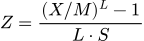
Where:
- X — the child's measured recumbent length in centimeters.
- M — the Zemel DS median length at that age and sex (not the CDC or WHO median).
- L — the Box-Cox skewness parameter for the DS population.
- S — the coefficient of variation for the DS population.
Third, the Z-score is mapped to a percentile through the standard normal cumulative distribution function, Φ(Z). A Z of 0 maps to the 50th percentile among children with Down syndrome, −1.88 to the 3rd, and +1.88 to the 97th.
Why CDC and WHO charts are not appropriate for children with Down syndrome. Babies and toddlers with Trisomy 21 have lower birth length, slower linear-growth velocity, and musculoskeletal differences (generalized hypotonia, cervical-spine ligamentous laxity, shorter long-bone proportions) that produce a distinctly shorter stature than the general pediatric population. If the same 70 cm measurement at 12 months is plotted on the CDC chart, it reads near the 3rd percentile and may trigger a short-stature workup. Plotted on the Zemel DS-specific chart, the same measurement reads near the 50th percentile — right where a typical child with DS is expected to be. The American Academy of Pediatrics 2022 Health Supervision guidelines recommend Zemel 2015 for DS-specific growth monitoring from birth to age 3, and they underpin this calculator.
The Zemel length table is spaced at 1-month intervals from 1 to 36 months (it starts at 1 month because recumbent length at birth in DS is often confounded by NICU positioning, cardiac monitoring, and feeding-tube setups), so fractional ages (e.g., 6.8 months) are handled by linearly interpolating L, M, and S between the two bracketing rows.
Related Calculators
- DS Weight-for-Age (0-36 mo)
- DS Head Circ-for-Age (1-36 mo)
- DS Weight-for-Length
- DS Height-for-Age (2-20 yr) — for older children with Down syndrome
- BSA Calculator — Body surface area for clinical dosing
Related Sites
- RN Calc — Nursing dosage and calculation tools
- LoanChop — Loan prepayment calculator
- Z-Score Calculator — Z-score, percentile, and probability calculator
- AJ Designer — 200+ engineering and science calculators
- Hourly Salaries — Hourly wage to annual salary converter
- Percent Error Calculator — Calculate percent error between experimental and theoretical values