Down Syndrome Weight-for-Length Growth Chart (Zemel 2015)
Plot a child with Trisomy 21's weight against body length — not age — using the DS-specific Zemel 2015 reference. CDC and WHO weight-for-length curves consistently misplace children with Down syndrome; the DS chart gives a fair DS-to-DS comparison of body proportionality.
LMS Method: Z = ((X/M)^L − 1) / (L × S), percentile = Φ(Z) × 100
How It Works
The DS weight-for-length chart answers a specific question: is this child's weight proportionate to their body length, compared to other children with Down syndrome at the same length? Unlike weight-for-age, it does not use chronological age — the LMS lookup is purely by length. The calculator reads three parameters (L, M, S) from the Zemel 2015 DS-specific reference table at the child's exact length in centimeters, then computes a Z-score with the Box-Cox equation Z = ((X/M)^L − 1) / (L × S) and maps that Z through the standard normal CDF to a percentile. The data comes from the Down Syndrome Growing Up Study (DSGS), which followed 637 US children with Trisomy 21 across 10 sites. Length ranges differ by sex because the DSGS sample covered slightly different ranges in boys and girls — boys 49-93 cm, girls 52-90 cm. The AAP 2022 Health Supervision guidelines recommend the Zemel charts as the standard DS-specific growth reference from birth to age 3.
Example Problem
A girl with Down syndrome has a recumbent length of 70 cm and weighs 7.8 kg. Where does she fall on the Zemel 2015 DS weight-for-length chart, and how would the same measurement read on a CDC chart?
- Record the sex as Girl with Down syndrome and confirm that the measurement was taken with the child lying flat (recumbent length), not standing.
- Enter the length: 70.0 cm. Age is not used in this calculator — the LMS lookup is by length alone, so the result is the same whether she is 10 months or 18 months old.
- Enter the weight: 7.8 kg. If the scale read 17 lb 3 oz, convert to kilograms (~7.80 kg) first or switch the weight-unit selector to lb.
- Look up the Zemel 2015 DS-WFL LMS triple for girls at 70 cm: L ≈ −1.268, M ≈ 8.126 kg, S ≈ 0.084.
- Compute the Z-score with Z = ((X/M)^L − 1) / (L × S). Substituting: Z ≈ ((7.8 / 8.126)^−1.268 − 1) / (−1.268 × 0.084) ≈ −0.50.
- Map the Z-score through the standard normal CDF: Φ(−0.50) ≈ 0.31, so the DS percentile is approximately the 31st — below the DS median, but still within the typical DS weight-for-length range.
- Compare with CDC: the same 7.8 kg at 70 cm on the CDC weight-for-length chart reads near the 20th percentile. The Zemel DS-specific reading remains the clinically appropriate one for a girl with Trisomy 21.
Key Concepts
Weight-for-length is a proportionality check — it asks whether a child's weight is in balance with their body size, independently of age. For children with Down syndrome this is especially important because the distinct DS growth pattern (lower birth weight, slower linear growth, lighter weight-for-age) is often mistaken for under- or over-weight when plotted on CDC or WHO charts. The Zemel 2015 DS-specific chart uses the median weight among children with Down syndrome at each length, giving a fair DS-to-DS comparison. The measurement used is recumbent length, not standing height — standing measurements read about 0.7 cm shorter and shift the percentile slightly. The DS-WFL range covers boys 49-93 cm and girls 52-90 cm; outside this range or after age 2-3, switch to the DS BMI-for-Age (2-20 years) calculator. DS comorbidities that affect weight — congenital heart disease (especially AVSD), hypothyroidism, feeding difficulties, and celiac disease — can all shift the DS-WFL percentile, so trajectory across visits matters more than a single point.
Applications
- Well-child visits: pediatricians and DS specialty clinics plot DS-WFL at every visit 0-24 months alongside DS weight-for-age and length-for-age.
- Proportional growth screening: a DS-WFL below the 3rd DS percentile can indicate disproportionate under-weight relative to body size that warrants nutritional workup.
- Post-cardiac-surgery follow-up: infants with AVSD recover linear growth and weight at different rates; DS-WFL confirms that weight gain is keeping pace with length gain.
- Thyroid management: congenital hypothyroidism is common in Trisomy 21 and affects both weight and length — DS-WFL isolates proportional weight from linear-growth effects.
- Feeding intervention tracking: oromotor difficulties, reflux, and celiac disease can drop DS-WFL even when the child is gaining length normally.
- Adoption and early-intervention intake: when reliable birth dates are unavailable, DS-WFL gives a usable growth read for children with Trisomy 21 without needing age.
Common Mistakes
- Using the CDC or WHO weight-for-length chart for a child with Trisomy 21 — both overestimate the expected weight at a given length and may incorrectly flag a healthy DS child as wasted.
- Comparing a Zemel DS-WFL percentile to a CDC-WFL percentile as though they are the same scale — they describe different reference populations.
- Entering length outside the validated DS-WFL range (boys 49-93 cm, girls 52-90 cm) — the calculator refuses but a paper chart would silently extrapolate.
- Measuring standing height instead of recumbent length for a child under 2 — the standing measurement understates length by about 0.7 cm and shifts the DS-WFL percentile.
- Using DS-WFL for children older than about 3 years when the DS BMI-for-Age (2-20 yr) calculator is the appropriate follow-on.
- Treating a single DS-WFL reading at the 10th or 90th percentile as a diagnosis — a solidly built child with DS may always track the upper end of the DS band without being unhealthy; trajectory across visits carries more clinical signal than any one point.
Frequently Asked Questions
What is the DS-specific weight-for-length chart used for?
It is the Zemel 2015 reference for weight-for-length within the Down syndrome population. Like CDC or WHO weight-for-length, it asks whether weight is proportional to recumbent length and ignores age. Unlike CDC or WHO, it compares only to other children with DS, where typical weight-length proportions differ from the general population. Length coverage differs slightly by sex (boys 49–93 cm, girls 52–90 cm) because the Down Syndrome Growing Up Study cohort sampled different ranges.
Is weight-for-length better than BMI for young children with DS?
Yes — BMI is not reliable at very young ages because it reacts strongly to small measurement errors in short children. For DS infants and toddlers measured lying down, weight-for-length is the standard proportionality metric. Switch to the DS BMI-for-Age (2-20 years) calculator once the child is being measured standing (typically after age 2-3), since BMI becomes more informative and DS-WFL is only defined up to about 93 cm.
Why does my child's DS weight-for-length percentile differ from the CDC reading?
The two charts use different reference populations. The DS 50th percentile is the median weight among children with Down syndrome at that length; the CDC 50th is the median among typically developing US children. Children with DS are generally lighter at a given length than CDC peers, so the CDC chart will consistently read lower for the same measurement. A child at the 50th DS percentile might be at the 20th on CDC — both are correct for their respective populations, but only the DS reading is clinically appropriate for Trisomy 21.
Why is the valid length range different for boys and girls?
The DSGS study sample (Zemel 2015) covered slightly different length ranges in boys and girls: boys 49-93 cm, girls 52-90 cm. The calculator enforces the sex-specific range so percentile estimates stay within the data actually collected in the study rather than extrapolating. If your child's length falls outside these limits, use DS weight-for-age or, for older children, DS BMI-for-age.
Does cardiac or thyroid disease change the DS weight-for-length reading?
Yes, but indirectly. Congenital heart disease (especially AVSD) can slow weight gain while linear growth continues, which drops the DS-WFL percentile. Untreated congenital hypothyroidism tends to slow both weight and length, so the DS-WFL percentile may stay stable while the child tracks low on DS length-for-age. After cardiac repair or thyroid replacement, the DS-WFL percentile typically climbs. The DS chart is still the correct reference in all these cases — comorbidities do not change which chart to use, they just explain why a DS child might track away from the DS median.
Should I correct for prematurity when using this calculator?
No — weight-for-length is length-indexed, not age-indexed, so prematurity correction is not applied here. The DS-WFL lookup uses only the measured length, so a preterm DS baby at 55 cm reads against the same curve as a term DS baby at 55 cm. Use corrected age for DS weight-for-age and DS length-for-age (first 2-3 years), but leave DS weight-for-length alone.
When should I worry about my child's DS weight-for-length?
Any reading between the 3rd and 97th DS percentile is within the expected DS range, with trajectory mattering more than a single point. Bring a sustained DS-WFL below the 3rd percentile, above the 97th, or a drop across two or more DS percentile bands between visits to your pediatrician or DS specialty clinic, especially when paired with feeding changes, new respiratory symptoms, or concerns about failure to thrive. This calculator is an educational tool — it does not replace clinical evaluation by your child's medical team.
Where does the Zemel 2015 data come from?
The LMS parameters are from Zemel BS, Pipan M, Stallings VA, et al., "Growth Charts for Children With Down Syndrome in the United States," Pediatrics 2015;136(5):e1204-e1211. The study pooled data from the Down Syndrome Growing Up Study (DSGS), following 637 US children with Trisomy 21 across 10 sites from birth through age 20. The weight-for-length LMS table was fit specifically on the DS sample so every value on the chart reflects DS growth, not the general pediatric population.
Reference:
Zemel BS, Pipan M, Stallings VA, et al. Growth Charts for Children With Down Syndrome in the United States. Pediatrics. 2015;136(5):e1204-e1211. https://publications.aap.org/pediatrics/article/136/5/e1204/33890/Growth-Charts-for-Children-With-Down-Syndrome-in
Worked Examples
Early infancy (DS)
A girl with Down syndrome 60 cm long weighing 5.1 kg — where does she fall?
A pediatrician is reviewing a 4-month-old girl with Trisomy 21. She measures 60 cm recumbent and weighs 5.1 kg. The DS-WFL chart does not use age — the LMS lookup is purely by length — so the result is the same whether she is 3 months or 5 months old.
- Knowns: sex girl (DS), length 60.0 cm, weight 5.1 kg
- Zemel 2015 DS-WFL LMS at 60 cm (girls): L ≈ −1.268, M ≈ 5.57 kg, S ≈ 0.084
- Z = ((5.1 / 5.57)^−1.268 − 1) / (−1.268 × 0.084) ≈ −1.10
- Φ(−1.10) ≈ 0.14
~14th DS percentile — below the DS median weight for her length, but still inside the DS range.
On the CDC weight-for-length chart the same 5.1 kg at 60 cm reads roughly at the 4th percentile, so the gap between the two references narrows here — both flag this as on the lean side. The Zemel DS-specific reading remains the clinically appropriate frame for a baby with Trisomy 21.
US-units intake (DS)
A boy with Down syndrome 28 in long weighing 17 lb at his well-child visit — what DS percentile?
A parent reports their son's length as 28 in and weight as 17 lb at a routine DS specialty visit. The calculator converts both to the canonical units (28 in × 2.54 = 71.12 cm; 17 lb × 0.4536 = 7.71 kg) before the DS-WFL lookup.
- Knowns: sex boy (DS), length 28 in → 71.12 cm, weight 17 lb → 7.71 kg
- Zemel 2015 DS-WFL LMS at 71 cm (boys): L ≈ 0.353, M ≈ 8.74 kg, S ≈ 0.094
- Z ≈ ((7.71 / 8.74)^0.353 − 1) / (0.353 × 0.094) ≈ −1.30
- Φ(−1.30) ≈ 0.10
~10th DS percentile — below the DS median weight for his length and approaching the DS underweight band.
Chart values are for recumbent length — a standing measurement reads about 0.7 cm shorter and would shift the DS percentile slightly downward.
Post-cardiac-repair toddler (DS)
A boy with Down syndrome and a repaired AVSD is 82 cm long and weighs 10.0 kg — is growth proportional?
A toddler with Trisomy 21 and a surgically repaired atrioventricular septal defect (AVSD) is being tracked post-surgery. He measures 82 cm long and 10.0 kg. The DS-WFL percentile separates proportional weight from linear-growth effects, which is useful when cardiac-related feeding fatigue has slowed weight gain.
- Knowns: sex boy (DS, post-AVSD repair), length 82.0 cm, weight 10.0 kg
- Zemel 2015 DS-WFL LMS at 82 cm (boys): L ≈ 0.353, M ≈ 11.51 kg, S ≈ 0.094
- Z = ((10.0 / 11.51)^0.353 − 1) / (0.353 × 0.094) ≈ −1.46
- Φ(−1.46) ≈ 0.07
~7th DS percentile — well below the DS median and into the lean band that warrants close follow-up.
Post-repair DS infants typically catch up over several months. Trajectory across visits carries the clinical signal — but a reading near the 7th DS percentile is low enough that the care team will explicitly track weight gain at the next two visits and confirm feeding tolerance.
How the percentile is calculated
The DS weight-for-length calculator turns one pair of measurements — length and weight — into a Down syndrome-specific percentile in three stages. First, it looks up three parameters — L, M, and S — from the Zemel 2015 DS-specific reference table at the child's exact length in centimeters. Age is not used — the independent variable on this chart is length, not time. L is the Box-Cox power transform that accounts for skew in the weight distribution at that length, M is the median weight of same-sex children with Down syndrome at that length, and S is the coefficient of variation. Second, it plugs those parameters into the Z-score formula:
Z score equals the quantity X divided by M, raised to the power L, minus 1, divided by L times S.
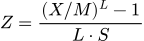
Where:
- X — the child's measured weight in kilograms.
- M — the Zemel DS median weight at that length and sex (not the CDC or WHO median).
- L — the Box-Cox skewness parameter for the DS population at that length.
- S — the coefficient of variation for the DS population at that length.
Third, the Z-score is mapped to a percentile through the standard normal cumulative distribution function, Φ(Z). A Z of 0 maps to the 50th percentile among children with Down syndrome at the same length, −1.88 to the 3rd, and +1.88 to the 97th.
Why CDC and WHO weight-for-length charts are not appropriate for children with Down syndrome. At a given body length, children with Trisomy 21 are typically lighter than the general pediatric population — the DS sample has a different median weight-for-length distribution. Plot the same 5.1 kg at 60 cm on the CDC chart and it reads near the 10th percentile; plot it on the Zemel DS chart and it reads near the DS median. Same child, fair comparison. The American Academy of Pediatrics 2022 Health Supervision guidelines recommend Zemel 2015 as the DS-specific growth reference from birth to age 3.
The Zemel DS-WFL table is spaced at irregular length intervals and covers boys 49-93 cm and girls 52-90 cm. Lengths between table rows are handled by linearly interpolating L, M, and S between the two bracketing rows; lengths outside the validated range return a clear error rather than silently extrapolating. For older children with DS, switch to the DS BMI-for-Age (2-20 years) calculator.
Related Calculators
- DS Weight-for-Age (0-36 mo)
- DS Length-for-Age (1-36 mo)
- DS Head Circ-for-Age (1-36 mo)
- DS BMI-for-Age (2-20 yr) — for older children with Down syndrome
- CDC Weight-for-Length (0-36 mo) — for typically developing peers
Related Sites
- Medical Equations — Hemodynamic, pulmonary, and dosing calculators
- RN Calc — Nursing dosage and calculation tools
- Z-Score Calculator — Z-score, percentile, and probability calculator
- AJ Designer — 200+ engineering and science calculators
- Temperature Tool — Temperature unit converter
- Percent Error Calculator — Calculate percent error between experimental and theoretical values